



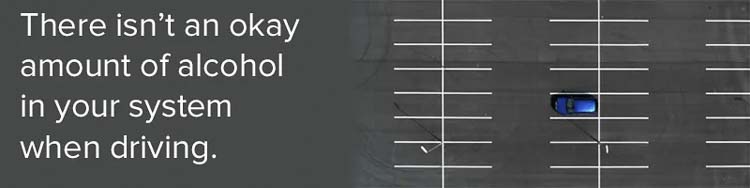
Target Zero Manager Doug Dahl reminds that there isn’t an okay amount of alcohol in your system when driving
Doug Dahl
The Wise Drive
Q: I know it’s not legal to drive with an open alcohol container in the car, but is it legal for a driver to drink alcohol in a parked car? Assuming the driver doesn’t drink enough to be impaired, have they broken the law?
A: Before I tackle the question about the law, I’d like to clear something up. There isn’t an okay amount of alcohol in your system when driving. Washington’s per se law sets the blood alcohol concentration (BAC) at .08, but a driver can be affected by alcohol at well below that limit. And impairment begins earlier than you might think.

At a BAC of .02 (one drink or less for most of us) a driver experiences a decline in visual function and the ability to do two (or more) tasks at once, like maintain a safe following distance while checking mirrors and making a lane change, for example. By .05 a driver experiences a reduction in their coordination, ability to track moving objects, and response to emergency driving situations; their risk of a fatal crash increases by 40 percent. And I’m using conservative data; some studies show a 100 percent increase in fatal crash risk.
Getting back to the question, Washington’s open container law is actually pretty broad. The law states that it’s a violation to drink or be in possession of an open container of alcohol “when the vehicle is upon a highway.” That’s more than driving on the road. The law defines a highway as, “the entire width between the boundary lines of every way publicly maintained when any part thereof is open to the use of the public for purposes of vehicular travel.” If you can drive on it and it’s paid for with tax dollars, it’s probably a highway. And the boundary line isn’t where the pavement ends (that’s where the roadway ends); it includes the shoulder, any parking, and even the green space along the side of the road. Drinking a beer in a parking stall at a rest stop would be a violation of the open container law.
Even part of your driveway might be within the highway boundary. In many neighborhoods the city right-of-way is much wider than the paved roadway. Sometimes that can result in homes where nearly all of their driveway is part of the highway.
What about if you’re in a private parking lot? Even if a parking lot is privately owned it’s probably a public place, and Washington has a law that prohibits drinking liquor in a public place. The law has a long list of what it considers a public place, but you can sum it up as any place that is accessible and generally used by the public. Even though you have an increased expectation of privacy in your vehicle, if you do an action that’s visible to the public, like drink in your car, it’s a violation of the law. I actually wasn’t sure I was right about that, so I described this scenario to a prosecutor who’s an expert in traffic law. Her response was, “I would prosecute that.”
What if I’m camping in my motorhome? Okay, the law does have an exception for the living quarters of a motor home, but there’s a requirement that you’re in the home part of the RV, not the motor part.
There’s a good reason why the law takes drinking in vehicles so seriously. Even though only a small percentage of drivers ever drive impaired, about half of all traffic fatalities in Washington involve impairment. Alcohol and vehicles are not a good mix.
TheWiseDrive is hosted by Doug Dahl, a Target Zero manager for the Washington Traffic Safety Commission.

Also read:
- POLL: After hearing state leaders describe the I-5 Bridge as vulnerable in an earthquake, what is your reaction?
 State and local leaders describe the I-5 Bridge as structurally at risk but recommend drivers continue crossing it while complex replacement plans unfold.
 - Opinion: Historical state income tax and another massive operating budget highlight the end of the 2026 legislative session
 Rep. John Ley details the passage of a state income tax, an expanding $80 billion budget, and new Clark County infrastructure funding following the 2026 legislative session.
 - Opinion: Fighting for transparency in Washington government
 A recent court decision allows Washington lawmakers broad new secrecy over internal records, as advocates report rising obstacles to government transparency and public engagement.
 - Opinion: Attacking Democracy in the name of Democracy
 Ryan Frost critiques several 2024 legislative bills, warning unchecked Democrat dominance enables policies that erode local accountability, block referenda, and threaten citizen participation.
 - Opinion: Washington passed an income tax to fund education, then the same majority cut education — and left $700+ million on the table
 State officials passed a new income tax to fund education, then approved over $1 billion in cuts—while forgoing $700 million in annual federal scholarships students could have received.
