


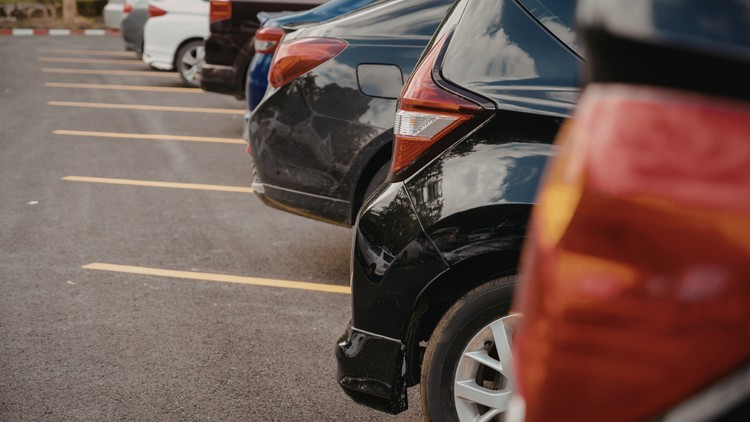
🎧 Parking Lot Crashes: Who Enforces Traffic Laws on Private Property?
Target Zero Manager Doug Dahl answers a question about traffic enforcement in grocery store parking lots
Doug Dahl
The Wise Drive
Q: Who is responsible for traffic enforcement, and crime generally, in grocery store parking lots? I was recently involved in an incident and nowhere was any traffic enforcer visible. The store’s management made it clear it wasn’t their responsibility. Unlike large malls, they had no security.

Doug Dahl
A: I’m a traffic safety nerd, not a crime nerd, so I’ll cover what the law says about traffic enforcement on private property, and I’ll pretend to know what I’m talking about regarding crime. I’m stating that up front so you know how much confidence to have in my response.
The reason you don’t see any traffic enforcers in parking lots is because, for the most part, traffic laws don’t apply on private property. The very first sentence in Washington’s Rules of the Road states that the rules in that chapter apply “exclusively to the operation of vehicles on highways…” followed by a few exceptions that “apply on highways and elsewhere throughout the state.”
As you might imagine, this list includes the most serious offenses: vehicular homicide and assault, impaired driving, reckless driving, negligent driving, and a few other related violations. Also, if you get in a crash, you have the same responsibility to report the crash whether you’re on a public road or on private property.
Police could patrol parking lots looking for high-risk traffic violations, but that’s not where most of them occur, so they generally choose to put their limited resources elsewhere. That’s not to say it never happens. Several cities in Washington have at times focused on traffic enforcement in parking lots, but it’s been to address a specific problem – illegal racing.
Even if a store has security staff, they probably won’t be enforcing any traffic (or criminal) laws. Most private security officers do not have that authority. That’s not always the case though. Sometimes companies hire off-duty police officers to work security. Those officers maintain their police powers while working for a private company.
I don’t know the specifics of your incident, so I’ll generalize about who might be responsible for responding to or taking action regarding a traffic incident in a parking lot. If the incident rose to the level of one of the traffic crimes I mentioned earlier, your best choice of action is calling the police. They would investigate the crime and enforce the law as appropriate. The same goes for a non-traffic crime committed in a parking lot.
If the incident was a crash that caused more than 1000 dollars damage to either vehicle or anyone was injured, the law requires drivers involved in the crash to report it. You could do that by calling the police, or by submitting a collision report yourself.
If it was a minor fender-bender with no injuries and minimal damage, there is no requirement to make a collision report (although you still could if you wanted to). Even if you don’t need to report the collision, the law requires the drivers involved to exchange information. It would be up to your insurance company to sort out who was responsible for the crash.
If the incident wasn’t a crime, and didn’t result in a crash, maybe there wasn’t a violation of any law. Say another driver saw you about to pull into a parking spot, and accelerated into it before you could pull in. I don’t know of a law that requires yielding to someone about to park. And it’s not illegal to be a jerk (until that jerkiness meets some established legal standard). Then the right move is to be the mature one in the situation and respond accordingly.

Also read:
- Opinion: Were Republican voters just sleeping during the August primary election?
 CCRP Chairman Matt Bumala says 60% of primary no-shows in the 17th and 18th districts were Republicans.
 - Opinion: WA Cares’ launch showcased care WA Cares did not provide
 Gov. Ferguson showcased a caregiving arrangement at the WA Cares launch that the program had not paid for a single day of.
 - Opinion: Portland’s War on Cars Part 4 – A smarter automobile strategy to end gridlock
 O’Toole argues fuel wasted in Portland-area congestion has sextupled since 1982, generating 250,000 tons of extra greenhouse gases annually.
 - Opinion: The Tooth Fairy’s secrets to making brushing & flossing magical
 Delta Dental of Washington’s Tooth Fairy Experience offers free resources to help children build lifelong brushing and flossing habits.
 - Opinion: Transit ridership trends are dismal but regional plans are oblivious
 Puget Sound transit passenger-miles fell 31% from 2015 to 2024 despite a half-million-resident population increase.