




Mark Harmsworth of the Washington Policy Center explains how high license fees destroy jobs and disincentives businesses from expanding into new areas to create new jobs
Mark Harmsworth
Washington Policy Center
Small businesses (and in fact all businesses in Washington) are seeing exponential cost increases in business license fees charged by local municipalities. Many cities are now charging business license fees based on revenue, employee counts and hours worked, rather than a fixed fee.

The latest city to consider increasing its fees is Tacoma with an increase to $1,000. This is an increase of 400% over last year’s fee ($250) for businesses with revenue over $1 million.
Complicating the calculation of the license fee charged, is the requirement, by some cities, to count only the hours that an employee works physically inside the city limits, or where a nexus is created. State law explicitly restricts a city from requiring a business license when work is performed from outside the city limits, as is the case for many remote service providers.
These fees can add up to several thousand dollars for a small business, and for larger corporations, several million dollars.
Using the City of Redmond as an example, the cities original business license structure was created in 1996 and has been updated most recently in 2020. For a small business of 5 full-time employees located inside the city limits with revenues above $2,000, the annual fee would be 5 x $122, or $610. The original fee was $10 per employee in 1996 and through a series of council actions, by 2022 had increased to $122 per full time employee, over a 1,100% increase.
For some of the largest employers in Redmond, the fees will be in the millions of dollars.
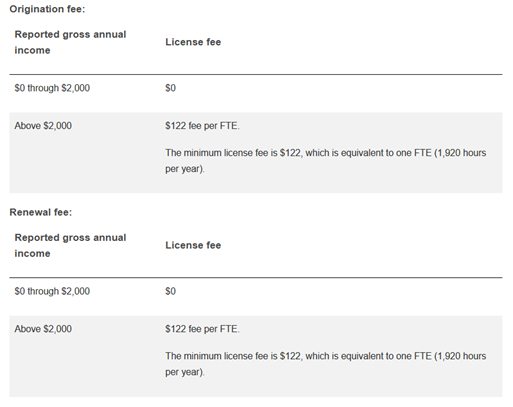
The problem is compounded when businesses operate in multiple jurisdictions. For businesses that only operate in one municipality, the filing is relatively simple. However, for businesses that operate in multiple locations, the license fees become significant. A business may be located within one City, but is required to pay license fees in every city it operates in.
The filing process, while more streamlined due to the recent requirement for municipalities to use the Washington Department of Revenue centralized system, is complicated by the requirement to calculate the revenue generated in each city while physically located inside the city limits.
The business license qualification requirement requires the business to track the hours and revenue for work performed inside and outside the city limits separately. In the case of a contractor, who may only perform a minimal amount of work inside the city, this is a massive administrative burden.
Many businesses, because of the difficult licensing process, do not bother applying for a license, particularly if the work being performed is minimal, or infrequent within a jurisdiction’s boundaries. As fees increase, the profit from the work in the jurisdiction is reduced and the incentive to ignore licensing requirements increases. Complicating the process further, is each municipality has different rules, fees and qualification processes.
Licensing fees are a hidden cost of doing business and these costs are added to the cost of products and services that businesses provide and, in some jurisdictions, provide no benefit or service to the business as other taxes pay for essential services inside the city limits.
High license fees destroy jobs and disincentives businesses from expanding into new areas to create new jobs.
Mark Harmsworth is the director of the Small Business Center at the Washington Policy Center.

Also read:
- Opinion: Half the road, full stop – Understanding pedestrian right-of-way
 Doug Dahl explains how Washington’s law requires drivers to stop when a pedestrian is within one lane of their half of the road, not just when directly in front.
 - Opinion: The state’s RFK-proofing bill comes with a cost
 Mandates like HB 2242 can lead to higher premiums as insurance companies absorb costs for new preventive services, affecting affordability statewide.
 - Opinion: What is the cost of a bridge?
 John Ley argues the I-5 Bridge replacement’s soaring cost stems from costly extras like light rail, noting other states deliver larger, toll-free bridges for much less.
 - POLL: Do you agree with giving a state commission the power to remove an elected sheriff?
 A new poll asks if a state commission—not voters—should have the power to remove an elected sheriff, following concerns raised by Clark County Sheriff John Horch.
 - Opinion: Defending Democracy by denying it?
 Washington voters are blocked from weighing in on new income taxes as state lawmakers and officials bypass public input, drawing criticism from Northwest voices.
 wpDiscuz
