



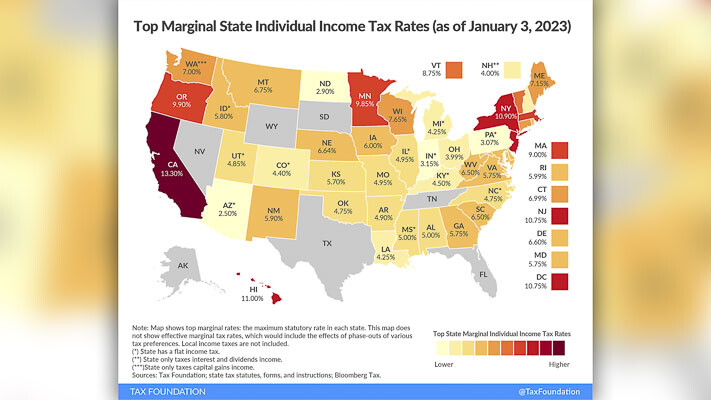
Taking effect for the first time this year, Washington is now the only state in the country to impose a standalone income tax on capital gains
Jason Mercier
Mountain States Policy Center
With property tax assessments increasing rapidly in Wyoming, some have begun to discuss whether there should be changes to the Cowboy State’s tax structure. It is important to first remember that assessed property values do not necessarily drive the actual property tax bill. Instead, that tax obligation is primarily set through the budget process by the amount to be spent (whether approved by government officials or voters through levies).

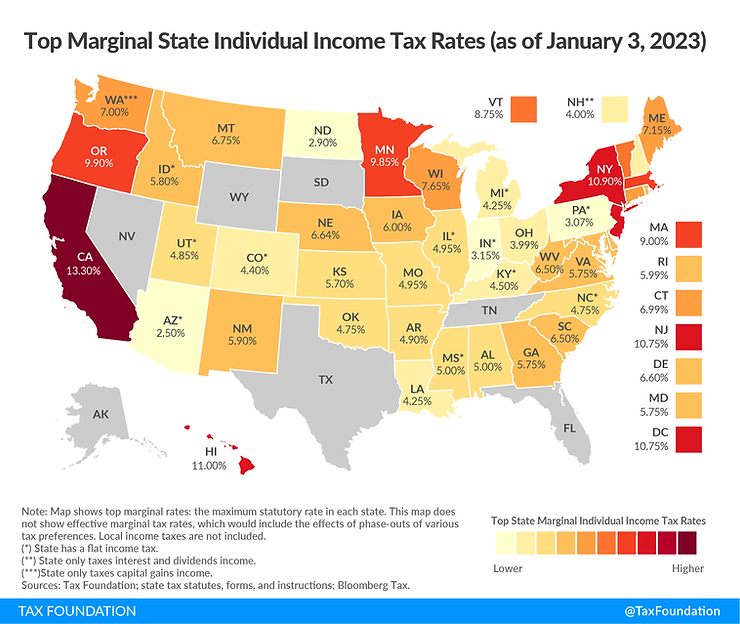
Concerning Wyoming’s current tax structure, as one of just a handful of states without a personal income tax, extreme caution should be taken to avoid losing this economic competitive advantage. This is especially true with any discussion of imposing a highly volatile and unpredictable income tax on capital gains.
Taking effect for the first time this year, Washington is now the only state in the country to impose a standalone income tax on capital gains (other income tax states tax it as ordinary income as part of their income tax codes). The policy choice has resulted in national tax rankings removing Washington’s prior standing of not having a personal income tax.
The federal Internal Revenue Service (IRS) has made it very clear that a capital gains tax is an income tax. Our friends at the Washington Policy Center posted this letter from the IRS clearly explaining this fact.
IRS: “This is in response to your inquiry regarding the tax treatment of capital gains. You ask whether tax on capital gains is considered an excise tax or an income tax? It is an income tax. More specifically, capital gains are treated as income under the tax code and taxed as such.”
Imposing taxes on capital gains income is not a recipe for predictable state revenue.
As explained by the California Legislative Analyst’s Office (LAO):
“California’s tax revenues have numerous volatile elements, but among the more significant sources of revenue volatility are the state’s tax levies on net capital gains through the personal income tax.”
“Capital gains depend heavily on movements in financial markets. As such, capital gains revenue is extremely volatile and difficult to predict. In any given year, there is significant risk that capital gains revenue could fall below budgetary expectations.”
If the goal of structural state tax reform is to improve budget stability and avoid boom-and-bust tax collections, an income tax on capital gains is the worst possible choice Wyoming policymakers can make.
Jason Mercier is the vice president and director of research at the Mountain States Policy Center.

Also read:
- Opinion: The growing gap between public voice and political power
 Todd Myers describes how large-scale protest and sign-ins often fail to sway state leaders, and argues authentic influence is most likely found through local action.
 - Opinion: Who is winning the race for affordable power?
 Hydroelectric power keeps Washington competitive, but new laws and carbon pricing are driving up electricity costs for residents each year.
 - Opinion: Half the road, full stop – Understanding pedestrian right-of-way
 Doug Dahl explains how Washington’s law requires drivers to stop when a pedestrian is within one lane of their half of the road, not just when directly in front.
 - Opinion: The state’s RFK-proofing bill comes with a cost
 Mandates like HB 2242 can lead to higher premiums as insurance companies absorb costs for new preventive services, affecting affordability statewide.
 - Opinion: What is the cost of a bridge?
 John Ley argues the I-5 Bridge replacement’s soaring cost stems from costly extras like light rail, noting other states deliver larger, toll-free bridges for much less.
 wpDiscuz
