



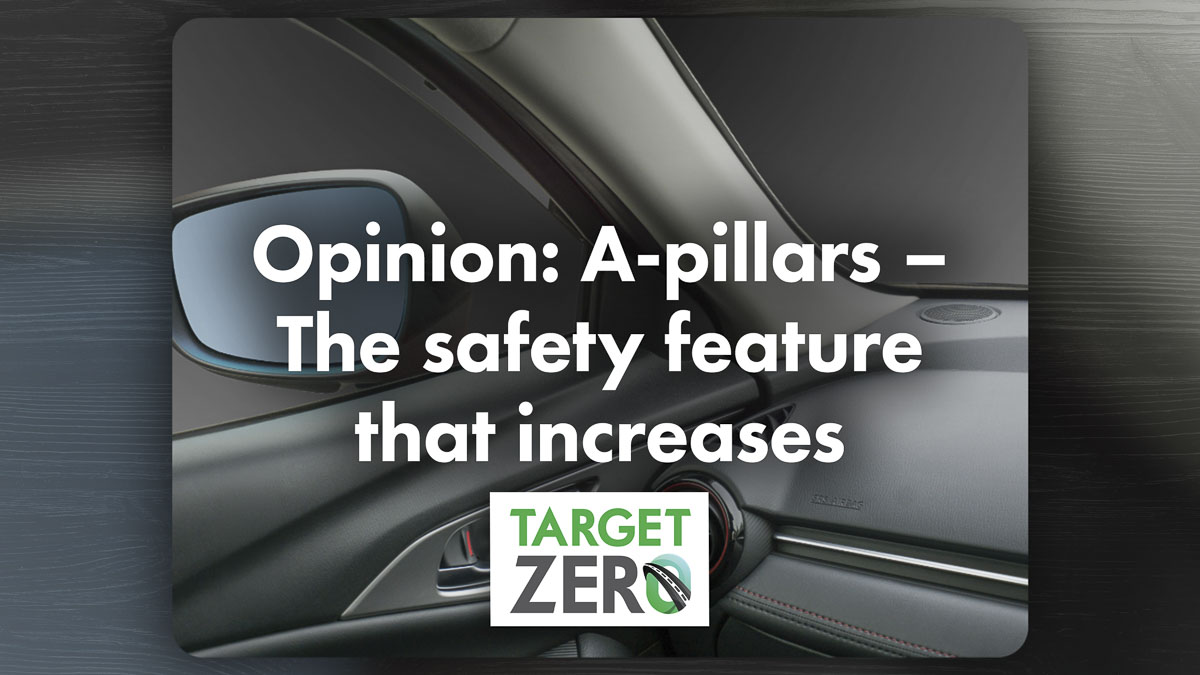
Target Zero Manager Doug Dahl discusses an issue with visibility in new cars
Doug Dahl
The Wise Drive
Q: I feel like visibility in new cars is getting worse. It seems to be because the posts on either side of the windshield are so much wider than they used to be. Am I just getting old, or is this a real thing?
A: Well, we’re all getting older. But considering the alternative, that’s not so bad. And let’s not blame this on age; if a post is blocking your vision, getting younger won’t help you see through it. What you’re referring to is what I call the A-pillar problem.

First though, a bit of car anatomy. Pillars are the parts of a vehicle that hold the roof up, or from a safety perspective, they’re what keep the roof from crushing down in a crash. They’re labeled A through C or D, beginning at the front of the vehicle. So the pillars on either side of the windshield are A-pillars, the ones between the front and back doors are B-pillars, and the ones behind the back seats are C-pillars. A longer vehicle like a van or SUV has D-pillars, and a two-door hardtop skips the B-pillar.
Today’s solutions become tomorrow’s problems. That’s certainly true for A-pillars. If you’ve driven a car that was built before the mid-1990s, you may recall that A-pillars were narrow, sometimes barely noticeable. Today they’re wide enough to hide a pedestrian, a motorcyclist, even another car if the timing and distance is just right (or more accurately, wrong).
What changed? SUVs became popular, and with that popularity there was a 35 percent increase in roll-over crashes. Back in the era of sedans and wagons, roll-overs were infrequent enough that it wasn’t even part of vehicle safety testing. But as demand for tall and relatively top-heavy vehicles took off, so did solutions for protecting the occupants of those vehicles.
Improving occupant safety meant strengthening the cage we ride in. A side-effect of that strength is wider pillars. Based on my informal research (measuring one car from 1985 and one from 2017), A-pillars have doubled in width. That translates to double the area hidden from the driver’s view. Sure, my study might be off a bit, but if you’ve paid any attention to evolving vehicle design you can confirm I’m at least in the ballpark.
But beefing up car pillars wasn’t the only strategy. Manufacturers were also developing electronic stability control. It was new technology in the 1990s, but by 2011 it was required in all new vehicles. With that, SUVs that previously had a two-star safety rating now scored a five. With stability control minimizing the roll-over problem, thick A-pillars became a bit of a solution in want of a problem.
Today we have an occupant safety feature (thick A-pillars) that increases the risk of a crash with other road users, especially pedestrians. That presents a philosophical question; If we have to make a compromise, should we lean toward reducing the likelihood of a crash with someone else, or increasing the survivability of a crash for the vehicle occupant? Said another way, is it okay to make people inside a vehicle safer if it increases harm to people outside the vehicle?
We can debate that, but meanwhile, we have to deal with the current reality. The A-pillar problem can be overcome once we realize what we’re missing. It’s not going to get out of your way, so you’ll need to move to see around it. Leaning forward or side-to-side can help you spot someone hidden by that big post. It’s not a perfect solution, but it’s worth the minimal effort to avoid a serious crash.
Also read:
- 49th Legislative District Democrats share their reasons for backing state income tax at Town Hall
 Three Democrat legislators defended the new income tax affecting only those earning over $1 million annually.
 - Letter: Freeze the scope and build the bridge
 Vancouver resident calls for project discipline after 22 years of planning and nearly half a billion in costs.
 - Opinion: ‘When are we going to get the full and complete details of the Interstate Bridge Replacement Program’s I-5 Bridge replacement project?’
 IBR team buried key details about light rail ending at waterfront with massive elevator system required.
 - POLL: Do you support extending light rail beyond the waterfront to connect with C-TRAN at Library Square?
 Readers can weigh in on Anne McEnerny-Ogle’s proposal to extend light rail beyond the waterfront to Library Square for improved C-TRAN connections.
 - Opinion: Passing a cyclist – Law, myth and a little patience
 Most drivers can’t legally pass cyclists in-lane due to vehicle width versus road measurements.
 wpDiscuz
