



Camas resident John Ley comments on TriMet’s push for a tunnel under the Willamette River

In the battle for more bridges and transportation corridors across the Columbia River, we often hear “experts” and politicians say, “there isn’t enough money” to do two bridges. They insist we must fix the Interstate 5 Bridge first.
The newest bridge in the region is the $1.5 billion Tillikum Crossing Bridge in Portland, which is for light rail, bikes and pedestrians. Now, TriMet and Metro are putting a $2 billion-plus light rail tunnel on the table, in addition to the $2.9 billion Tigard/Tualatin light rail extension.
TriMet’s MAX light rail system has two huge weaknesses. One is the Achilles heel – all MAX light rail trains use the 117-year-old Steel Bridge. The other – they can only put two cars in a train, due to the length of a downtown Portland city block. Both weaknesses were known and ignored in the original creation of Portland’s light rail system.
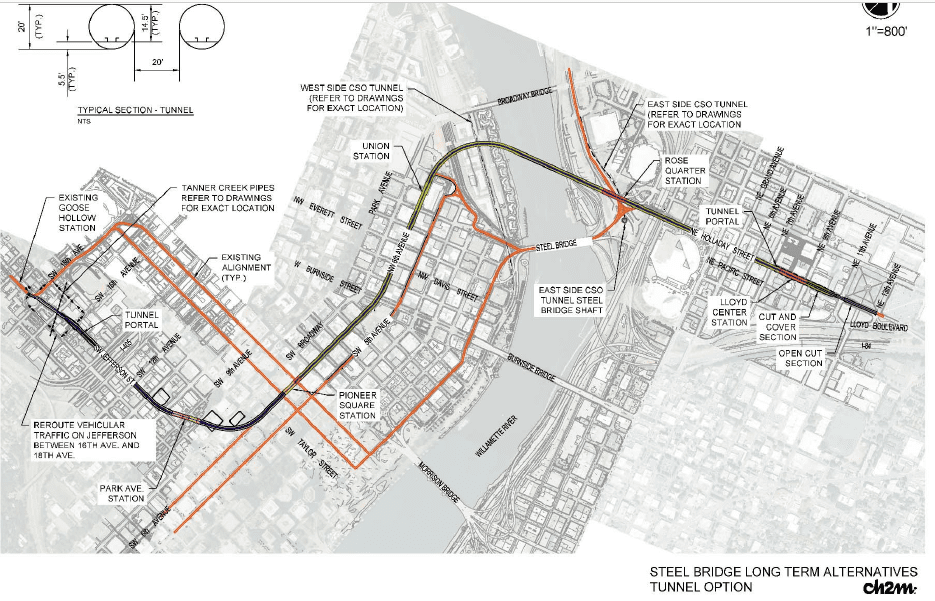
Metro and TriMet are now pushing for two tunnels under the Willamette River and under downtown Portland. It is one of four possible solutions under consideration, but by far the most expensive. At a Metro “open house” in July, a TriMet staffer told me the $2 billion price tag would be significantly higher.
The alleged “need” is saving time. Current MAX trains cross the Steel Bridge every 90 seconds during rush hour, 40 trains per hour. TriMet can’t expand current service and meet their 2040 expected demand of 64 trains every hour, using the current Steel Bridge.
One rightly should question the underlying assumptions – is there a legitimate need for a 60 percent increase in the number of MAX trains crossing the river?
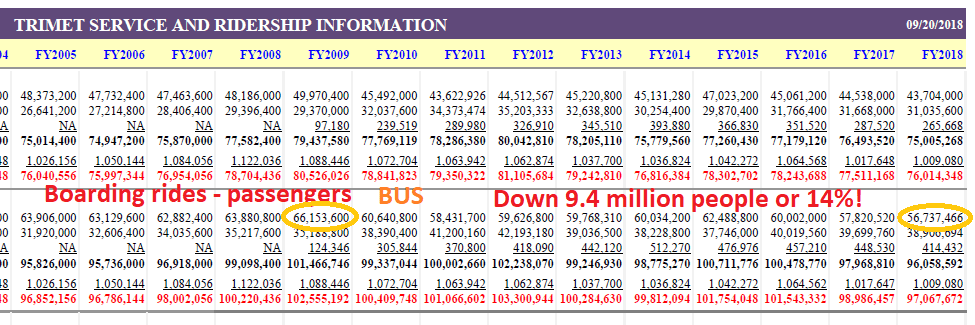
TriMet reports bus passenger boarding’s peaked in 2009 and are down 14 percent, a decline of over 9 million boarding’s by 2018. Furthermore, light rail ridership peaked in 2012 with 35.2 million originating riders, losing 11 percent or 4.2 million originating riders by 2018.
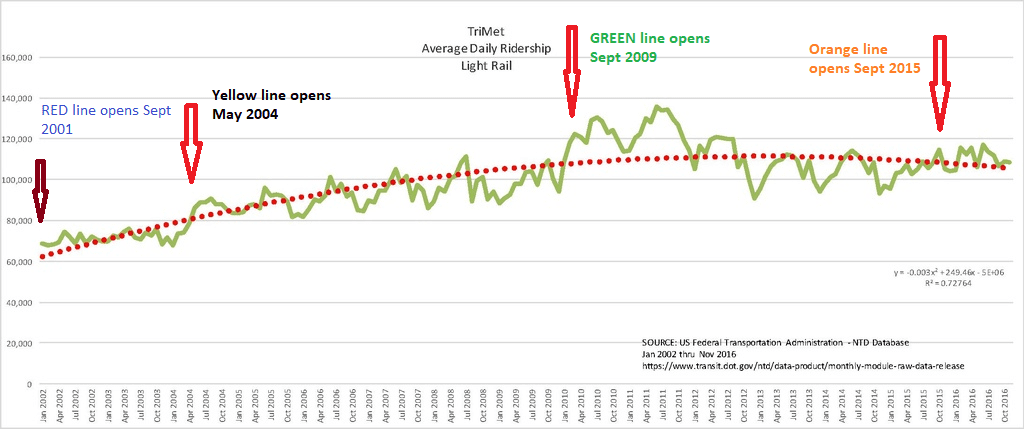
More importantly, the decline in MAX ridership has occurred in spite of TriMet starting the Green Line in Sept 2009 and the Orange Line in Sept 2015. Today, ridership numbers are below the Sept 2009 level according to a Federal Transit Administration graphic, demonstrating that the addition of two new light rail lines added no new passengers.
The bottom line – will there be a need for 60 percent more trains crossing the Willamette River in 2040, given that MAX ridership has declined by over 10 percent in the last half decade? Probably not.
Time saved by eliminating stops
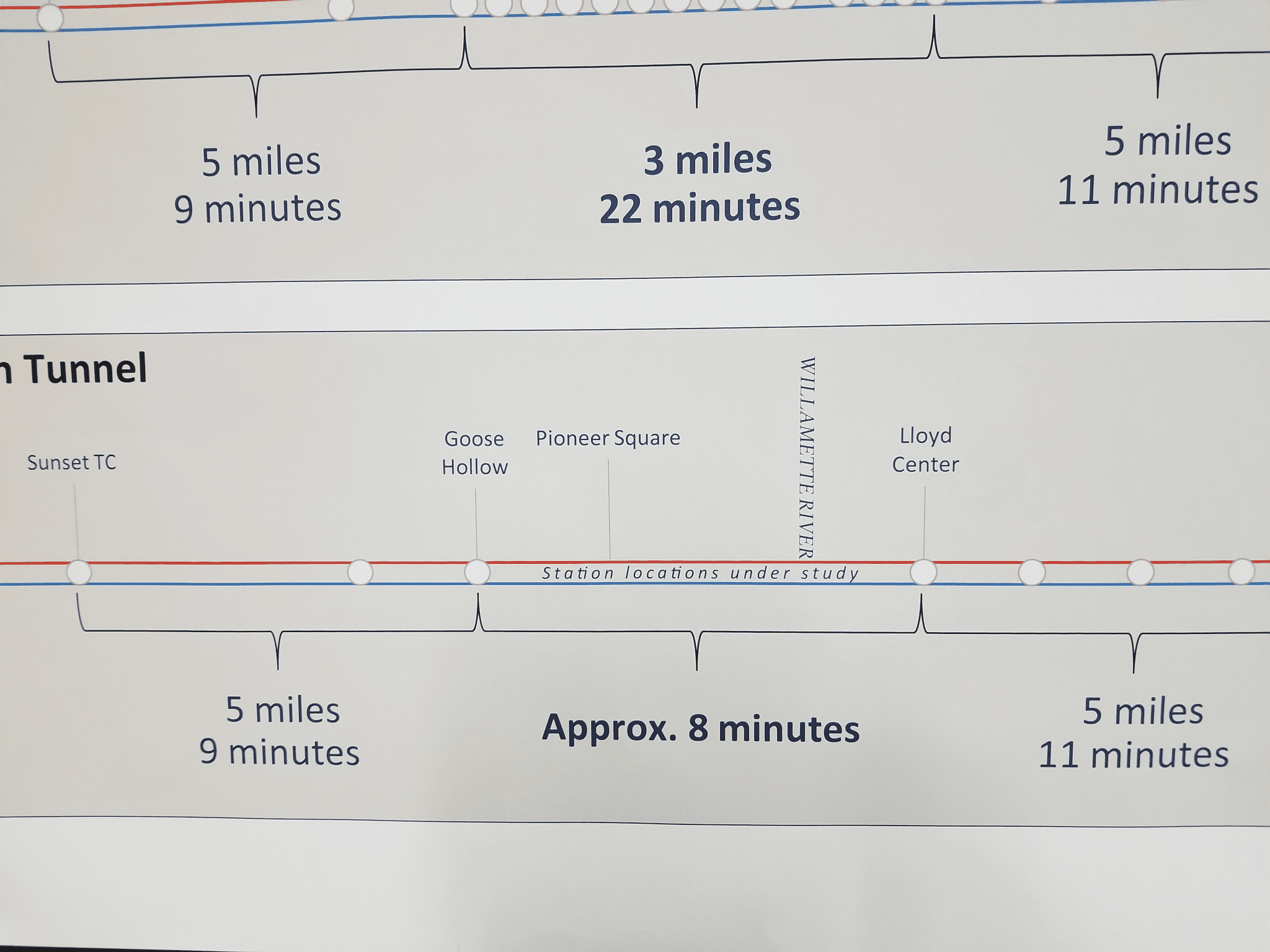
One of TriMet’s selling points for the expensive tunnel option is it will save “about 15 minutes” for riders using the tunnel. But how does the tunnel save time when it follows a similar winding route through downtown as the street-level MAX? By eliminating a dozen light rail stops in downtown Portland! How does that serve the people? MAX passengers with a downtown destination between Lloyd Center and Goose Hollow, will have to get off the “express” train and transfer to the “local” light rail train, adding time to their travel.
An honest, unanswered question is how much time would passengers save if TriMet eliminated those same stops on their surface light rail system? More importantly, is TriMet being truthful to taxpayers about “all” their future plans? The tunnel following existing MAX routing suggests future plans will add back stops (and travel time) at various downtown locations. How much more will that cost?
If TriMet had originally created a subway, or an elevated rail system like Chicago, they would not be limited to just two cars in a train. They would be able to expand passenger capacity by simply adding new cars to each train. Now that roughly $5 billion has been expended on light rail, they hope citizens won’t mind doubling down, $2 billion or more for two light rail tunnels under the Willamette, and $2.9 billion for the Tigard/Tualatin light rail expansion.
Taxpayers should put this in context. Last fall PEMCO reported 94 percent of Northwest citizens desire to use their privately-owned vehicles.
An April Oregon Transportation Commission survey found 51 percent of citizens want to “expand and improve interstates and interstate bridges;” another 14 percent want expanded arterials.
A January 2019 Metro poll showed the number one priority was roads and highways. They reported 31 percent of citizens want “widening roads and highways” as their top priority. The Portland Tribune summarized: “On its own, improving public transit is a lower priority than making road improvements and the more overarching goal of easing traffic — voters still overwhelmingly rely on driving alone to get around,” reads the poll’s conclusions.
The $2 billion tunnel dollars would pay for widening I-205’s Abernethy Bridge and adding 6 miles of freeway lanes to Stafford Road – $500 million. It would rehab the Morrison Bridge – $48 million, the Hawthorne Bridge $24 million, rehab the Burnside Bridge – $80 million. The funds would pay to widen US 26 from 4 to 6 lanes (Brookwood to Cornelius Pass) $26.5 million, and add auxiliary lanes to Hwy 217 in Beaverton $152.5 million. It would pay from an east country bridge crossing the Columbia River — $800 million, and add a lift-span to the BNSF rail bridge, eliminating 95 percent of Interstate Bridge lifts –$35.5 million. It would pay for a separate bridge from Delta Park to Hayden Island – $80 million; and much more in needed road and bridge repairs. (Data from Metro 2018 RTP).
The full $5 billion for the two projects would cover a significant part of a much needed westside bypass. Commissioner Roy Rogers says Washington County is “gridlocked” and needs a western bypass, first identified in 1970’s transportation plans.
Citizens want point-to-point service in either privately owned vehicles or Lyft/Uber vehicles. Regional transportation planners have failed to change citizens behavior with mass transit service, which continues its national decline.
Use the $2 billion MAX tunnel money to expand metro area roads and freeways; use it to build new transportation corridors including new bridges across the Columbia River. It’s been 40 years since a new transportation corridor was built (I-205). Serve the people and their transportation needs and desires.
Here’s a TriMet graphic showing the 14 light rail stops from Lloyd Center to Goose Hollow.
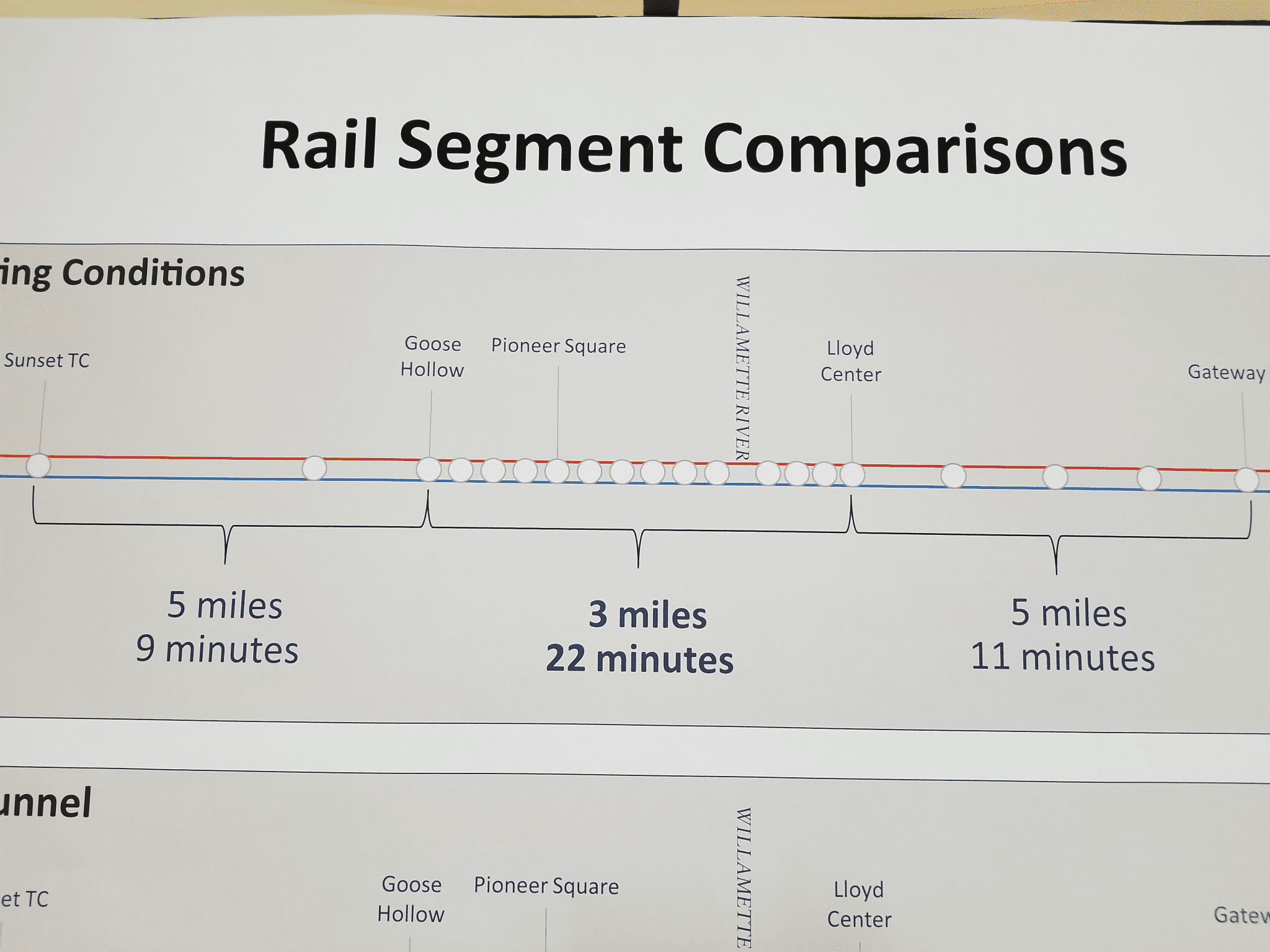
The Tunnel proposal eliminates the 12 stops between Lloyd Center and Goose Hollow, saving about 14 minutes.
TriMet Bus ridership drops.
Uber and Lyft carry a significant number of people in Seattle. Much more than taxis, as people “vote” with their money for point-to-point transportation service.
The Seattle Times reports in a Nov. 2018 story: “Every day in the Seattle region, Uber and Lyft provide more rides than:
• Sound Transit light rail (77,576 rides on a typical weekday).
• The population of Bellingham (89,045).
“The ride-hailing giants provided more than 91,000 rides on an average day in the second quarter of this year, according to ridership reports the companies filed with the city of Seattle. They are on pace to provide more than 31 million trips this year,” reported The Seattle Times.
John Ley is a Camas resident who is a proponent of responsive and responsible government.

This post makes good arguments but fails to consider whether 94% of our citizens using their private vehicles is feasible or good. Transit will reduce climate emissions and improve walkability, which makes cities more liveable and makes their citizens more healthy. Please stop writing articles with the assumption that unrestricted private vehicle use until the end of time is a good thing.
Alex —
MAX light rail is not “green”. It carries fewer and fewer passengers each year.
TriMet buses are “greener” than light rail. However given the reality that most of the buses are running around with only a handful of passengers, the 49 passenger buses with 8-10 passengers is not “green”. You could a hotel-style van that carries 15-20 people on most TriMet and C-Tran routes and carry current passengers, except in the morning & evening rush hours. That would be even “greener”.
How is the bus “greener” than the MAX, when the MAX is powered by 100% renewable energy. Also the MAX according Trimet’s statistics show that it gained ridership for both the MAX and the bus in 2023 when compared to 2022.
PGE burns coal to produce electricity. Not really green energy.
Nico — if you look at historical MAX ridership, it peaked over a decade ago. Ridership was in decline before the pandemic lockdowns. It fell off a cliff during the pandemic, and is only now beginning to recover. But it is only about half or perhaps 60 percent of pre pandemic levels.
Here is a MAX graphic.
The cost of light rail construction alone equates to $15 per rider,
for the next twenty years, using Trimet ridership numbers. The winners in the light rail fiasco are Hoffman Construction and PGE who makes money on the electricity to operate the system. Electric buses would be a far better option for mass transit.
The planners love to use the term “light” rail since it sounds less expensive than “heavy” rail. But the main difference is that “light” rail uses shorter trains while “heavy” rail uses larger/longer trains.
I grew up in the SF Bay Area and part of my time there I commuted via BART from a suburban station to San Francisco. BART is a heavy rail system. It operates 10 car trains at peak times. These trains are capable of carrying 1500 passengers (or more depending on how crowded the cars get) at one time. Tri-Met trains appear to be capable of carrying a maximum of 200+ passengers per train. “Light” rail is slightly cheaper to build since station platforms are shorter. But all the other costs (rail, electrical, switches, etc.) are identical between “Light” and “Heavy” rail transit systems.
Rail transit systems are inflexible. If a train has a mechanical problem or if some other problem blocks the line, then the system is (partially) blocked. Everyone is late. (Once on BART, I was on a following train when a medical emergency required evacuation of a passenger from the station at the first stop in San Francisco. A dozen following trains were “trapped” in the Bay Tube (under water) and at stations in the East Bay waiting some 35 minutes while Medics evacuated the disabled passenger.) Unfortunately, various “glitches” caused smaller delays, making “schedules” a rather annoying joke. I haven’t ridden any Tri-Met trains, but from news reports, it seems that similar problems regularly delay trains.
Busses, however, can generally easily pass a disabled bus or detour a few blocks around a disruption on the streets. I commuted via bus parallel to the BART routes for years before and during BART construction. My busses were rarely late except once or twice when some serious disruption occurred on the Bay Bridge. Even then, late busses rarely were more than just a few minutes behind schedule. Once BART was built, workers would arrive significantly late at least once a week.
Vancouver and Clark County don’t need Tri-Met. The line that will connect to the IBR is operated at a very slow speed over city streets (stoping at signals, etc.) while express busses could go right to a central Tri-Met station near downtown, allowing transfer to Tri-Met or other local bus lines. Of course, point to point (Uber, Lyft) transit is likely to become more popular over time. Busses and car services do not require the expensive infrastructure as a rail system requires. (A dedicated bridge lane during commute hours for busses and autos with 3 or more passengers would be sufficient.)
Oregon owes a lot of its strengths to rail infrastructure, much of which unfortunately no longer even exists (including the Oregon Electric and Red Electric Interurban Passenger Railways m, an elaborate and extensive streetcar grid they interfaced with as well as an integrated bunch of trolley lines.) The turncoat auto industry lobbied to have our taxpayer dollars funded passenger interurban and municipal routes torn out and paved over or else neglected into failure after privatization in acts of premeditated sabotage and treachery; this is before they further betrayed the nation by moving manufacturing out of country decimating the American workforce to only be rewarded for this sedition by being subsidized by our taxes along with being bailed out multiple times only for the executives to pocket the money we were taxed for their personal profits of plunder and pilfering pillage. The further we move away from the logical layout provided by streetcar grids and electric commuter interurban railroads the uglier and less livable the city and its suburbs become. An intelligent coastal city would take advantage of this limited time of people crowding in to install city assets that will benefit us for generations such as a rail route beneath the Willamette meaning the Steel Bridge won’t break the light rail circuit interrupting all MAX lines every time it lifts, and railway going between Vancouver and us. I-5 should be buried on the inner east side stretch to make the area tolerable and reclaim space for the Black community to rebuild their community they had stolen from them. The WES should expand to extend down to Salem reuniting the Portland metropolitan area with our capital. It makes perfect sense to build the full Southwest Corridor (Purple) Line with railway stations on Marquam Hill and at Portland Community College Sylvania Campus, for example, and zero sense not to.
Electric cars also destroy the environment through resource mining, manufacturing processes and ultimately going to the landfill in mass droves. The pollution they cause is simply unnecessary as is the amount of urban space squandered on parking and other paved over autocentric wastes. MORE VEHICLES ON THE ROAD MEANS MORE AVOIDABLE DEATHS WILL CONTINUE TO CONSTANTLY OCCUR!They also perpetuate redlining, urban sprawl, the food deserts that come from that invariably, along with cities that are not navigable as a pedestrian or bicyclist and are, in fact, inhospitable to humanity along with being lethally horrendous towards animals.They add to traffic congestion. Commodification of societal needs and normalization of trying to substitute rampant consumerism where we need standardized, regulated and uniform public utilities doesn’t work.
Putting the financial burden of transportation inefficiently and directly on the individual citizen is simply not wise or fair and hasn’t been the norm for even 80 years. We need to invest in commuter rail that’s properly implemented as it typically is overseas. A commuter rail system is an engineering marvel while buses are just buses. The most reliable predictor of a neighborhood being impoverished is if it has no commuter rail connection. The American people are apathetic through decades of disenfranchisement and a lot of that marginalization (eg Robert Moses’s racist urban renewal) is through divestment of public infrastructure, utilities and programs to help the American people. We can’t undo the social inequities inflicted upon and retained by redlining until we transcend the highway robbery carcentric built habitat that physically structurally reinforces them. We’re past the point of car dominated transportation being anything better than a tragic hindrance or an outright travesty. Public works materially improving life for the taxpaying citizenry will bolster civic pride.
Transcontinental High Speed Rail should integrate seamlessly with commuter rail networks so it can evenly function as one cohesive system and this will convert flyover country (CONUS flights should be virtually eliminated) back into a thriving heartland by functioning as an artery of commute and commerce which will reduce clustering on the coasts. Similarly, wholly integrated circuits of commuter rail blended with interurban routes, light rail lines, street car grids, subways, and even trolleys along with electric ferries functioning together as a comprehensive, coherent series of interwoven systems would prevent people from having to live on top of each other in city centers in order to have quick access to urban cores and downtown areas so this would stimulate our local economies and prevent gentrification from demolishing cherished heirlooms of our historicity, destroying our classic neighborhoods, shredding the fabric of our communities and toppling our civic landmarks and architectural heirlooms along with other social capital such as venerable culture generating venues. We lost so many marvelous structures for nothing more than mere surface lots as our city was hollowed out on the heels of white flight to the lily white, poorly planned suburbs. Whole swaths of communities were obliterated in a racist/classist attack on the people of Portland and we lost entire neighborhoods along with cultural centers such as the Jazz District, our Italian and Jewish neighborhoods as well as other minorities who weren’t assisted with any sort of fair, decent assistance to relocate. The absolute annihilation of our city still adversely hinders us collectively to this hamstrung day, and the groups targeted, intensely even if so many folks don’t know enough to connect the dots of cause and effect.
Numerous studies show that built environments of homogenously bleak and bland duplitecture dreck that profiteering developers push on us for their privatized gains to our public loss for the riches of themselves and corporate slumlords not only cause homelessness from being financially inaccessible to most Americans, but also cause depression from creating such a devastatingly sterile, cold, unloving urban habitat that’s too congested and overcrowded to work properly as a correctly engineered built environment. Our roadways are overcrowded and no amount of widening them and adding lanes will do anything to help it because it just leads to induced demand that inevitably grinds to a halt at snags and bottlenecks down the road. Shouldn’t American cities be thriving centers of culture and character rather than austere and chintzy morasses of mediocrity?
I believe that we can design the cities of our nation to reflect a future that embraces humanity and that we also must for America to have any sort of a bright future ahead of it. Right now we are mired in the destruction of our cities from the inward attacking neocolonial oppressors who weaponize their clout of wealth against the nation for their own off-shore un-American gains of privileged, parasitic, private profits. This greed fueled anti-social exploitation is present day feudalism driving us into another gilded age. Tons of new petrochemical building “luxury living” housing units remain empty serving only as financial assets in investment portfolios of hedge fund, “private equity” and permanent capital firm cretins sheltering dubiously acquired wealth instead of as direly needed shelter for humans. We deserve a landscape we can be proud of and country should come first before corporate looting and exploitation. Legacies are important and live on forever.
With space opened up in our cities we could rebuild beloved structures gone from economic and environmental disaster utilizing new technologies such as hempcrete and 3-D printing. We could create vertical agriculture, green pocket areas, etc. on spots currently now just serving as paved over squares and nothing more. We can extend democracy into offering the taxpayer residents democratic say in what their city consists of, how it looks and how it operates promoting civic engagement and participation. If you don’t like that then stay in Camas and mind your own business John instead of disingenuously using cherry-picked and otherwise misrepresented stats while pretending you’re any sort of expert and without ulterior motives.
The two most pressing needs are a Bridge West of the I-5, and one East of I-205.
Loot Rail serves so few it’s not worth the money it would cost.
So, your reasoning that the money would be better spent on road projects is because that’s what drivers want. That doesn’t seem very logical. We need to change the status quo to attempt to combat climate change, not to mention how unpleasant cars make cities. Adding more lanes to highways would increase noise pollution, air pollution, and provide some glorious microplastics to go into people’s bodies who are unfortunate enough to live near a highway.
Providing a better service will generate more ridership, if less people drive, then there will be reduced demand for expanding roads. The solution is not to keep on investing in car infrastructure, it’s to provide a more sustainable and healthy future. This isn’t the 1960s, so stop thinking like it.