


🎧 Should Vancouver Go PFAS-Free on Camping Gear?
Peter Bracchi believes environmental responsibility should not stop where political discomfort begins
Editor’s note: Opinions expressed in this letter to the editor are those of the author alone and may not reflect the editorial position of ClarkCountyToday.com
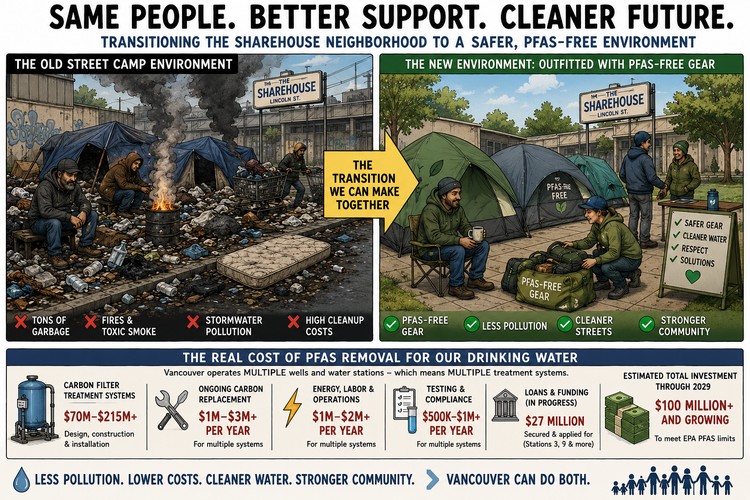
The city of Vancouver is preparing to spend tens of millions of dollars installing Granular Activated Carbon (GAC) filtration systems and upgrading multiple water stations to remove PFAS “forever chemicals” from our drinking water supply.

Peter Bracchi
Why? Because PFAS contamination is now serious enough that the EPA dramatically lowered allowable limits to just 4 parts per trillion for PFOA and PFOS.
The cost to the public will be enormous.
Unlike cities with a single centralized treatment facility, Vancouver operates multiple groundwater wells and water stations spread across the city. That means multiple treatment systems, multiple infrastructure upgrades, ongoing carbon replacement costs, energy costs, testing costs, engineering costs, and long-term maintenance expenses extending for decades.
At the same time, for more than eight years, the city has tolerated repeated accumulations of garbage, discarded tents, burned materials, waterproof tarps, treated fabrics, plastics, and other camping debris around the Men’s Share House corridor.
City crews have repeatedly cleaned the area. Police and fire departments have repeatedly responded. Tons of waste have accumulated over time in a corridor directly exposed to rainwater, runoff, and storm drains.
Does it really take a scientist to ask whether eight-plus years of outdoor waste, treated camping gear, burned synthetic materials, and street debris may have contributed some level of PFAS or other contaminants into stormwater and groundwater?
Testing may be required to prove the exact amount. But common sense says this issue deserves serious evaluation.
The answer is not to attack homeless individuals. The answer is to modernize policy and reduce environmental risk.
Vancouver should begin transitioning publicly funded outreach programs, shelters, and donated supply systems toward PFAS-free tents, tarps, rain gear, and outdoor materials whenever feasible.
If we are willing to spend millions filtering PFAS from drinking water, we should also be willing to reduce preventable sources of contamination where we can.
Environmental responsibility should not stop where political discomfort begins.
Peter Bracchi Vancouver

Also read:
- Opinion: Were Republican voters just sleeping during the August primary election?
 CCRP Chairman Matt Bumala says 60% of primary no-shows in the 17th and 18th districts were Republicans.
 - Opinion: WA Cares’ launch showcased care WA Cares did not provide
 Gov. Ferguson showcased a caregiving arrangement at the WA Cares launch that the program had not paid for a single day of.
 - Auditor, auditor candidate address scrutiny over job title
 Greg Kimsey says roughly 40 county employees hold the deputy county auditor designation Kelly used in his campaign.
 - Opinion: Is Mitchell Kelly misleading voters with his ‘deputy auditor’ claim?
 Clark County HR records show no position called “Deputy County Auditor” has ever existed, Anderson argues.
 - Opinion: Democrats rig the ballot to save their income tax
 Churchill argues the ballot disclosure warning voters of education cuts describes revenue never collected and not yet allocated.