



Bob Ortblad reports that the IBR’s Supplemental Environmental Impact Statement includes 26 technical reports, but a critically important geotechnical report is missing, and the IBR has offered no explanation
Editor’s note: Opinions expressed in this letter to the editor are those of the author alone and do not reflect the editorial position of ClarkCountyToday.com
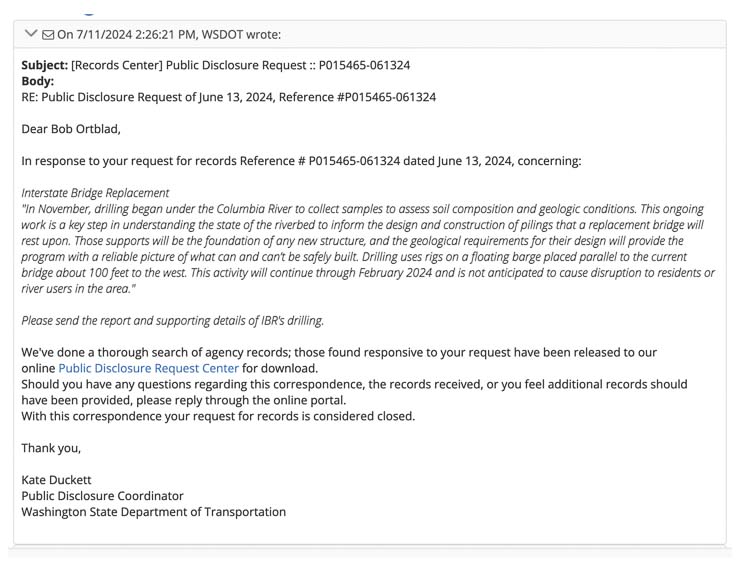
The Interstate Bridge Replacement Program (IBR) is hiding a serious “boulder” problem that threatens the feasibility of the IBR’s Columbia River bridge design. IBR’s Supplemental Environmental Impact Statement includes 26 technical reports, but a critically important geotechnical report is missing, and the IBR has offered no explanation. I filed a Public Disclosure Request and obtained IBR’s “Geotechnical Data Report” dated May 2024.

The IBR plans to support its bridge with a dozen piers. Each pier will need eight supporting shafts for a total of 96 in-river shafts. These shafts will be steel pipe piles 10-foot in diameter and up to 250 feet long. IBR plans to use a giant oscillating machine to twist piles back and forth, sinking them into about 200 feet of sandy sediment down to a solid Troutdale Formation.
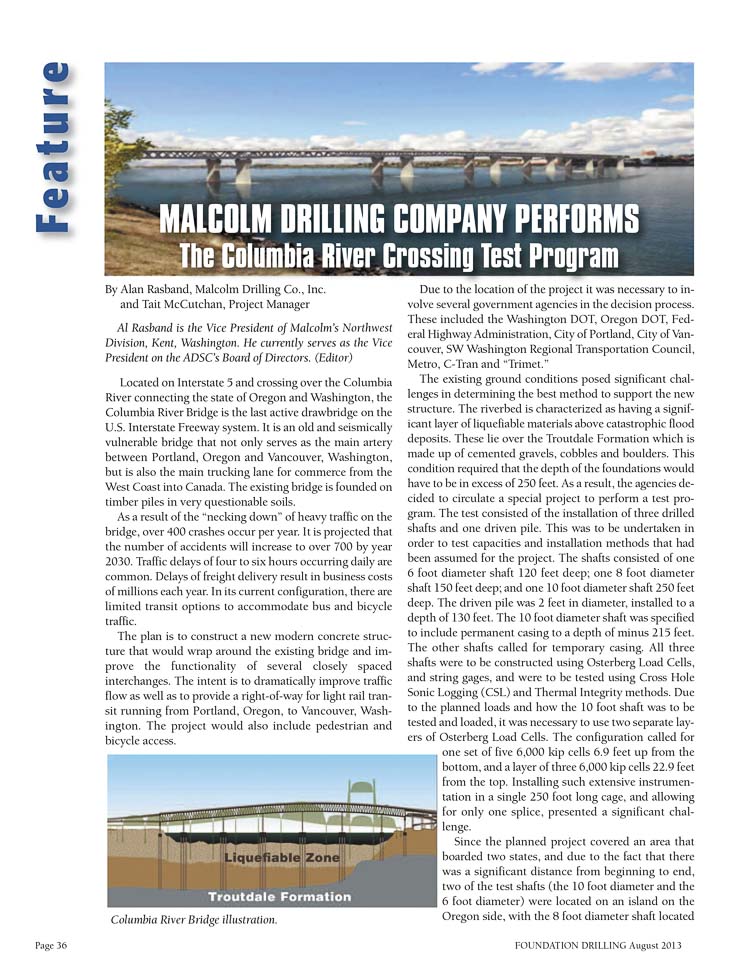
IBR’s “Geotechnical Data Report” describes the encounter of many boulders and cobbles in a 200-foot layer of sediment. The report referenced boulders 106 times and cobbles 175 times. In 2012, the Columbia River Crossing spent $4.2 million to test a few piles and a single shaft. Malcolm Drilling Co. tried to sink a single 10-foot diameter steel casing down 250 feet on Hayden Island. In a trade journal, Malcolm Drilling recounted its failure to sink this test shaft due to boulders.
“The Columbia River Crossing Test Program,” 2013
“However, during excavation and casing installation of the 10- foot diameter shafts, an unknown layer of very dense boulders in a “fixed condition,” resulted in damage to an installation tooth ring to the point that excavation to the planned shaft depth was impossible.”
IBR also plans to install 1,775 temporary 24-inch and 48-inch inriver piles to support a giant oscillating machine as it tries to sink 96 in-river 10-foot diameter shafts.
In 2012, each shaft was estimated to cost $1.25 million. Today, each shaft will cost $2.5 million. If many boulders are encountered the cost per shaft could soar even higher. The cost of bridge drilled shafts is very unpredictable ranging from $250 million to $500 million.
An Immersed Tunnel alternative that the IBR has fraudulently disqualified needs no drilled shafts saving up to $500 million. An Immersed Tunnel is supported by the displacement of its weight similar to a floating bridge.
Bob Ortblad MSCE, MBA
Seattle, WA
Supporting documents (click for PDF’s):

Also read:
- 49th Legislative District Democrats share their reasons for backing state income tax at Town Hall
 Three Democrat legislators defended the new income tax affecting only those earning over $1 million annually.
 - Letter: Freeze the scope and build the bridge
 Vancouver resident calls for project discipline after 22 years of planning and nearly half a billion in costs.
 - Opinion: ‘When are we going to get the full and complete details of the Interstate Bridge Replacement Program’s I-5 Bridge replacement project?’
 IBR team buried key details about light rail ending at waterfront with massive elevator system required.
 - POLL: Do you support extending light rail beyond the waterfront to connect with C-TRAN at Library Square?
 Readers can weigh in on Anne McEnerny-Ogle’s proposal to extend light rail beyond the waterfront to Library Square for improved C-TRAN connections.
 - Opinion: Passing a cyclist – Law, myth and a little patience
 Most drivers can’t legally pass cyclists in-lane due to vehicle width versus road measurements.
 wpDiscuz
