



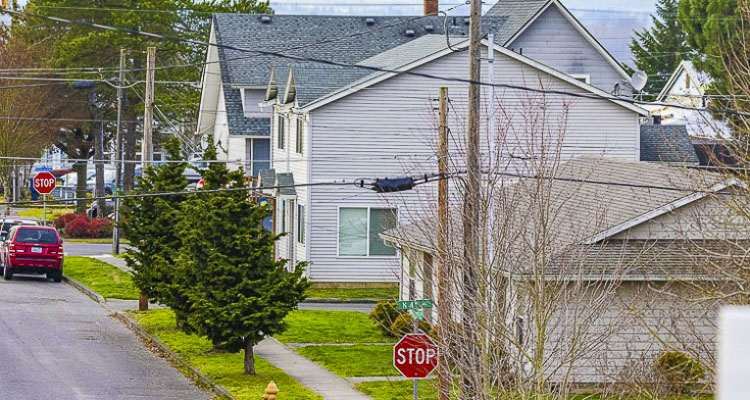
Todd Myers of the Washington Policy Center explains why Washington cannot disassociate itself from the larger electrical grid
Todd Myers
Washington Policy Center
As the sun went down in California on September 6 and solar energy disappeared, wholesale electricity prices jumped from $117 per megawatt hour (MWh) to over $1,200 per MWh in some places. There were isolated blackouts in some communities.

Washington state’s electricity is more reliable than California’s, in large part due to the hydropower we have. Hydropower acts as a large battery, providing electricity when it is needed. That flexibility means that when demand increases, especially during the peak hours in the evening, the system can respond.
California, on the other hand, is heavily reliant on renewable energy – particularly solar power – which disappears almost precisely when demand is peaking. As you can see from the graph below, three things made up for the steep decline in solar power – energy stored in batteries, imports, and natural gas.
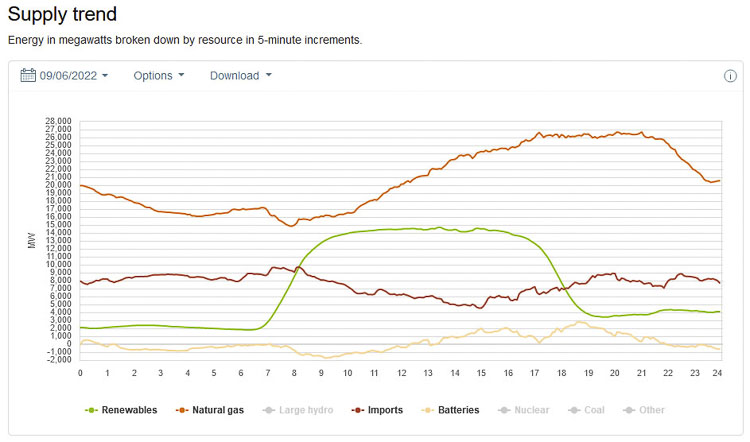
Natural gas accounted for the lion’s share of the generation. Indeed, renewables only accounted for about 8 percent of electrical generation during the peak hours when there was the highest risk of blackouts.

Imports made up the second largest source, with a significant share coming from Bonneville Power in Pacific Northwest.
With California offering such high prices, excess generating capacity was put into action. Those high prices, however, had an impact on the “day ahead” market in Washington state, and the high prices in California were mirrored here.
On September 6, the day-ahead price for one MWh of electricity between 6 and 7 pm was $1,242 in San Francisco. In Los Angeles it was $1,202. Those prices migrated north, driving prices in Seattle, Kennewick, and Spokane up to $1,130/MWh.
By way of comparison, one week later, those prices were between $106 and $118/MWh.
These costs don’t tell the whole story. Most of the electricity used by utilities is either generated by the utility or purchased on a contract at a significantly lower price, typically less than $50/MWh.
Energy shortages in California migrate north, driving prices up dramatically, costing Washington utilities the same for one hour as they would normally pay for twelve. Prices that are 20 times a much as standard rates, even for short periods, can add significantly to the total cost of electricity for a utility.
Governor Inslee recently said he wants to integrate our climate policy more closely with California. Like electricity prices, the result is likely to be that Washington residents will pay for decisions being made by California legislators.
Washington cannot disassociate itself from the larger electrical grid, nor should it. On the whole, trade is more efficient and helps ensure there is a steady supply of electricity. But Washington’s energy policy must take account of the reality that California’s management (or mismanagement) of their energy policy has an impact on us and we need to ensure we have adequate resources so we don’t get left holding the bag when California is short.
Todd Myers is the director of the Center for the Environment at the Washington Policy Center.

Also read:
- Opinion: The income tax proposal has arrived
 Ryan Frost of the Washington Policy Center argues that a proposed Washington income tax creates a new revenue stream rather than delivering tax reform or relief.
 - Opinion: ‘If they want light rail, they should be the ones who pay for it’
 Clark County Today Editor Ken Vance argues that supporters of light rail tied to the I-5 Bridge replacement should bear the local cost of operating and maintaining the system through a narrowly drawn sub-district.
 - POLL: If a sub-district is created, what area should it include?
 Clark County residents are asked where a potential C-TRAN sub-district should be drawn if voters are asked to fund light rail operations and maintenance costs.
 - Opinion: IBR falsely blaming inflation
 Joe Cortright argues that inflation explains only a small portion of the IBR project’s cost increases and that rising consultant and staff expenses are the primary drivers.
 - Letter: The Interstate Bridge Replacement Program’s $141 million bribe can be better spent on sandwich steel-concrete tubes
 Bob Ortblad argues that an immersed tunnel using sandwich steel-concrete tubes would be a more cost-effective alternative to the current Interstate Bridge Replacement Program design.

Being a long-time Washington resident, seems to me that Inslee’s idea of throwing we Washington folks into the California energy problem is simply not good for we Washington folks. I am not a fan of Jay Inslee any more than I am of the current WDC administration or the governor of California. I understand the desire to transition and would support one over a 40 year period…to give us time to invent the dilithium crystals that power the the Starship Enterprise.