


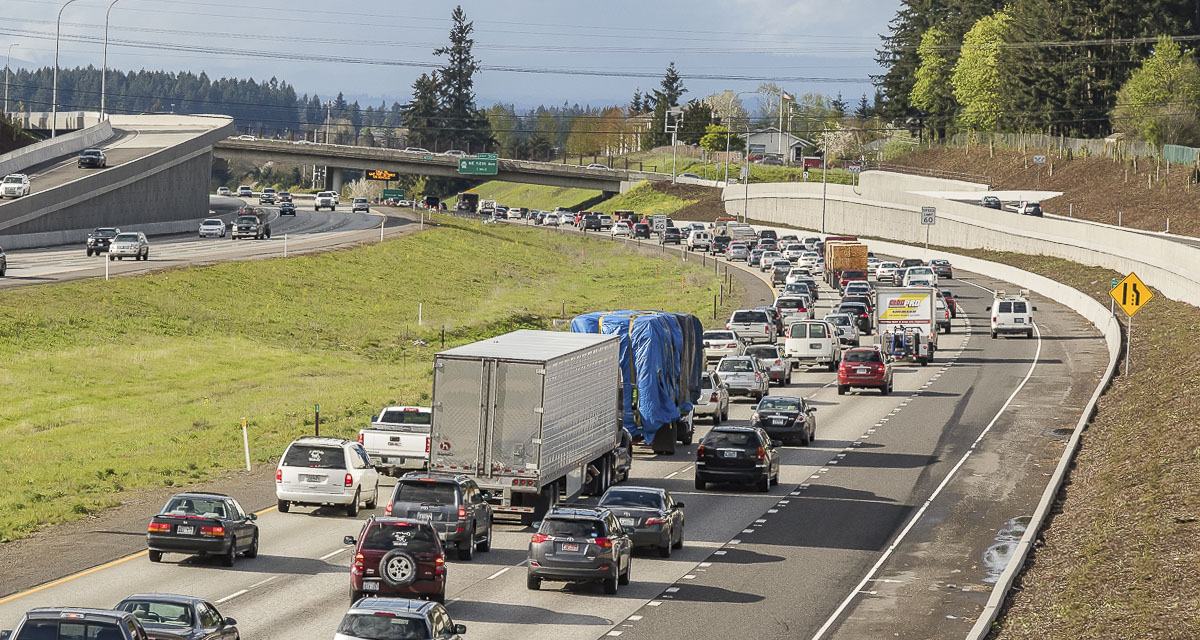
The reasons cited include increased costs to capital projects, reduced gas tax revenue, and less-than-expected federal grant funding for Move Ahead Washington transportation package projects
TJ Martinell
The Center Square Washington
The Washington State Department of Transportation’s accounts face a combined $900 million funding shortfall by the 2027-2029 biennium, according to a state Senate committee. The reasons cited include increased costs to capital projects, reduced gas tax revenue, and less-than-expected federal grant funding for Move Ahead Washington transportation package projects.
For the current biennium under the 2024 supplemental budget, WSDOT’s budget and revenue are evenly matched at $14.55 billion. However, at current funding levels numerous accounts will be in the red, including:
- $7.4 million in the State Patrol Highway Account
- $137 million in the Puget Sound Ferry Operations Account
- $74.7 million in the Motor Vehicle Account
- $556 million in the Move Ahead Washington Account
- $73.8 million in the Capital Vessel Replacement Account
Senate Transportation Committee Budget Coordinator Haley Gamble warned members at the committee’s Friday meeting that “while we’re only looking at a six-year window, I can tell you that the red numbers grow in the out years. The financial outlook gets steadily worse as we move into the future.”
One of the ongoing issues is that “the revenues have never really recovered from that COVID drop we saw.”
Gamble added that an impending gas tax revenue forecast update showing lower than estimated levels will also affect state agency funding.
“The budget has been balanced with some significant fund transfers from the operating budget recently,” she said. “Whether or not we’ll see that continue or whether we’ll see those transfers adjusted, we don’t know.”
A major contributor to the fiscal impacts were assumptions that Move Ahead Washington would receive $650 million in competitive federal funds. However, Gamble said that “we have not seen those federal funds coming in at a rate that was assumed.”
Another problem she noted was that bids for contracts put out by WSDOT have been increasing. “We don’t know if that will continue as the economic climate changes, but that’s a another unknown for 2025.”
Although the transportation budget does not have to restrict spending to the economic forecast under state the way the operating budget must, Gamble speculated that “I would imagine that OFM [Office of Financial Management] would not allow you to proceed if that was not a balanced budget for at least a two-year period. If they can’t guarantee that they can pay that contract, it’s very difficult for them to sign contracts.”
This report was first published by The Center Square Washington.
Also read:
- Opinion: Portland’s War on Cars Part 4 – A smarter automobile strategy to end gridlock
 O’Toole argues fuel wasted in Portland-area congestion has sextupled since 1982, generating 250,000 tons of extra greenhouse gases annually.
 - Opinion: Transit ridership trends are dismal but regional plans are oblivious
 Puget Sound transit passenger-miles fell 31% from 2015 to 2024 despite a half-million-resident population increase.
 - Interstate Bridge Replacement Program seeks qualified firms for bridge replacement contract
 The CRBR project is backed by $5.7 billion from state funds, federal grants, and future tolling.
 - Opinion: Bankrupt – A $3.5 billion Rose Quarter Freeway widening project
 Joe Cortright argues ODOT’s Rose Quarter project has grown from a $450M approval to a $3.5B estimate, with a $2B funding gap.
 - Opinion: Portland’s War on Cars 3 – Ending the war on automobiles
 O’Toole argues Portland should add toll lanes, fix safety hazards, and redesign TriMet routes to end its anti-auto policies.