



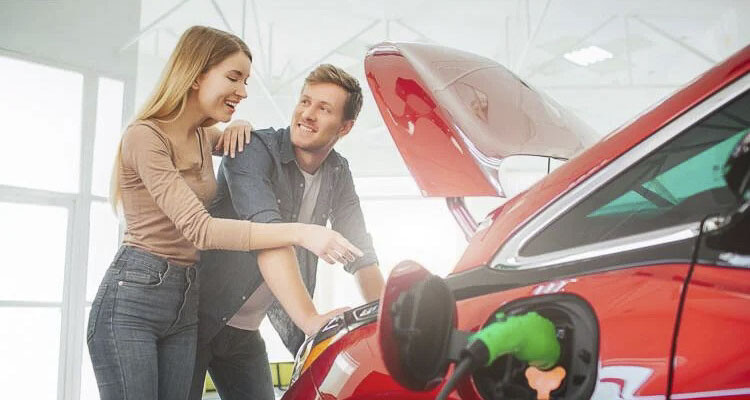
Last year, Gov. Jay Inslee said Washington will follow California’s lead and ban the sale of new gas-powered automobiles in the state by 2035
Brett Davis
The Center Square Washington
The Washington State Legislature’s Joint Transportation Committee has been updated on a draft final report on encouraging high consumption fuel users, or HCFUs, to switch to electric vehicles.
The committee was tasked last year by the Legislature to assess opportunities to encourage HCFUs to switch to electric vehicles as part of the state’s overall plan to go green in fighting climate change.
HCFUs are defined as drivers that burn 1,000 gallons or more of fuel per year, approximately 6.3% of motorists.
“It essentially is wanting to collect data and probe the question of first of all whether or the extent to which there are high-consumption fuel users – sometimes referred to as gasoline super-users – in Washington and what is their prevalence,” said Jeff Doyle, project manager for engineering and construction firm CDM Smith, at Tuesday’s presentation at the Spokane Convention Center in Eastern Washington. “How many gallons of fuel do they consume? Would it be in their benefit price-wise to switch to electric vehicles? And what policies, including charging infrastructure, might be important to incentivize them to try to switch or transition to electric vehicles?”
According to the draft final report, the top 10% of all drivers burn 26% of the fuel in the state. That translates into the top 10% of drivers burning through more than 434 million gallons of fuel, as compared to the bottom 50% of drivers going through nearly 388 million gallons of fuel.
“The main takeaway there is that HCFUs primarily are driving heavier, larger vehicles,” Doyle said, referring to SUVs, pickup trucks and vans.
The draft final report found that HCFUs are willing to pay more for an electric vehicle than the average driver and that HCFUs are as knowledgeable about electric vehicles as other drivers, although they do have concerns about electric vehicle performance when it comes to considerations like hauling and towing capabilities.
“But overall, I think the important takeaway is that the same policies that’s effective for the other 93% of drivers is also effective for HCFUs, and largely those are policies that already exist in Washington.”
The draft final report recommends four policy options tailored to HCFUs: 1) an “electric miles” lease incentive 2) an HCFU vehicle trade-in incentive 3) vehicle loaner programs that allow occasional use of a gas-powered vehicle and 4) rebates for home chargers and installation.
John Kiser, senior vice president of automotive & mobility at marketing research company Ipsos Inc., was optimistic about the future of electric vehicles in Washington state and the U.S. as a whole.
“Electric vehicle prices have actually been being reduced,” he told the committee. “We saw Tesla reduce their prices multiple times through the end of 2022 and the beginning of 2023.”
Tesla’s price cutting caused other manufacturers of electric vehicles to do the same, Kiser added.
He credited the federal Inflation Reduction Act of 2022, with its tax credit of up to $7,500 when buying a new electric vehicle, for the price drop, but said more work remains to be done to mainstream electric vehicles.
“About 6% of all vehicle sales in 2022 [were] a battery electric vehicle,” Kiser said. “That’s increasing, it’s growing. But it’s still only 6%, so we still have a far way to go in order to get to those conversions so having price reductions so that that gap in price isn’t as strong is certainly going to be advantageous.”
Baxter Shandobil, transportation planner with CDM, gave an example of how consumers could save money with an electric vehicle.
Per the draft final report, he pointed to comparing the total cost of ownership between a Toyota Camry Luxury Edition gas-powered automobile, which costs $27,315, and the Tesla Model 3 rear-wheel drive electric vehicle, which costs $41,630.
“However, in the super-commuter segments, despite an MSRP that’s $14,000 higher, the Tesla Model 3 is cheaper to own than the Toyota Camry by the second year of ownership because of lower operating costs, the Model 3’s eligibility for a partial federal tax credit as well as a Washington sales tax exemption on the first $15,000 of the purchase price,” Shandobil explained. “Including trade-in value of the vehicle, the total cost of ownership of the Tesla is about $10,000 less than the Camry after five years of ownership.”
Kiser noted that there will be more choices in electric vehicles in the future that will be more attainable for more people.
Some lawmakers on the committee expressed some skepticism.
“For example, to illustrate, I have a local elected in my district who is definitely a high-consumption user,” Rep. Jim Walsh, R-Aberdeen, said. “Purchased an EV. Ended up leaving it in the garage and uses the older beater truck to do his business because he says it’s more reliable in bad weather. He feels safer, especially in the winter, driving it on country roads. And it’s preferable because of what it can do, particularly in a rural environment, particularly in adverse weather conditions.”
Rep. Mike Volz, R-Spokane, pointed out that he wouldn’t be able to drive to Olympia on a single charge of an electric vehicle.
Kiser admitted that more work remains to be done in terms of building infrastructure for the planned mass adoption of electric vehicles, as well as keeping the public informed about advances in electric vehicle technology that make them more appealing and accessible to the average person.
“Consumers still don’t know,” he said.
Last year, Gov. Jay Inslee said Washington will follow California’s lead and ban the sale of new gas-powered automobiles in the state by 2035.
This report was first published by The Center Square Washington.
Also read:
- Vancouver Fire Department responds to emergency aircraft landing on SR-14
 A Cessna aircraft made an emergency landing on State Route 14 near milepost 2 after experiencing mechanical issues.
 - Final Supplemental Environmental Impact Statement published for Interstate Bridge Replacement Program
 Federal agencies published the final environmental impact statement for the Interstate Bridge replacement project.
 - Speed cameras designed to bring added safety to work zones
 WSP issued 65,000 infractions in first year, with 59,000 being penalty-free first offenses as program expands statewide.
 - Marie Gluesenkamp Perez seeks federal assistance in combating sea lion predation of salmon & steelhead fishing stock
 Congresswoman pushes for expanded lethal removal authority as sea lions devour Columbia River fish stocks.
 - Opinion: The high cost of hiding – Why IBR’s delayed revenue study is a $15 billion warning sign
 IBR delays critical toll revenue analysis until June 2027, hiding financial details until after project approval.
