


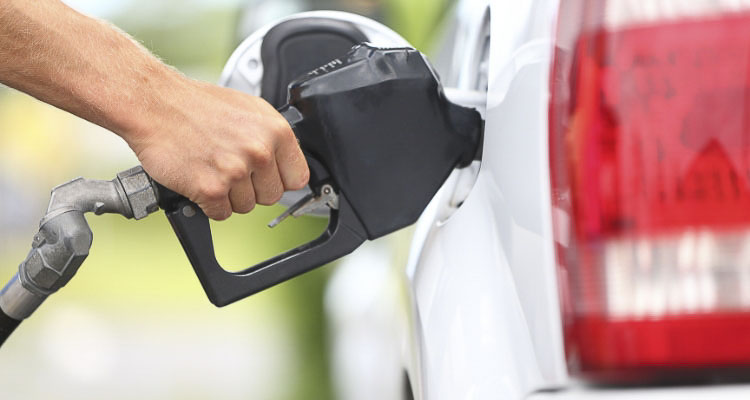
On Monday, the average price of a gallon of regular unleaded was sitting at $4.10 statewide
Timothy Schumann
The Center Square Washington
Despite nine straight weeks of declining fuel prices, Washington remains one of the most expensive states to fuel up in nationwide.
On Monday, the average price of a gallon of regular unleaded was sitting at $4.10 statewide, down from $4.31 the week prior, according to AAA data. This marks the second week in a row of 21 cents per gallon drops.
“The seasonal pattern of less driving due to shorter days and crummy weather, combined with a lower oil cost, is driving gas prices lower,” said AAA spokesperson Andrew Gross in a statement. “If this trend continues, many states could see their average prices fall below $3 a gallon by early next year.”
Compared with the national average of $3.26 per gallon, Washington’s $4.10 places it a full 84 cents higher and a full $1.41 off the Texas average. Sitting at $2.69 per gallon, the Lone Star State is currently the nation’s cheapest fuel market.
Despite the 21 cents per gallon decrease, Washington moved up the list of most expensive fuel markets nationwide from fifth last week to fourth this week. Washington’s pump prices were only beat out by Nevada, California, and Hawaii which filled out third to first on the list.
Intra-state variance increased six cents last week, spanning a range of $1.05 per gallon. The outliers this week are Seattle’s King County in the west and Douglas County in the east, at $4.51and $3.46 per gallon respectively. This price variance still largely follows the Cascade Range, with residents to the west paying a higher premium at the pump than residents to the east.
Washington state residents also have a new cap-and-trade tax to look forward to starting Jan. 1 which, as previously reported by The Center Square, would drive fuel costs an estimated 46 cents per gallon higher. This will come on top of Washington’s current rate of 49.4 cents per gallon of state tax.
This report was first published by The Center Square Washington.
Also read:
- Opinion: Portland’s War on Cars Part 4 – A smarter automobile strategy to end gridlock
 O’Toole argues fuel wasted in Portland-area congestion has sextupled since 1982, generating 250,000 tons of extra greenhouse gases annually.
 - Opinion: Transit ridership trends are dismal but regional plans are oblivious
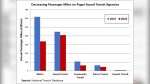 Puget Sound transit passenger-miles fell 31% from 2015 to 2024 despite a half-million-resident population increase.
 - Interstate Bridge Replacement Program seeks qualified firms for bridge replacement contract
 The CRBR project is backed by $5.7 billion from state funds, federal grants, and future tolling.
 - Opinion: Bankrupt – A $3.5 billion Rose Quarter Freeway widening project
 Joe Cortright argues ODOT’s Rose Quarter project has grown from a $450M approval to a $3.5B estimate, with a $2B funding gap.
 - Opinion: Portland’s War on Cars 3 – Ending the war on automobiles
 O’Toole argues Portland should add toll lanes, fix safety hazards, and redesign TriMet routes to end its anti-auto policies.