



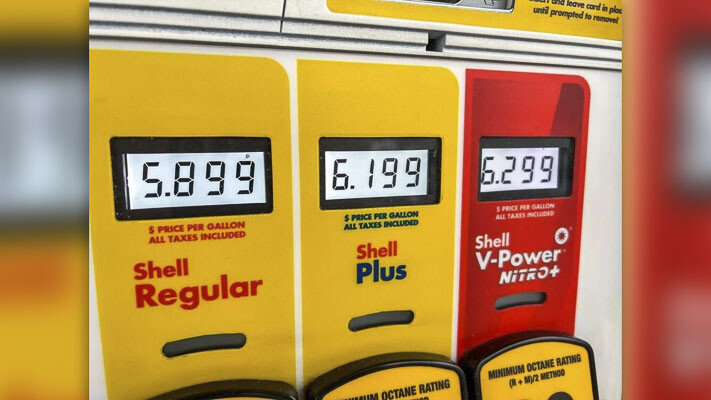
As of Jan. 1 of this year, Washingtonians are paying for a new cap-and-trade system
Timothy Schumann
The Center Square Washington
The average price of a gallon of regular unleaded was $4.57 statewide on Monday, up from $4.50 a week before, according to AAA data. Washingtonians are paying for three months of fuel price increases this calendar year following the implementation of a carbon tax earlier this year.
This 7 cents per gallon increase moved opposite the national average, which fell from $3.67 per gallon to $3.66 per gallon, a 1 cent per gallon decrease over the same time period.
“The recent surge in oil costs took a break this week, with the price of oil tumbling back into the upper $70s per barrel,” AAA spokesperson Andrew Gross said in a statement. “If this oil price trend continues, drivers may see falling gas prices.”
While that oil price may be reflected in the slight one-cent per gallon decrease nationally, residents of the Evergreen State are paying more than most. Washington’s pump prices currently stand at the fourth most expensive nationally. Only California, Hawaii, and Arizona are pricier.
Washington’s $4.57 per gallon places it 91 cents per gallon higher than the national average of $3.66 per gallon. It is also $1.44 per gallon more than what Mississippi residents – the nation’s least expensive fuel cost of $3.13 per gallon – pay.
Washington intra-state variance remains high at $1.33 per gallon, down 2 cents per gallon from last week. San Juan and Asotin counties had the most and least expensive gas prices in the state, at $5.16 and $3.83 per gallon.
Residents to the west of the Cascade range continue to pay higher premiums at the pump.
As of Jan. 1 of this year, Washingtonians are paying for a new cap-and-trade system.
“The first auction of CO2 allowances [averaged] $48.50 per metric ton of CO2. This equates to about 39 cents per gallon of gasoline and 47 cents per gallon of diesel,” announced a report by the Washington Policy Center based on recently released Washington State Department of Ecology data.
This report was first published by The Center Square Washington.
Also read:
- Opinion: ‘When are we going to get the full and complete details of the Interstate Bridge Replacement Program’s I-5 Bridge replacement project?’
 IBR team buried key details about light rail ending at waterfront with massive elevator system required.
 - POLL: Do you support extending light rail beyond the waterfront to connect with C-TRAN at Library Square?
 Readers can weigh in on Anne McEnerny-Ogle’s proposal to extend light rail beyond the waterfront to Library Square for improved C-TRAN connections.
 - Opinion: Passing a cyclist – Law, myth and a little patience
 Most drivers can’t legally pass cyclists in-lane due to vehicle width versus road measurements.
 - Vancouver mayor counters IBR’s proposal for the only light rail stop to be at the waterfront
 Vancouver’s mayor wants light rail extended beyond the waterfront to connect with C-TRAN buses at Library Square.
 - Letter: ‘This is the worst thing that ever happened to the region’
 A Hayden Island resident Sam Churchill is criticized in a letter calling the $14 billion Interstate Bridge Replacement project a “boondoggle” that destroys local businesses.
 wpDiscuz
