



Senate Bill 5855 adds a new section to current state law, which already requires law enforcement officers to be clearly identifiable by wearing a name tag or badge, and generally prohibits officers from wearing any type of face covering while performing their duties
Carleen Johnson
The Center Square Washington
 See Grok’s analysis of this story
During a recent public hearing before the Senate Law & Justice Committee, Washington state lawmakers debated a bill that would limit when police officers can cover their faces.
Senate Bill 5855 adds a new section to current state law, which already requires law enforcement officers to be clearly identifiable by wearing a name tag or badge, and generally prohibits officers from wearing any type of face covering while performing their duties.
The new section would prohibit local, state, and federal law enforcement officers from wearing masks while interacting with the public, with certain exceptions, including while working as undercover operatives and acting as members of the Special Weapons and Tactics, or SWAT, team. It would also allow a person detained by an unlawfully masked local or state officer to sue that officer in their official capacity.
SB 5855 comes in response to recent tensions and protests over arrests made by federal Immigration and Customs Enforcement, or ICE, officers.
“We’re all aware of incidents that started occurring last year where we started seeing law enforcement officers throughout the country where they were bringing intimidation tactics and bringing fear in neighborhoods, our families and communities,” Sen. Javier Valdez, D-Seattle, the bill’s sponsor, said during Tuesday’s public hearing.
Nathan Olson, policy advisor to Gov. Bob Ferguson, testified in support of the bill.
“Knowing who is protecting and serving in their community helps build trust between law enforcement personnel and who they serve,” he said.
Paula Sardinas with the Washington Build Back Black Alliance also spoke in support of the legislation.
“Our communities are deeply familiar with the systemic and structural harm masked authority can cause,” she said. “The use of opaque face coverings during routine police interactions invokes fear, it invokes trauma, and for many of us it harkens back to the era of the Ku Klux Klan.”
U.S. Border Czar Tom Homan has defended ICE agents’ use of masks to conceal their identity as officers have been doxxed, meaning their faces and identities have been searched for and published on the internet, typically with malicious intent.
“The same people who are complaining about ICE wearing masks, have they ever said anything about a BLM protestor wearing a mask?” Homan asked Politico last year.
First Assistant U.S. Attorney Pete Serrano cited the U.S. Constitution’s Supremacy Clause, which establishes that federal law takes precedence over state laws.
“It does actually present a direct threat, both for members of the public and for members of law enforcement,” he said. “It’s also got some constitutional issues.”
Serrano said the bill could further endanger federal officers.
“As of last fall, doxxing increased by 1,000% and 8,000% death threats to our members of the law enforcement community,” he said.
Last year, California became the first state to pass a law banning law enforcement officers from wearing masks that conceal their identity.
That law is being challenged by the U.S. Department of Justice, which claims the law violates the Supremacy Clause by trying to regulate federal agents, arguing it puts agents’ lives at risk.
Sen. Jeff Holy, R-Cheney, suggested the committee and Valdez hold off on the bill until the federal courts make a concrete decision.
“I understand exactly what you’re trying to do, and it’s a noble cause,” he said. “I’m not sure this is ready for prime time until it is resolved in California.”
The bill was scheduled last in the hearing, so as time ran out for those signing up to testify, Chair Manka Dhingra, D-Seattle, told those who expected to testify to submit written testimony.
More than 14,000 people signed in support of the bill, while over 2,000 signed in opposition.
SB 5855 is scheduled for executive session in the same committee on Thursday at 10:30 a.m.
This report was first published by The Center Square Washington.

This independent analysis was created with Grok, an AI model from xAI. It is not written or edited by ClarkCountyToday.com and is provided to help readers evaluate the article’s sourcing and context.
Quick summary
Senate Bill 5855, pre‑filed by Sen. Javier Valdez, would prohibit local, state, and federal law enforcement officers from wearing masks that conceal their identities during public interactions, with exceptions for undercover and SWAT operations. The proposal would also allow lawsuits against unlawfully masked local or state officers, according to the article’s description of the bill.
What Grok notices
- Quotes Valdez describing the bill as a response to intimidation concerns, while including arguments from supporters and opponents about accountability versus officer safety.
- Includes support voiced by an advisor to Gov. Ferguson and opposition arguments focused on doxxing risks and concerns that restrictions on federal officers raise federal‑supremacy issues.
- Links the proposal to recent tensions around ICE arrests and public interactions, using those events as context for why lawmakers are considering an identification‑mask restriction.
- References parallels to California, including a challenged law, suggesting Washington’s proposal may face similar legal scrutiny depending on how it applies to federal agents.
- Provides process details—such as large volumes of public testimony (over 14,000 in support and about 2,000 opposed, as reported) and the upcoming executive session—so readers can track where the bill stands.
Questions worth asking
- How could a mask ban affect officer safety in high‑risk situations or in cases where officers fear doxxing or retaliation?
- What balance could be struck between public accountability and officer protection during routine interactions—especially when identification can be shown in ways other than an uncovered face?
- How might the legislation influence trust between communities and federal agents such as ICE, particularly during high‑visibility arrest activity?
- In other states or jurisdictions, what measurable effects have similar policies had on arrest procedures, officer recruitment/retention, and complaints?
- If facial coverings are restricted, what clearer alternatives—badge visibility requirements, body‑camera policies, unique ID numbers, or written identification protocols—could achieve accountability goals?
Research this topic more
- Washington State Legislature – SB 5855 text, bill history, and status
- Washington Senate Law & Justice Committee – hearing materials, recordings, and testimony
- U.S. Department of Justice – information relevant to federal legal positions on similar policies
- Washington State Patrol – agency policies and identification practices (for context)
- National Conference of State Legislatures – overview resources on state law‑enforcement identification laws

Also read:
- State Representatives McClintock and Ley answer questions at town hall in Battle Ground
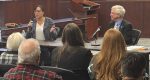 Residents voiced rising concerns about property taxes, school funding debates, the impact of new income tax legislation, and major costs tied to the Interstate Bridge plan.
 - As Washington gets an income tax, the fight to overturn it begins
 Opponents are organizing lawsuits and potential ballot measures to challenge the new 9.9% income tax on Washington households earning over $1 million.
 - VIDEO: WA diesel hits record $6.53, crushing truckers and school budgets
 With diesel nearing $6.53 per gallon in Washington, trucking businesses and school districts now confront sharply higher fuel expenses affecting budgets and workers.
 - WA’s status solidifies as one of the most expensive places in US
 A new study shows Washington outpaces most states on cost of living, with metrics revealing a sharp rise in daily expenses and major metro areas ranking among the nation’s most expensive.
 - Opinion: Someone explain the Democrat Party to me please
 Lars Larson criticizes Democrat politicians for shutdown threats, Homeland Security funding refusals, and positions on election laws, housing, and gun rights.
