



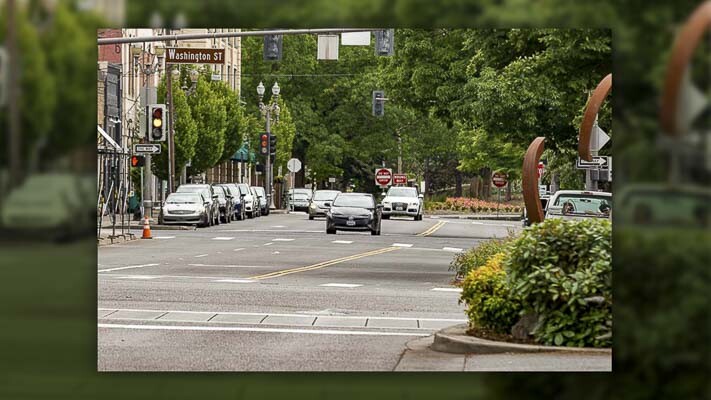
In order to reach the 28 percent tree canopy goal, it would cost the city tens of millions of dollars
Spencer Pauley
The Center Square Washington
An Urban Forestry Management Plan is up for a vote by the Vancouver City Council in November with an ambitious goal of increasing the city’s tree canopy coverage to 28 percent by 2047.
The plan, created in part by software company PlanIT GEO, touts that the city’s current 21 percent tree coverage provides over $40 million in ecological benefits to the city. The city’s current overall budget spends $1.7 billion, not counting supplemental appropriations.
However, in order to reach the 28 percent tree canopy goal, it would cost the city tens of millions of dollars.
The draft plan estimates in one scenario that the city would spend approximately $25 million over 25 years in order to plant 100 percent of the 124,900 trees needed to reach 28 percent tree canopy cover by 2047.
If 100 percent of the trees were planted through city contracts, the cost would amount to $56.2 million through 2047.
These costs are based on regional and industry estimates, which include costs for hole preparation, transportation, unloading, planting time and backfilling. Notably, the estimates are not adjusted for future inflation.
Another scenario in which the city of Vancouver led 60 percent (74,940 trees) of planting costs estimate approximately $15 million needed over the next 25 years in order to reach the Urban Forestry Management Plan’s goal. The annual planting costs would total $599,520.
The remaining 40 percent (49,960) would come from city partners and private-led planting. In order to plant the 49,960 trees, it would cost $17.5 million over 25 years, or $699,440 per year, according to the draft plan.
In this scenario, The draft plan states that it would amount to $1.8 million in maintenance if each tree were maintained annually. Given the goal of a 7-to-10 year proactive maintenance program, 7,494 trees per year amounts to $181,355 annually, according to the draft plan.
Statistics show that there are approximately 99,000 trees currently in maintained areas citywide.
Estimated costs for an “effective pruning program” include hiring six new full-time positions at an annual cost of $553,811; four arborists, two crew supervisors. The plan also includes one seasonal part-time employee. The total cost for a new public tree maintenance team is estimated at $900,621 for the hiring of new positions, as well as the purchases of gear and equipment.
The city already has an above-average tree canopy coverage that provides $44 million in benefits to the city, according to officials.
Breaking down the $44 million value shows Vancouver’s urban forest removed approximately 297,000 pounds of pollutants, a $2 million value, and reduced 243 million gallons of stormwater runoff, saving the city an additional $2 million, according to the plan’s statistics.
The eco-benefits of Vancouver’s current tree canopy also stored 447 million pounds of carbon, which officials estimate is a $38 million value and another 14 million pounds of sequestered carbon, totaling $1 million in value.
Vancouver Urban Forester Charles Ray said in a Planning Commission meeting on Sept. 26 that the $44 million was derived from the best available science from the i-Tree tools that the city utilized in its 2021 Tree Canopy Assessment Report.
The city uses a three-year subscription to PlanIT GEO’s TreePlotter and Canopy software to track tree canopy data. The subscription costs approximately $10,000 per year.
According to data in the plan, the city saw tree canopy coverage go from 3 percent in 2011 to 19 percent in 2019. The most recent dataset from 2021 had the city’s tree coverage at 21 percent.
Vancouver scored an urban forestry audit score of 78 out of 100, which is considered good. Ray noted that most communities score in the 60-70 range.
Vancouver’s urban forestry stems from a mix of revenues. These include the city’s Department of Public Works Stormwater Utility Fund and the city’s Tree Fund, for a total budget of $1 million in 2022, according to the city’s 2022 urban forestry report.
Ray told The Center Square that the average program cost for the planting and maintenance of the city’s urban forest is $667 per tree.
Vancouver planted 1,323 new trees in 2022, which are expected to intercept approximately 1,005,480 gallons of stormwater annually once they mature. They are anticipated to absorb more than 13,230 pounds of pollutants each year from the air we breathe.
“Overall, these 1,323 new trees as they mature will provide greater than $3 million worth of benefits, a 250 percent return on this wise investment,” the city’s 2022 annual report states.
Ray said that the Vancouver community has backed the city’s work to increase the city’s tree canopy coverage.
“We are pleased with the support and participation from the community with the draft plan and our program,” Ray said to The Center Square in an email.
Staff anticipate bringing the final draft Urban Forestry Management Plan forward to the city council on Oct. 23 for a first reading and Nov. 6 for a second reading and public hearing with a recommendation of adoption.
This report was first published by The Center Square Washington.
Also read:
- Former WA Supreme Court justice joins legal effort against income tax
 Phil Talmadge and Rob McKenna have joined forces with the Citizens Action Defense Fund to oppose Washington’s new tax on high-income earners, raising legal and constitutional questions.
 - Makeover in store for Congress with flood of lawmakers headed for the exits
 A wave of exits from Congress—over 65 lawmakers—will usher in unfamiliar faces and decrease veteran expertise, shifting the political landscape in Washington.
 - Opinion: Sheriffs fight back
 Four county sheriffs are suing to block a new law giving a governor-appointed board power to decertify and remove sheriffs, bypassing voter oversight in Washington.
 - Obituary for Lucille ‘Erma’ Christenson Madore – April 22,1924-March 13, 2026
 Known for her love of music and family, Lucille ‘Erma’ Christenson Madore lived through nearly 102 years and leaves a large, grateful legacy in Vancouver.
 - Fiscal fallout: $375 million bond debt indirectly funding operating budget
 Shifting $375 million from a loan fund impacts local infrastructure as Washington state covers operating costs with bond debt, prompting concern among officials and advocacy groups.
 - Lawsuit aims to block new eligibility requirements for WA sheriffs
 Four sheriffs are suing over a state law that sets new eligibility rules, arguing it undermines voter authority by allowing removal for certification issues.
 - Opinion: The growing gap between public voice and political power
 Todd Myers describes how large-scale protest and sign-ins often fail to sway state leaders, and argues authentic influence is most likely found through local action.
 wpDiscuz
