



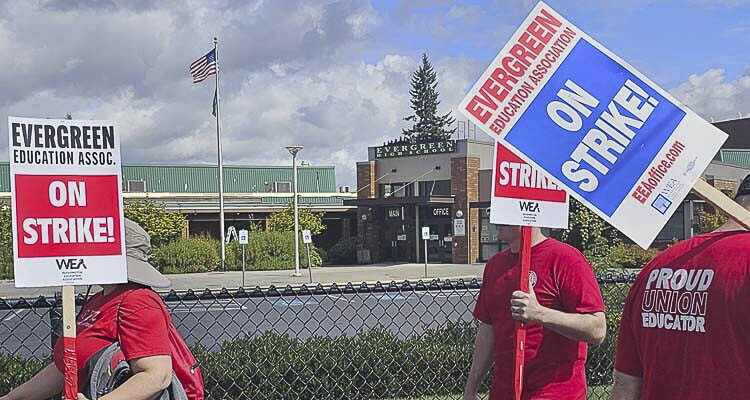
According to the bill’s fiscal note, Washington state could potentially see an increase of unemployment insurance claims ranging from 812 to 3,000 additional claims a year
Spencer Pauley
The Center Square Washington
The Washington state House Appropriations Committee has passed a proposed bill that would allow workers in Washington state to receive unemployment insurance during strikes.
Proposed House Bill 1893 would remove the prohibition against receiving unemployment insurance benefits for workers participating in a strike.
Currently, a worker is disqualified from receiving benefits if he or she is unemployed because of a strike.
If benefits are not charged to any employer, those costs are socialized and shared evenly by all employers participating in the unemployment insurance system.
The current maximum weekly unemployment insurance benefit amount is $1,019, according to HB 1893.
If the bill is signed into law, benefits would be paid out of the unemployment insurance trust fund as opposed to the actual company that the striking employees work for. However, those costs would be shared evenly by all employers participating in the system.
At Monday’s House Appropriations Committee meeting Rep. Timm Ormsby, D-Spokane, said that workers go on strike as “an action of last resort” and that “many of them are in very tentative [and] precarious financial positions when they take this action of last resort.”
Rep Chris Corry, R-Yakima, agreed that there should be a tentative balance between workers and employers, but said that the bill would tip the balance in favor of striking workers.
“It doesn’t take long before this does have an impact not only on the [unemployment insurance trust fund], but on rates paid by employers and employees across the state,” Corry said. “Therefore, we don’t think this is the right policy.”
According to the bill’s fiscal note, Washington state could potentially see an increase of unemployment insurance claims ranging from 812 to 3,000 additional claims a year. This translates into an increase of $9.8 million to $14.1 million in annual payout of benefits that currently sit around $120 million a year.
The note also found that the state denied an average of 2,313 claims per year due to a labor dispute.
According to the Cornell University Labor Action Tracker, thousands of workers went on strike in one of 26 labor actions in Washington in 2023.
The proposed bill is similar to a bill in California that Gov. Gavin Newsom vetoed last October, as previously reported by The Center Square. That bill would have allowed striking workers to collect unemployment benefits, which in California are funded by employers.
Newsom’s reasoning for vetoing the bill was that any expansion of eligibility for unemployment insurance benefits could increase the state’s outstanding federal unemployment insurance debt that was projected to be nearly $20 billion by the end of 2023. It could also jeopardize California’s Benefit Cost Ratio add-on waiver application, significantly increasing taxes on employers.
House Bill 1893 has been referred to the Rules Committee for review.
This report was first published by The Center Square Washington.
Also read:
- POLL: After hearing state leaders describe the I-5 Bridge as vulnerable in an earthquake, what is your reaction?
 State and local leaders describe the I-5 Bridge as structurally at risk but recommend drivers continue crossing it while complex replacement plans unfold.
 - Opinion: Historical state income tax and another massive operating budget highlight the end of the 2026 legislative session
 Rep. John Ley details the passage of a state income tax, an expanding $80 billion budget, and new Clark County infrastructure funding following the 2026 legislative session.
 - VIDEO: Legal challenges certain as Gov. Ferguson prepares to sign new income tax
 Senate Minority Leader John Braun and other legislators expect legal challenges and initiative efforts to follow Gov. Ferguson’s signature on Washington’s new income tax law affecting high earners and businesses.
 - Vancouver Fire Department honors firefighters, community members at annual awards ceremony
 Acts of bravery, including river rescues and life-saving interventions by both residents and first responders, were recognized at the Vancouver Fire Department’s annual awards ceremony.
 - ‘Cram the Cruiser’ to benefit Battle Ground and Prairie High Schools
 Officer Phil Anderson’s food pantry at Battle Ground High inspired Prairie High to launch its own, providing snacks and building bridges between students and law enforcement.
 - Opinion: Fighting for transparency in Washington government
 A recent court decision allows Washington lawmakers broad new secrecy over internal records, as advocates report rising obstacles to government transparency and public engagement.
 - New Washington law clarifies what is an ‘election’
 After a court ruling challenged the state’s definition of “election,” lawmakers clarified the law to prevent double voting and maintain the integrity of Washington’s ballots.
