



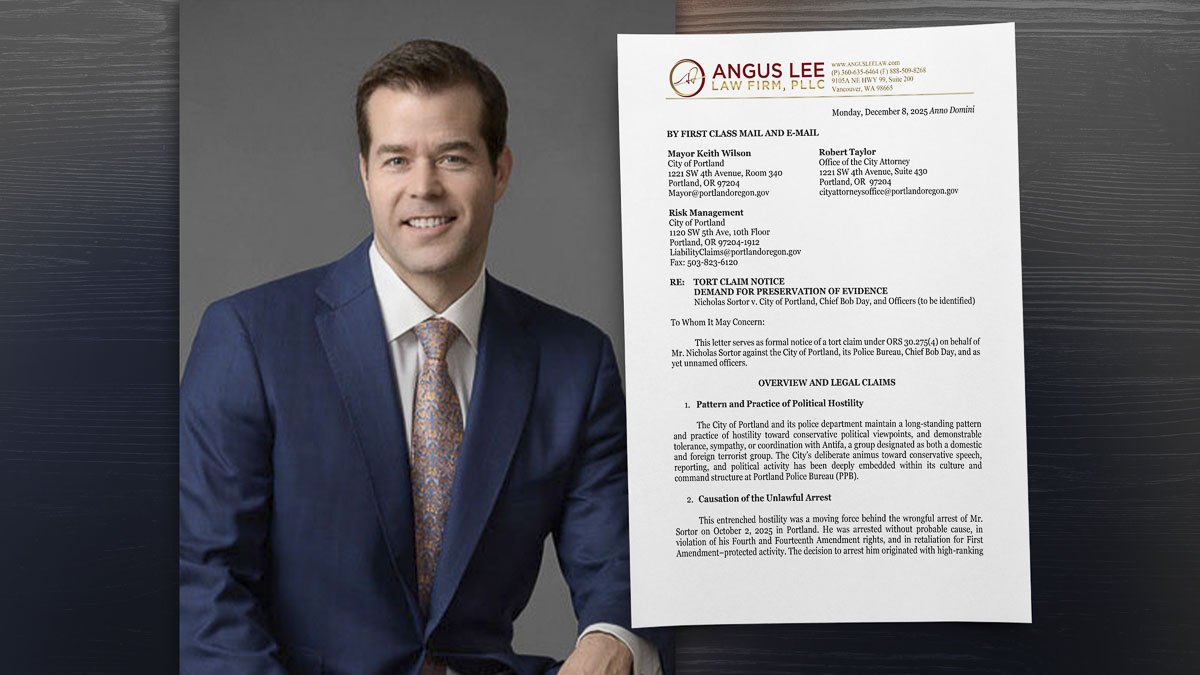
Claim is accompanied by a historical memorandum documenting systemic political bias and Civil Rights violations
 See Grok’s analysis of this story
PORTLAND, OR – On Monday (Dec. 8), counsel for journalist Nicholas Sortor formally served the city of Portland with a tort claim arising from his unlawful arrest on October 2, 2025 outside the Portland ICE facility. The claim alleges unlawful arrest, First Amendment retaliation, equal-protection violations, and municipal liability under § 1983.
The incident occurred after Sortor retrieved a burning American flag that Antifa insurrectionists had lit on fire and thrown on to ground. Within minutes of documenting the Antifa crowd, reporting from the public sidewalk, and attempting to avoid escalating threats, he was attacked by masked individuals while Portland Police officers stood by and watched. Moments later, instead of intervening to stop the mob, PPB officers turned on Sortor and arrested him without probable cause. The Multnomah County District Attorney later found that all of Sortor’s actions were lawful and expressly defensive in nature, confirming he had committed no crime.
“This wrongful arrest was not just a mistake,” said attorney Angus Lee. “It was the product of a deeply embedded culture of political discrimination in Portland law enforcement.”
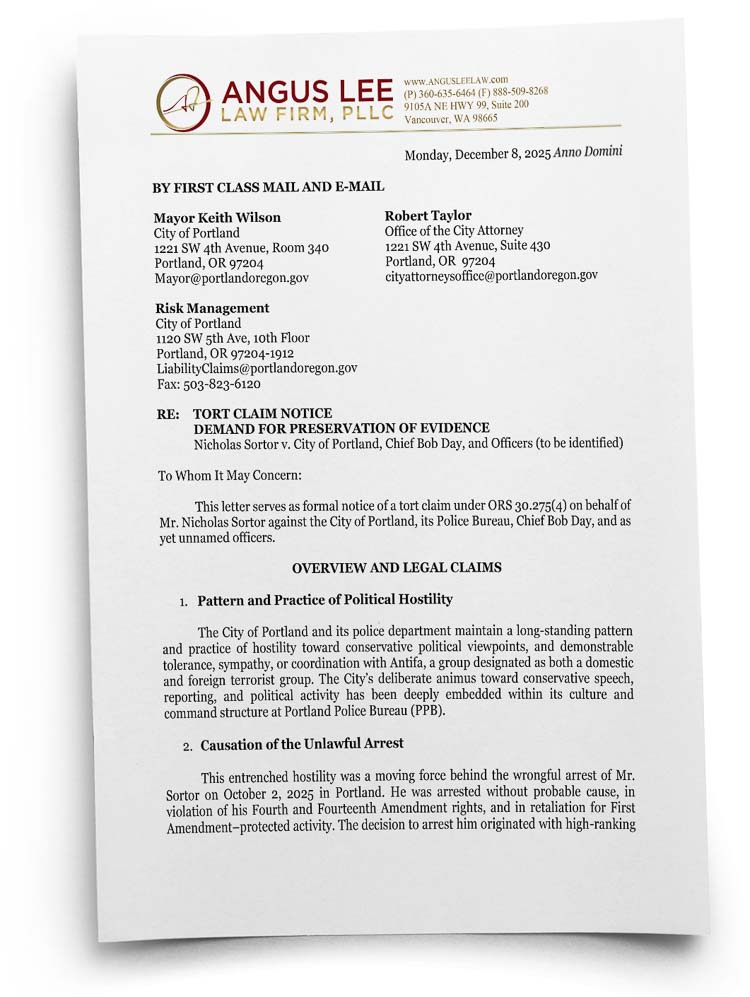
Along with the tort claim, the legal team is releasing a comprehensive historical memorandum detailing Portland’s long-standing pattern and practice of political bias in law enforcement. The memorandum outlines nearly a decade of discriminatory non-enforcement toward Antifa and retaliatory enforcement against conservatives, journalists, and political dissenters. It further explains how Portland’s political leadership cultivated a climate in which police routinely ignored Antifa’s criminal conduct while targeting those who exposed or opposed it.
A copy of this memorandum has been sent to the Civil Rights Division of the United States Department of Justice, which has acknowledged receipt and is reviewing the material as part of its ongoing assessment of the Portland Police Bureau. “The Department of Justice now has a full accounting of Portland’s history of selective policing,” Lee said. “They are reviewing evidence that the City has, for years, used its police force to advance political objectives rather than enforce the law evenly.”
The claim notes that this is not an isolated incident but a predictable consequence of Portland’s long-standing culture of political favoritism. “We have every reason to believe that Portland law enforcement knows exactly who many of these Antifa members are,” Lee stated. “There are strong indications that officers have been communicating with them, cooperating with them, or allowing them operational freedom that no other group would ever receive. Our investigation will dig deeply into those relationships.”
As the case proceeds, discovery will examine command-level decision making, communications between City leadership and police personnel, the failure to arrest known Antifa offenders, internal discussions about political protest management, and the City’s longstanding unwillingness to enforce criminal laws against favored political actors.
“This case is going to expose the structural bias that Portland officials have spent years denying,” Lee added. “The public will finally see how deeply this problem runs.”
Copies of the tort claim and the historical memorandum are attached to this release.

This independent analysis was created with Grok, an AI model from xAI. It is not written or edited by ClarkCountyToday.com and is provided to help readers evaluate the article’s sourcing and context.
Quick summary
Attorney Angus Lee has filed a tort claim against the city of Portland on behalf of conservative journalist Nicholas Sortor for his October 2, 2025, arrest outside the Portland ICE facility, alleging unlawful arrest, First Amendment retaliation, equal‑protection violations, and municipal liability under §1983. The claim is accompanied by a historical memorandum alleging nearly a decade of discriminatory non‑enforcement toward Antifa and retaliatory actions against conservatives, journalists, and dissenters, with a copy sent to the U.S. Department of Justice’s Civil Rights Division.
What Grok notices
- Describes the sequence from Sortor’s arrest through the district attorney’s conclusion that no crime occurred, giving context for the legal theories in the tort claim.
- Quotes attorney Angus Lee on alleged patterns of unequal enforcement and retaliation, helping readers understand the broader issues he plans to raise.
- Notes that the accompanying memorandum catalogs prior protest‑related incidents, presenting the claim as part of a longer history rather than an isolated case.
- Reflects the perspective of Sortor’s legal team on Portland’s protest‑policing practices; the city’s response is not included in this account.
- Mentions that the materials were sent to the U.S. Department of Justice, signaling a possible federal‑oversight angle readers may want to follow.
Questions worth asking
- How might discovery in this tort claim shed light on internal Portland Police and city communications about protest management and media presence?
- What precedents from prior First Amendment and selective‑enforcement civil rights cases could shape the outcome of Sortor’s lawsuit?
- In what ways has past federal oversight or settlement agreements influenced reforms within the Portland Police Bureau?
- How do differing accounts of the October 2 incident affect public perceptions of police accountability and press freedom?
- What role could community input and independent review boards play in addressing allegations of selective enforcement during protests?
Research this topic more
- U.S. Department of Justice Civil Rights Division – investigations and guidance on police practices and First Amendment rights
- Portland Police Bureau – official information on protest response policies and after‑action reports
- Multnomah County District Attorney’s Office – charging decisions, case summaries, and policy statements
- Oregon Department of Justice – state civil rights enforcement authority and legal resources
- ACLU of Oregon – analyses of protest rights, police accountability, and news‑gathering protections
Also read:
- Opinion: The beginning of the end of anchor babies
 Lars Larson argues the Constitution excludes children born to non-legal residents, as the Supreme Court debates birthright citizenship and public opinion data shows limited support.
 - County extends application deadline for Commission on Aging openings
 Clark County is seeking diverse applicants to fill four roles on its Commission on Aging, with a focus on mobility and housing in 2026. New deadline set for applications.
 - VIDEO: Rejected – WA SOS will not process referendum to repeal income tax law
 State officials stopped Let’s Go Washington’s referendum to overturn the new tax, citing constitutional limits. Legal and political battles, including a Supreme Court challenge, are expected next.
 - Washington’s studded tire deadline is March 31
 Drivers must remove studded tires by March 31 or face a $137 fine, with WSDOT urging early action due to busy service centers and no planned deadline extension.
 - Community in Action: Police cruisers ‘crammed’ with snacks to benefit local students
 Nearly 8,500 snacks filled police cruisers at Fred Meyer as the community rallied to stock high school pantries and build new relationships.
 - Southwest Washington lawmakers to hold a series of town hall meetings throughout the 17th Legislative District
 Sen. Paul Harris, Rep. Kevin Waters, and Rep. David Stuebe will answer questions and discuss the state’s expanded operating budget and newly passed income tax at five April town halls.
 - Can your wellness routine be harming your teeth?
 Dental enamel can’t regenerate once damaged, but steps like using a straw, rinsing with water, and choosing fluoride toothpaste can help protect your teeth from acidic beverages.
 wpDiscuz
