



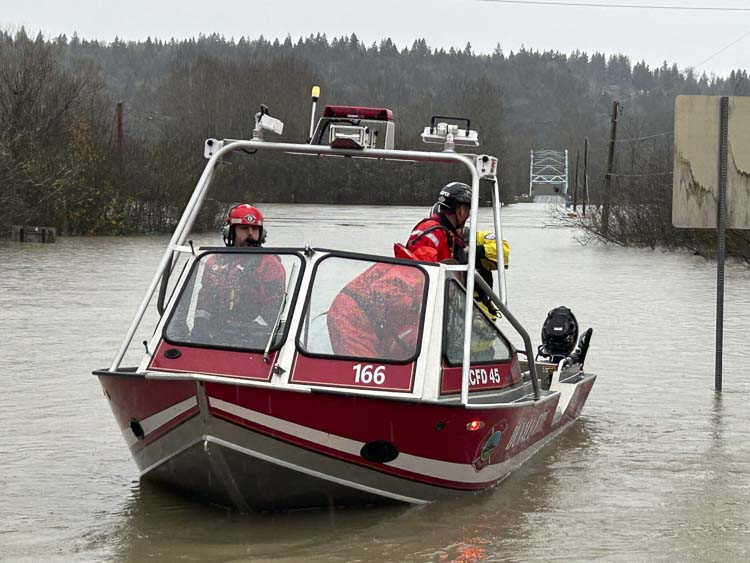
It’s still unclear whether the federal government will step in to assist with what officials are describing as a ‘catastrophic’ flood event
Jake Goldstein-Street
Washington State Standard
 See Grok’s analysis of this story
Washington state awaits an answer on its request for federal aid as it deals with unprecedented river flooding from days of heavy rain.
There were no known fatalities due to the storms or flooding as of midday Thursday, according to Gov. Bob Ferguson. And officials say it is too soon to fully gauge the damage. But thousands of people have been told to move to higher ground to escape rising floodwaters, roads are closed around the state and there are concerns about whether levees and dikes will hold.
Floodwaters were expected to crest along many rivers Thursday into Friday.
At a press conference Thursday in Mount Vernon, Ferguson noted he met with Federal Emergency Management Agency officials Wednesday afternoon, shortly after submitting his request for federal assistance.
“We walked through the numerous highway closures,” Ferguson said. “We walked through the flood levels. We walked through tens of thousands of Washingtonians being evacuated, and we tried to be as persuasive as we could to our partners in the federal government that they need to approve that emergency right away.”
He was planning to meet with FEMA officials again Thursday afternoon.
Late Wednesday, authorities directed everyone in the Skagit Valley’s 100-year floodplain to leave. This includes Burlington, Hamilton, La Conner, Lyman as well as parts of Mount Vernon and Sedro-Woolley. About 78,000 people live in the floodplain, local officials said.
In all, about 100,000 people were expected to be evacuated from flood-prone areas across the state.
The National Weather Service called the predicted flooding “catastrophic and potentially life threatening.” Communities near the Skagit and Snohomish rivers and their tributaries could be inundated. The heavy rainfall brings the risk of landslides. Debris had already swept across sections of important roadways, including U.S. 2 and Interstate 90.
While the atmospheric river is forecast to die down Thursday, fears of increasing river flooding remain through the rest of the week, according to the weather service. And wet conditions could continue into much of next week.
“This situation is extremely unpredictable,” Ferguson said.
“We’re using the best information we can to provide guidance,” he added. “I just want to emphasize that if you have instructions to evacuate from your local authorities, please, please, please evacuate.”
Ferguson activated the Washington National Guard to respond to the flooding. On Thursday morning, National Guard members were filling sandbags to help stave off the worst of the flooding along the Skagit River. A total of 300 were expected to be deployed by late Thursday.
On the ground
State Sen. Keith Wagoner’s home in Sedro-Woolley is on the edge of the 100-year floodplain for the Skagit River. He said he and his wife have packed bags and moved items to the second floor of the house.
“Fingers crossed but ready to go,” he said Thursday morning, before joining Ferguson in Mount Vernon.
Water could be seen on River Road at the city’s Riverfront Park on Wednesday, he said. “We are still safe but the water is still rising. I think the worst is yet to come. If the predictions hold true, it is really going to do some damage.”
Skagit County Commissioner Lisa Janicki expressed dismay at seeing cars trying to drive on flooded roads and residents walking dogs on dikes that could give way.
“Please don’t do that,” Janicki said. “Get off those dikes. Get home. Take care of your loved ones.”
To the south, the Snohomish River also rose to record levels early Thursday, with the potential for overtopping levees and flash flooding. Rivers as far south as the Cowlitz and as far east as the Wenatchee were also experiencing major flooding.
U.S. 2 and U.S. 97 remain closed in both directions. The eastbound lanes on a segment of I-90 near North Bend reopened Thursday afternoon. Dozens of other highways and roads are also blocked.
And in Orting, between the Puyallup and Carbon rivers in Pierce County, waters have topped some stretches of levees. About 150 homes are under evacuation orders, said Mayor Joshua Penner, who is also a state representative.
“As long as the rivers don’t rise another 1%, we’re OK,” he said.
Aid anxiety
Ferguson, a Democrat, earlier this year blasted the Trump administration for denying his predecessor’s plea for federal aid in the aftermath of last year’s bomb cyclone storm. On Thursday, he was more restrained, saying he was focused on emergency response efforts.
In a letter Thursday, the state’s entire congressional delegation, including Republican U.S. Reps. Dan Newhouse and Michael Baumgartner, urged President Donald Trump to approve Ferguson’s request immediately. They wrote that recovery in Skagit County is “expected to take years or even decades.”
“It is essential that the federal government steps in to provide the resources necessary to allow our state to respond to this disaster and begin the road to recovery as soon as possible,” the letter reads.
Ferguson said he’d encouraged “his friends on the other side of the aisle” to make their case for federal assistance to the Trump administration, amid fears the Republican president is favoring GOP-led states for aid.
The administration, for example, has tried to shut down FEMA funding to protect against natural disasters. This included more than $150 million for projects in Washington, including for levees and floodwalls in Aberdeen and Hoquiam.
But on Thursday, a federal judge in Massachusetts ruled the move was unlawful, and that the federal government needed to reopen the funding. Washington Attorney General Nick Brown led the lawsuit filed by nearly two dozen states to regain access to the money.
“The devastating flooding hurting communities across Western Washington right now underscores why these kinds of mitigation grants are so vital,” Brown said in a statement.
Ferguson plans to host another press conference with updates on the flooding Friday.
Washington State Standard reporter Jerry Cornfield contributed to this report. This report was first published by the Washington State Standard.

This independent analysis was created with Grok, an AI model from xAI. It is not written or edited by ClarkCountyToday.com and is provided to help readers evaluate the article’s sourcing and context.
Quick summary
Washington state faces catastrophic flooding from an atmospheric river, prompting evacuation orders for about 100,000 people in areas such as the Skagit Valley and Snohomish River basin, with rivers expected to crest at record levels through Friday. Gov. Bob Ferguson has activated the National Guard and requested expedited federal aid from FEMA, which remains pending amid bipartisan congressional support.
What Grok notices
- Uses timely quotes from Gov. Ferguson, local officials (including Skagit Commissioner Lisa Janicki), and National Weather Service forecasts that help convey immediate risks and response priorities.
- Provides geographic context on the hardest-hit basins, road closures, and the scale of National Guard deployment, making the statewide impact easier to follow.
- Signals that conditions may remain fluid into next week; readers may want to check the latest river‑crest updates and current shelter/evacuation information.
- Draws on Washington State Standard reporting with multiple journalist contributions, suggesting broad sourcing and on‑the‑ground detail.
Questions worth asking
- How are evacuation plans prioritizing vulnerable residents, including seniors, people with disabilities, and those without reliable transportation?
- What long‑term infrastructure options—such as levee reinforcement, floodplain management, or stormwater upgrades—are under consideration to reduce future atmospheric‑river impacts?
- How might extended flooding increase landslide risk in Cascade foothill communities, and what monitoring is in place for slope failures?
- How do past FEMA decision timelines or denials shape the state’s current strategy for requesting and documenting federal assistance?
- What role do climate and weather trend analyses play in planning for the frequency and intensity of extreme precipitation events?
Research this topic more
- Washington Emergency Management Division – flood alerts, evacuation information, and response updates
- National Weather Service, Seattle – river gauge data, rainfall totals, and flood forecasts
- FEMA Disaster Declarations – status of Washington aid requests and approved declarations
- Washington State Department of Transportation – highway closures and travel advisories
- USGS Washington Water Science Center – river flow monitoring, station data, and historical context
Also read:
- Opinion: Lawsuit filed against the unconstitutional income tax in Washington state
 Former Attorney General Rob McKenna and Supreme Court Justice Phil Talmadge challenge the 9.9% income tax in Klickitat Superior Court.
 - Vancouver Police investigate domestic violence homicide
 Vancouver Police Major Crimes Unit investigating after woman found dead with knife wounds on NE Oakbrook Circle.
 - Letter: ‘Oregon and Washington aren’t refusing to clean their rolls — they’re contesting federal jurisdiction and timing’
 Camas resident challenges Lars Larson’s fraud claims, explaining legal disputes over federal jurisdiction.
 - County Council to hold hearing on preferred land use alternative for comprehensive plan update
 Clark County Council will select preferred land use alternative from three options studied in environmental review.
 - Opinion: ‘When are we going to get the full and complete details of the Interstate Bridge Replacement Program’s I-5 Bridge replacement project?’
 IBR team buried key details about light rail ending at waterfront with massive elevator system required.
 - POLL: Do you support extending light rail beyond the waterfront to connect with C-TRAN at Library Square?
 Readers can weigh in on Anne McEnerny-Ogle’s proposal to extend light rail beyond the waterfront to Library Square for improved C-TRAN connections.
 - Opinion: Passing a cyclist – Law, myth and a little patience
 Most drivers can’t legally pass cyclists in-lane due to vehicle width versus road measurements.
