


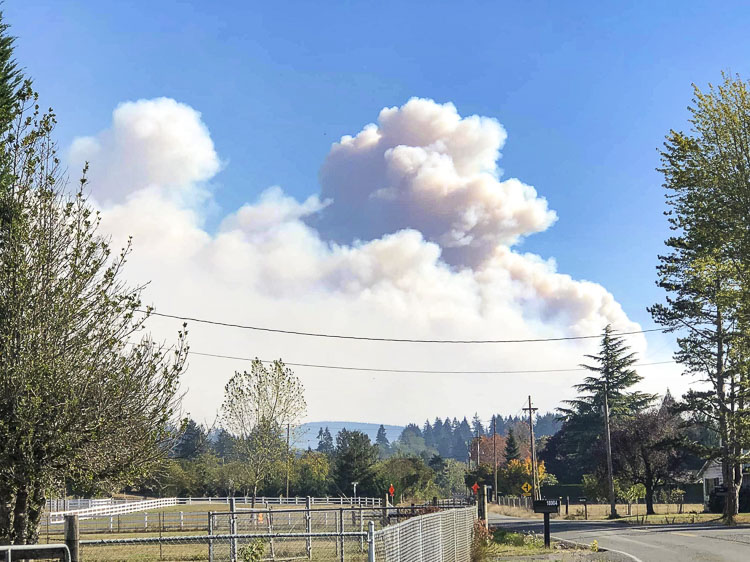
When the air is smoky, even healthy people can have symptoms or health problems
VANCOUVER – Air quality has reached unhealthy levels in parts of Clark County due to smoke from wildfires. Clark County Public Health is urging residents to regularly monitor local air quality and take steps to protect their health while air is smoky.
Air quality in Clark County currently ranges from moderate in Vancouver to unhealthy in north Clark County, according to Washington State Department of Ecology’s Air Monitoring Network. When air quality is in the unhealthy category everyone, especially sensitive groups, should limit time outdoors, avoid strenuous outdoor activities and take steps to keep indoor air cleaner.
Public Health also recommends keeping children indoors and canceling children’s outdoor athletic events and activities when air quality is unhealthy. Schools, child care facilities, before and after school programs and youth sports programs should refer to state Department of Health guidance for protecting the health of children when air is smoky. Organizers of outdoor public events should also consider canceling events when air is unhealthy.
Breathing smoke from wildfires isn’t healthy for anyone, but some people are more likely to have health problems when the air quality isn’t good. People at risk for problems include children, adults older than 65, people with heart and lung diseases, people with respiratory infections and colds, people who have had a stroke, pregnant people and people who smoke.
When the air is smoky, even healthy people can have symptoms or health problems. Symptoms can range from minor irritation to life-threatening complications, including:
- Sore throat
- Headaches
- Burning eyes
- Coughing
- Wheezing
- Shortness of breath
- Chest pain
People with heart or lung diseases should follow the medical management plans created with their health care providers. Those experiencing serious symptoms, such as shortness of breath or chest pain, should seek immediate medical care.
Here are additional steps people can take to improve indoor air quality and protect their health when air is smoky:
- Keep windows and doors closed.
- Create a cleaner-air room in the home using a portable air cleaner with a HEPA filter. Choose a room with no fireplace and few windows and doors.
- Turn the air conditioner in the home and vehicle to recirculate to avoid bringing smoky outdoor air inside.
- Don’t pollute indoor air. Avoid burning candles, using aerosol products, frying food and smoking.
- Do not vacuum unless using a vacuum with a HEPA filter. Vacuuming stirs up dust and smoke particles.
- Seek indoor shelter or public places with monitored air quality if air in the home cannot be improved.
- Use and properly wear a respiratory mask labeled N95, if appropriate. People who must be outside for extended periods of time in smoky air may benefit from wearing one of these masks, if worn correctly. If the mask does not fit properly, it will provide little or no protection and may offer a false sense of security. These masks are not recommended for children or people with beards. People with lung disease, heart disease or who are chronically ill should consult a health care provider before using a mask.
Additional resources:
- Clark County Public Health Smoke from Wildfires webpage
- Washington Smoke Blog
Information provided by Clark Co. WA Communications.
Also read:
- Opinion: Were Republican voters just sleeping during the August primary election?
 CCRP Chairman Matt Bumala says 60% of primary no-shows in the 17th and 18th districts were Republicans.
 - High school football: New coach prepares for long-term success at Prairie High School
 James Young-Lewis, a Clark County native who graduated from Evergreen in 2009, became Prairie’s head coach in May after working as an assistant coach across various programs since 2015, joining Prairie’s staff in 2024.
 - Cost to battle 20 wildfires in WA has topped $200M
 Twenty wildfires have cost Washington $207M in one month, more than two-thirds of what DNR spent all last fiscal year.
 - Opinion: WA Cares’ launch showcased care WA Cares did not provide
 Gov. Ferguson showcased a caregiving arrangement at the WA Cares launch that the program had not paid for a single day of.
 - Former State Rep. Liz Pike provides update on husband Neil Cahoon
 Neil Cahoon, a Camas resident, has undergone multiple surgeries including five on Aug. 15 after the Aug. 10 crash near La Center’s Daybreak Airport.
 - Opinion: Portland’s War on Cars Part 4 – A smarter automobile strategy to end gridlock
 O’Toole argues fuel wasted in Portland-area congestion has sextupled since 1982, generating 250,000 tons of extra greenhouse gases annually.
 - $1,000 first prize for Camas Plein Air Art Event honoring Marquita Call on Sept. 26
 Plein air artists compete Sept. 26 in Camas for $1,000 first prize honoring gallery founder Marquita Call.
 wpDiscuz