



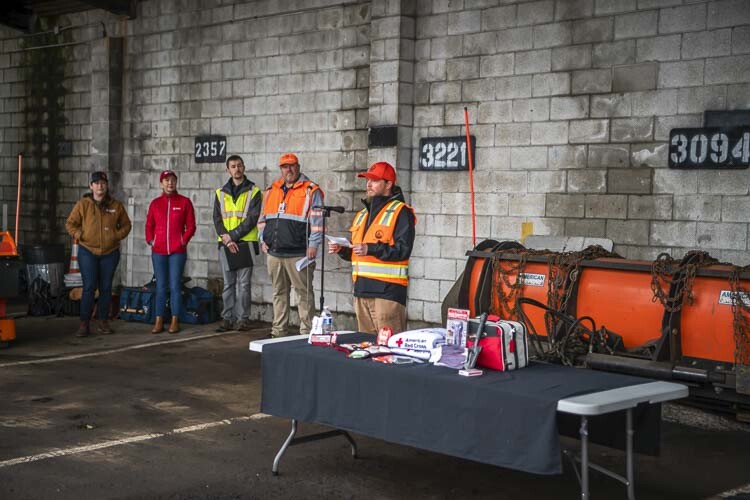
The agencies collectively asked that drivers take steps to prepare before traveling
VANCOUVER – At an event Thursday (Dec. 7), representatives from Washington State Department of Transportation, Clark County, city of Vancouver and C-TRAN outlined their role in helping travelers move more safely during various winter weather conditions and reinforced what travelers should do before they hit the road this winter. The agencies collectively asked that drivers take steps to prepare before traveling, with the American Red Cross explaining what a fully stocked emergency kit for a car should include.
“The city of Vancouver is prepared for the different types of weather that can come at us during the winter months,” said Ryan Lopossa, city of Vancouver Transportation Division manager. “However, if you are able to stay home during a severe winter weather event, please do. When you stay home, you help us keep routes clear for emergency vehicles. If you must travel, make sure you and your vehicle too are ready for winter weather.”
“WSDOT crews are ready to serve Southwest Washington and ask that travelers do their part to prepare for winter weather,” said Trisha Cummins, WSDOT Highway Maintenance Supervisor. “If you see our snow plows and trucks at work, remember to be patient and give them space. Safety of the crews and of the traveling public is our top priority.”
“We join with our partners in asking residents to stay off roads during inclement weather, when possible,” said Josh Lipscomb, Clark County Road Maintenance and Operations manager. “Keeping the roads clear helps us more quickly and efficiently treat the roads and make them safer for everyone. Please know that we work around the clock during severe weather to keep our roads as safe as possible.”

“No matter what the weather brings, C-TRAN will be running,” said Eric Florip, C-TRAN manager of Communications and Marketing. “We’ll be running for the thousands of Clark County residents that use transit every day. If you’re not a regular transit user but are not comfortable driving in snow and ice, we’re here if you need us. C-TRAN has more than 100 buses in our fixed-route fleet. Almost all of them are equipped with drop-down chains, which deploy automatically with the push of a button. We also have regular cable chains for more significant snow events, and as a backup if needed.”
“When driving in winter conditions, make sure you check your vehicle emergency supply kit before you go,” said Dawn Johnson, Regional Communications Manager, Red Cross Cascades Region. “Make sure you bring enough supplies for each person. Let someone know your destination and plan your travel during daylight hours, if possible.”
As part of the event, agencies also showcased a variety of snow and deicing equipment. Footage from the event is available. Click here to download.
Information provided by the city of Vancouver.
Also read:
- Opinion: Half the road, full stop – Understanding pedestrian right-of-way
 Doug Dahl explains how Washington’s law requires drivers to stop when a pedestrian is within one lane of their half of the road, not just when directly in front.
 - Opinion: What is the cost of a bridge?
 John Ley argues the I-5 Bridge replacement’s soaring cost stems from costly extras like light rail, noting other states deliver larger, toll-free bridges for much less.
 - Letter: Vancouver Mayor Anne McEnerny-Ogle makes several serious and incorrect engineering statements
 Bob Ortblad critiques engineering claims by Vancouver Mayor Anne McEnerny-Ogle, highlighting cost and safety advantages of an immersed tunnel for the I-5 crossing.
 - Washington’s studded tire deadline is March 31
 Drivers must remove studded tires by March 31 or face a $137 fine, with WSDOT urging early action due to busy service centers and no planned deadline extension.
 - VIDEO: WA diesel hits record $6.53, crushing truckers and school budgets
 With diesel nearing $6.53 per gallon in Washington, trucking businesses and school districts now confront sharply higher fuel expenses affecting budgets and workers.
