



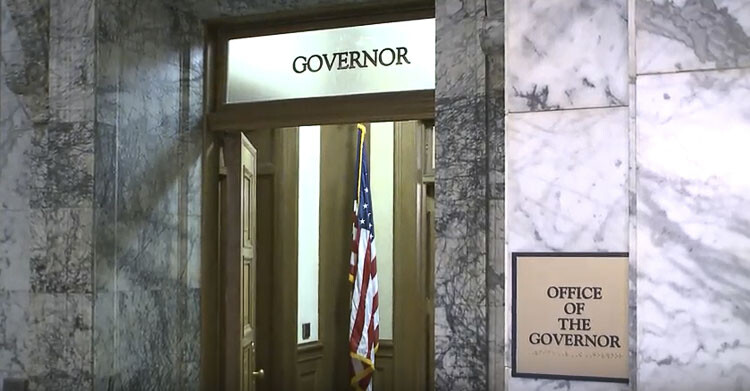
Lawmakers hope the Legislature is ready to make the crucial changes needed to avoid another governor-imposed state of emergency
Rep. Chris Corry has launched a new effort to rein in the governor’s emergency powers. House Bill 1535 is co-sponsored by Rep. Peter Abbarno, R-Centralia and is identical to House Bill 1772, Corry’s bi-partisan bill from the 2022 legislative session.
The governor finally ended the state of emergency (SOE) he declared in response to the COVID-19 pandemic on Halloween. The end of the SOE came after more than two and a half years that saw dozens of emergency proclamations with virtually no input from the public and, under current law, it could happen again.
Corry and Abbarno hope the Legislature is ready to make the crucial changes needed to avoid that.
“This bill brings back representative government to Washington state and the oversight required by our state constitution. The Legislature and the people it represents must be allowed to resume its proper role during a prolonged state of emergency. It is vital this proposal gets a hearing and is passed by the Legislature this session,” said Corry, R-Yakima.
“No one person should wield vast powers without checks and balances or a clear expiration date, even during an emergency,” said Rep. Abbarno.”Living under an emergency declaration for nearly three years exposed a serious loophole in our laws governing emergency powers, and it’s incumbent on the Legislature, as the law-making body, to fix it.”
Washington is one of only four states that hands over unilateral authority to the governor to declare and maintain a state of emergency (SOE). During a prolonged SOE, such as the COVID-19 pandemic, the legislative branch, which represents the voice of the people, has an extremely limited role in determining the policies set forth by the executive branch in Washington state.
Corry and Abbarno say it’s time to change that.
“There must be limits. The framers of our state constitution never intended for the governor to wield the kind of power he maintained for nearly three years. Clearly, when quick action is needed, the executive branch must be able to respond. But when a state of emergency lasts for months or even years, it’s difficult to justify prolonged unilateral – nearly autocratic – authority by the executive branch,” said Corry. “The public must have a voice in how to move forward. That’s the job of the Legislature.”
“The people of Washington are best served when communities from every corner of our state have a voice at the table,” said Rep. Abbarno. “That’s why it’s so important for the Legislature to act now. Let’s come together as Washingtonians, regardless of party, and ensure that future generations have the right balance between the executive’s ability to deal with emergencies and proper oversight from the branch closest to the people.”
Republicans understand the need for leadership in the face of emergencies from the executive branch. With that in mind, House Bill 1535 focuses on emergencies that last longer than 60 days to ensure the public – and the lawmakers that represent them – have a voice.
House Bill 1535 seeks to make the following emergency powers reforms:
- Allows the Legislature to pass a concurrent resolution declaring the termination of a SOE;
- During a SOE, the governor or Legislature may call a special session, consistent with the state constitution’s guidelines, to vote on a concurrent resolution to extend a SOE;
- If the Legislature is not in session, the SOE may also be terminated in writing by unanimous agreement of all four leaders in the House and Senate;
- Sixty days after being signed by the governor, unless extended by the Legislature by a concurrent resolution, the SOE will be terminated;
- Prohibits the governor from reinstating the same or substantially similar SOE when the original has expired;
- When needed, multiple extensions of an SOE may be issued by the Legislature; or, when the Legislature is not in session, by unanimous agreement of all four leaders of the House and Senate;
- Requires clarification of changes to law made through an executive proclamation; all such changes must be defined and shown fully in the law, along with any changes made over time; and
- Changes any violation of the statute from a gross misdemeanor to a civil infraction of up to $1,000 dollars.
During the past two legislative sessions, Republicans offered a half dozen emergency powers reform bills, but most never got a hearing let alone moved out of committee, with the exception of Rep. Corry’s House Bill 1772. Corry had hoped to improve on a Senate Democratic version of emergency powers reform last year by offering a floor amendment requiring the legislature to modify, end, or extend a state of emergency after 60 days. But Democrats pulled the bill after 30 minutes of discussion.
Information provided by Washington State House Republicans, houserepublicans.wa.gov
Also read:
- Opinion: Lawsuit filed against the unconstitutional income tax in Washington state
 Former Attorney General Rob McKenna and Supreme Court Justice Phil Talmadge challenge the 9.9% income tax in Klickitat Superior Court.
 - Vancouver Police investigate domestic violence homicide
 Vancouver Police Major Crimes Unit investigating after woman found dead with knife wounds on NE Oakbrook Circle.
 - Letter: ‘Oregon and Washington aren’t refusing to clean their rolls — they’re contesting federal jurisdiction and timing’
 Camas resident challenges Lars Larson’s fraud claims, explaining legal disputes over federal jurisdiction.
 - County Council to hold hearing on preferred land use alternative for comprehensive plan update
 Clark County Council will select preferred land use alternative from three options studied in environmental review.
 - Opinion: ‘When are we going to get the full and complete details of the Interstate Bridge Replacement Program’s I-5 Bridge replacement project?’
 IBR team buried key details about light rail ending at waterfront with massive elevator system required.
 - POLL: Do you support extending light rail beyond the waterfront to connect with C-TRAN at Library Square?
 Readers can weigh in on Anne McEnerny-Ogle’s proposal to extend light rail beyond the waterfront to Library Square for improved C-TRAN connections.
 - Opinion: Passing a cyclist – Law, myth and a little patience
 Most drivers can’t legally pass cyclists in-lane due to vehicle width versus road measurements.
 wpDiscuz
