



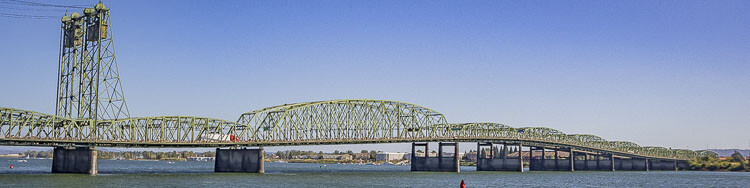
The episode is a dramatized live radio news report based on historical documents and other resources regarding the lift span of the bridge
VANCOUVER – Re-Imagined Radio will pay tribute to the 106-year-old Interstate Bridge in February with an episode titled “A Mighty Span.” The episode premieres Feb. 20 at 1 p.m. on KXRW-FM, Vancouver, and KXRY-FM, Portland. Subsequent broadcasts and streams will be provided by local, regional and international broadcast partners.
The bridge — the first to connect Portland, Ore., and Vancouver, Wash., across the Columbia River — opened on Feb. 14, 1917. The episode is a dramatized live radio news report based on historical documents and other resources regarding the lift span of the bridge. Through speeches and other sounds, listeners will be able to put themselves at the bridge the day of its opening and experience some of its spectacle and pride.
The episode was written by John Barber, faculty member of the Washington State University Vancouver Creative Media and Digital Culture Program and founder of Re-Imagined Radio. “Because radio technology did not exist here at the time, the radio broadcast regarding the opening of the bridge is constructed from other historical artifacts,” Barber said. To provide context, this episode explores early examples of radio news programs, including two of renown that produced dramatizations of historical news events: “The March of Time” and “You Are There.”
Re-imagined Radio premieres episodes on the third Monday of the month on KXRW-FM. In addition, every Sunday, an episode of Re-Imagined Radio is broadcast on KXRW, drawing from previously broadcast episodes. Episodes can be streamed on demand from the Re-Imagined Radio website, www.reimaginedradio.net.
Community partners
Re-Imagined Radio draws on community voice actors, Foley artists, musicians, sound artists and engineers. Partners include KXRW-FM, KXRY-FM, Marc Rose and Holly Slocum Design
About Re-Imagined Radio
Re-Imagined Radio was begun by Barber in 2013 to celebrate radio storytelling. “We select, produce and perform classic and contemporary stories across a spectrum of radio genres, from dramas to comedies, from oral to aural histories, from documentaries to fictions, from soundscapes to sonic journeys, from radio to sound art,” Barber said.
About WSU Vancouver
WSU Vancouver is in the homeland of Chinookan and Taidnapam peoples and the Cowlitz Indian Tribe. As one of six campuses of the WSU system, WSU Vancouver offers big-school resources in a small-school environment. The university provides affordable, high-quality baccalaureate- and graduate-level education to benefit the people and communities it serves. As the only four-year research university in Southwest Washington, WSU Vancouver helps drive economic growth through relationships with local businesses and industries, schools and nonprofit organizations.
Information provided by WSU Vancouver Communications.
Also read:
- POLL: Do you support extending light rail beyond the waterfront to connect with C-TRAN at Library Square?
 Readers can weigh in on Anne McEnerny-Ogle’s proposal to extend light rail beyond the waterfront to Library Square for improved C-TRAN connections.
 - Opinion: Passing a cyclist – Law, myth and a little patience
 Most drivers can’t legally pass cyclists in-lane due to vehicle width versus road measurements.
 - Vancouver mayor counters IBR’s proposal for the only light rail stop to be at the waterfront
 Vancouver’s mayor wants light rail extended beyond the waterfront to connect with C-TRAN buses at Library Square.
 - Letter: ‘This is the worst thing that ever happened to the region’
 A Hayden Island resident Sam Churchill is criticized in a letter calling the $14 billion Interstate Bridge Replacement project a “boondoggle” that destroys local businesses.
 - Opinion: Half the road, full stop – Understanding pedestrian right-of-way
 Doug Dahl explains how Washington’s law requires drivers to stop when a pedestrian is within one lane of their half of the road, not just when directly in front.
