


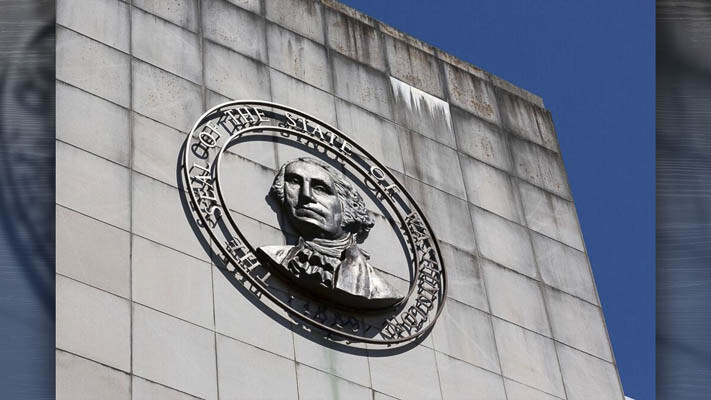
At the top of the list of priorities related to public safety is giving cities and counties more money to hire more police officers
Brett Davis
The Center Square Washington
Republican legislative leadership plans to focus on issues of public safety and affordability during the upcoming session that starts on Monday.
“These are the things they’re [constituents] focused on, and they’re not particularly political or partisan items,” Senate Republican Leader John Braun of Centralia told The Center Square during a virtual conversation in December. “They’re things that just affect normal people in the course of living their lives here in Washington.”
House Republican Leader Drew Stokesbary of Auburn echoed those comments.
“All of us want to go down to Olympia, sacrifice time away from our friends and family and communities, because we want to make the state a better place to live and work and grow a family,” he said. “And we wouldn’t be interested in doing the job if we didn’t think the state had a lot of potential.”
At the top of the list of priorities related to public safety is giving cities and counties more money to hire more police officers, according to Braun.
Stokesbary said Washington needs to get back to the “middle of the pack” in terms of the number of law enforcement officers in the state.
According to the nonprofit data and demographics organization World Population Review, Washington has about 8,960 police officers, which translates into one of the fewest numbers of police officers per capita of any state in the nation: approximately 313 police officers for every 100,000 people.
“It’s also going to take some money,” Stokesbary said of efforts to get more police on the street, including filling currently unfilled positions and then adding more police officers. “The best estimates right now are about a billion dollars a year to pay for enough officers to get from where we’re at now to the middle of the pack.”
Police officer staffing crises have become common not just in Washington, but across the nation, as the law enforcement profession has been demonized in some political circles, resulting in mass retirements and a drop in recruitment.
“But [the] first step is to essentially rebuild the attractiveness of the profession,” Stokesbary observed.
Braun said other public safety legislative priorities for Republicans during the upcoming session include creating a Bureau of Narcotics in the Washington State Patrol to combat fentanyl manufacturing and distribution, and giving cities the tools needed to clean up homeless encampments near parks, playgrounds, child care centers and schools.
In terms of affordability, gas prices and housing are major issues Republicans plan to address.
“Gas is on top of people’s minds right now because of the Climate Commitment Act,” Stokesbary said.
The CCA, which went into effect at the beginning of 2023, directs the Department of Ecology to develop and implement a statewide cap-and-trade program to cut carbon pollution. The cap-and-trade program’s carbon auctions have raised approximately $2 billion so far.
Critics argue the carbon tax has also raised gas prices. According to some estimates, the carbon tax has added about 50 cents to the cost of a gallon of gas in the Evergreen State.
But Gov. Jay Inslee and the Department of Ecology have argued that the cap-and-trade program has had only minimal effect on the price at the pump.
Republicans, Braun said, would like to “ameliorate” the increasing price of gas due to the CCA. Short of repealing the law, the senator said Republicans would like to give some $1 billion of money from the carbon auctions back to the public in the form of rebate checks.
Rep. April Connors, R-Kennewick, and Rep. Mary Dye, R-Pomeroy, have introduced House Bill 2040, also known as the Carbon Auction Rebate, to do just that.
On the housing front, Braun said the housing supply needs to increase to lower costs.
That means, Stokesbary said, that “we have to make more land available for development.”
How that’s done, the representative said, is very important.
“We have to, in a thoughtful and environmentally friendly way, create more buildable land, if we want to have a chance of closing the gap – having enough housing that market rates drive the costs and make it affordable for everybody,” Stokesbary explained.
The 60-day legislative session begins on Jan. 8.
This report was first published by The Center Square Washington.
Also read:
- Opinion: Fatal flaws of Socialism – The knowledge problem
 Cargill argues no government, committee, or computer can possess the dispersed knowledge that markets coordinate through prices.
 - Battle Ground Public Schools seeks citizen advisory committee members
 Battle Ground Public Schools invites parents and residents to join its Citizens Advisory Committee, with open meetings Sept. 10 and Oct. 8.
 - Ridgefield Main Street unveils new Greely Building photo panels
 Large-scale photo panels on the Greely Building showcase Ridgefield’s wildlife refuge, Chinookan Plankhouse, and dragon boat traditions.
 - Vancouver Police investigate fatal collision
 A 74-year-old man in a motorized wheelchair died after a pickup truck struck him in a Vancouver intersection Wednesday evening.
 - Opinion: ‘It may be time for McCleary 2.0’
 Dick Rylander examines the Battle Ground School District’s proposed $116,830,000 three-year EP&O levy heading to the November 2026 ballot.
 - Washington Policy Center tax expert warns that new income tax will affect everyone
 Ryan Frost argues Washington’s new 9.9% income tax has a $1M deduction that a simple legislative majority could remove.
 - Opinion: Were Republican voters just sleeping during the August primary election?
 CCRP Chairman Matt Bumala says 60% of primary no-shows in the 17th and 18th districts were Republicans.