



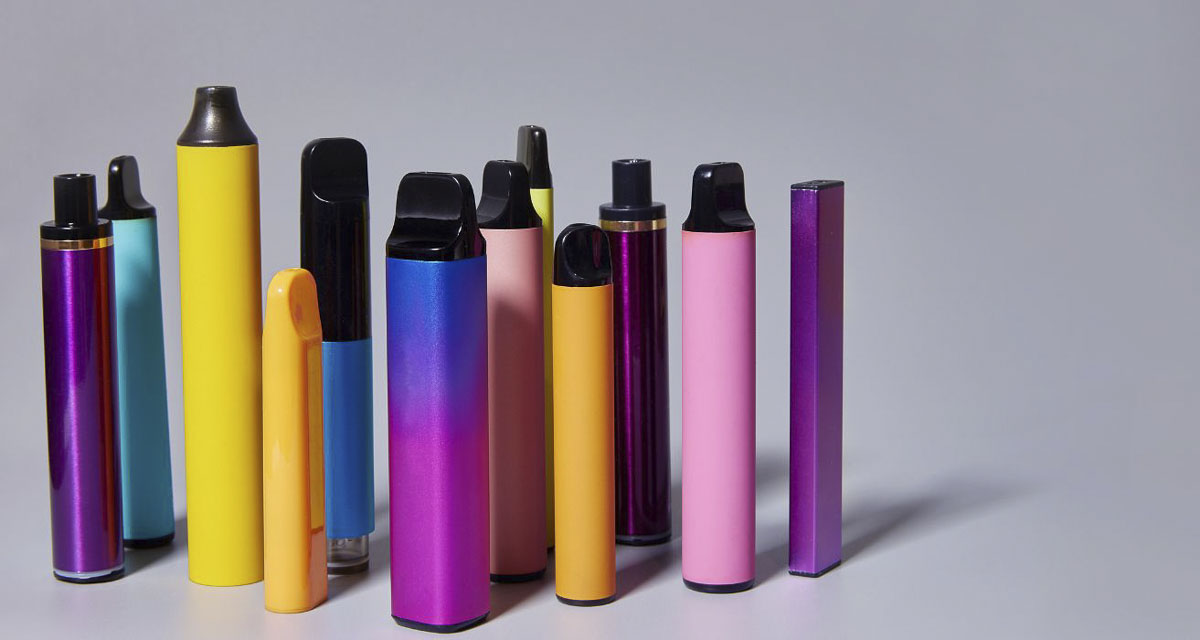
Vaping devices often contain batteries and hazardous substances that should never be thrown in garbage or recycling carts
VANCOUVER – Millions of vaping devices and cartridges are sold in the US each month, and a growing number of vapes are designed to be disposable, single-use devices. In one month, more than 13 million disposable devices are sold in the US. With the rise in popularity of disposable vapes comes a rise in electronic and hazardous wastes.
Vaping devices often contain batteries and hazardous substances that should never be thrown in garbage or recycling carts. Batteries disposed of in household garbage or recycling carts can ignite, posing significant fire risks during transportation and at transfer stations. And the liquid nicotine in vapes is highly toxic and can cause serious harm if ingested or absorbed through the skin.
Clark County Public Health’s Solid Waste Education and Outreach team is committed to ensuring the proper disposal of nicotine vapes and offers the following guidance for Clark County residents to dispose of the devices, batteries and cartridges for free:
Whole device, including cartridges (with or without liquid) and batteries
- Household hazardous waste disposal sites at three Clark County transfer stations. Limited to 1 gallon of vape products per visit.
Device battery
- Retail drop-off locations for battery recycling.
- Household hazardous waste disposal sites at Clark County transfer stations.
Empty liquid cartridges, tanks, bottles or vials
- Garbage only. Do not put these items in recycling carts.
Device without battery
- Household hazardous waste disposal sites at Clark County transfer stations. Limited to 1 gallon of vape products per visit.
- Drug Enforcement Agency’s National Prescription Drug Take Back events held each year on the last Saturday of April and October.
Vape devices collected for disposal by businesses, schools, government agencies and nonprofit organizations must be managed as business dangerous waste and are not accepted at the residential drop-off locations listed above. Learn more about business dangerous waste on the Public Health website.
Vape devices containing cannabis can only be disposed of by sites authorized to handle controlled substances, such as pharmacies and police departments, and are not accepted at residential drop-off locations.
For more information about disposal options for vapes and other battery-containing items, download the RecycleRight app or go to www.recyclingdoneright.com.
Nicotine is highly addictive and has known negative health effects. For help quitting vaping, call the Washington State Quitline at 1.800.QUIT.NOW or visit www.quitline.com, or download the 2Morrow Health app.
Information provided by Clark Co. WA Communications.
Also read:
- Vancouver Police investigate shooting
 Vancouver Police seek suspect after 20-year-old shot in SE Mill Plain parking lot early Saturday morning.
 - Dollars flowing into a pair of hotly contested WA congressional races
 Amanda McKinney leads 4th District GOP field with $523,892 raised, while Braun trails significantly behind incumbent.
 - Final Supplemental Environmental Impact Statement published for Interstate Bridge Replacement Program
 Federal agencies published the final environmental impact statement for the Interstate Bridge replacement project.
 - Belkot appeals judge’s decision to dismiss her case against Clark County
 Belkot’s attorney says the federal appeals court will hear the case in several months after judge dismissed all five claims.
 - Union baseball, softball teams honor military, veterans, and first responders
 Baseball and softball teams combined efforts to recognize military heroes and first responders with ceremonial pitches.
 - Union baseball, softball teams honor military, veterans, and first responders
 Baseball and softball teams combined efforts to recognize military heroes and first responders with ceremonial pitches.
 - Speed cameras designed to bring added safety to work zones
 WSP issued 65,000 infractions in first year, with 59,000 being penalty-free first offenses as program expands statewide.
