


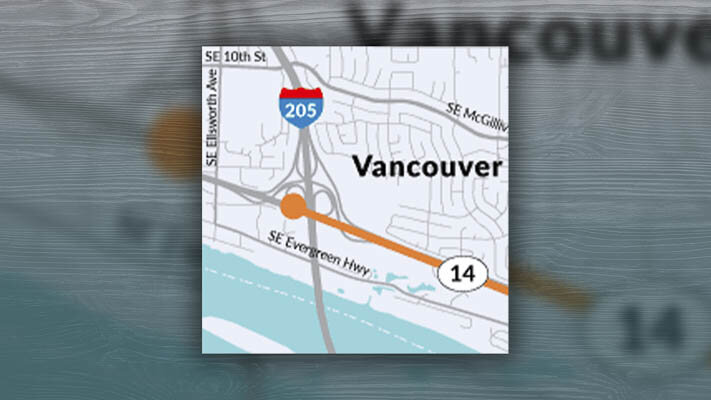
Congestion-reducing queue warning system and the 164th Street ramp meter will remain operational to improve safety
VANCOUVER – Winter is coming, and the State Route 14 auxiliary lane project will be taking a pause – but road construction work on SR 14 in Clark County between Southeast 164th Avenue and Interstate 205 will be back in action next spring.
Travelers might see crews working during the break in action but should not encounter any traffic changes in the work zone. They will also continue to see the traffic back-up warning system and ramp meters aiding in maintaining a smooth flow of traffic during the pause in construction.
When construction resumes, Washington State Department of Transportation’s contractor, Rotschy, Inc., will pave the way for a smoother ride thanks to a project that aims to improve travel times and trip reliability in east Vancouver. Once finished, crews will have expanded the roadway width so three travel lanes extend continuously along the full length of SR 14 in both directions between Southeast 164th Avenue and Interstate 205. This stretch of SR 14 often experiences congestion during peak commute times due to higher traffic volumes and frequent lane changes and merges near the interchange.
In addition to the new three-lane configuration, this project will introduce a peak-use shoulder lane on westbound SR 14. This lane will allow travelers heading to northbound I-205 to use the right shoulder during heavy traffic, creating an extra lane of travel (i.e., three lanes will become four).
Safety enhancements
Construction for the SR 14 – I-205 to SE 164th Avenue Auxiliary Lanes project kicked off in fall 2022, and with it came an increase in crashes in the work zone due to congestion, disabled vehicles, numerous lane changes and speeding. In response, WSDOT crews implemented new safety measures including a system that warns drivers about potential slowdowns along with ramp meters that help reduce collisions and increase safety during the remainder of construction, which is expected to last until summer 2024.
In August, crews implemented an innovative, temporary traffic back-up warning system just east of the work zone, changing the way drivers are alerted about potential slowdowns ahead. By utilizing electronic roadside message signs, this “smart” system ensures drivers are promptly informed about any stopped or slow traffic ahead, giving them ample time to adjust their speed as they approach the work zone.
Additionally, crews activated a new ramp meter at the 164th Street on-ramp to westbound SR 14 earlier than scheduled to alleviate congestion and enhance safety during construction. Implementing stop-and-go traffic signals controls the frequency of vehicles entering the freeway, resulting in a 30-percent reduction in collisions. Through the rest of construction, the system will meter two lanes. Upon the project’s completion in 2024, the final ramp meter configuration will manage three lanes of traffic. It will use a sophisticated system that detects and adjusts ramp timing based on traffic flow and queue length, improving efficiency.
In early fall of this year, the contractor used a break in the weather to accelerate final paving of the west end of the widening work. This added an extra lane for I-205 northbound to help relieve congestion.
Work zone safety outcomes
Adding these safety tools in the work zone, collisions have significantly decreased. Crews successfully installed the temporary back-up warning system Tuesday, Aug. 15. From that date until Tuesday, Oct. 24, there were eight collisions and one disabled vehicle in the work zone. By contrast, there were 18 collisions and seven disabled vehicles in the work zone between Friday, June 9, and Tuesday, Aug. 15.
“We’re happy to see a significant decrease to the number of collisions occurring in the work zone,” said WSDOT Project Engineer Susan Fell. “We want to give a ‘thank you!’ to drivers for doing their part to help reduce collisions and encourage them to continue driving slowly in the work zone, change lanes only as needed, and pay attention to work zone messaging.”
What’s next
Contractor crews have completed a 470-panel noise wall to reduce freeway sounds in nearby neighborhoods. The concrete surfaces are currently being finished and painted. Crews will wrap up this work by backfilling near the walls. Before the project pause, crews will install a new median barrier north of the existing median barrier, which will be removed. The new barrier will delineate space so that three continuous lanes of travel can be created in both directions.
Coming in spring 2024 alongside the final paving work, crews will install guardrails and add the finishing touches with final striping and permanent signing. To make the journey even smoother, WSDOT will activate overhead lane displays that will let travelers know when the part-time shoulder lane is open for traffic.
For traffic and project notifications, sign up to receive email/text updates. Check road conditions before traveling by visiting the WSDOT real-time travel map and get information by uploading the free WSDOT mobile app.
Also read:
- Opinion: Portland’s War on Cars Part 4 – A smarter automobile strategy to end gridlock
 O’Toole argues fuel wasted in Portland-area congestion has sextupled since 1982, generating 250,000 tons of extra greenhouse gases annually.
 - Opinion: Transit ridership trends are dismal but regional plans are oblivious
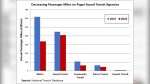 Puget Sound transit passenger-miles fell 31% from 2015 to 2024 despite a half-million-resident population increase.
 - Interstate Bridge Replacement Program seeks qualified firms for bridge replacement contract
 The CRBR project is backed by $5.7 billion from state funds, federal grants, and future tolling.
 - Opinion: Bankrupt – A $3.5 billion Rose Quarter Freeway widening project
 Joe Cortright argues ODOT’s Rose Quarter project has grown from a $450M approval to a $3.5B estimate, with a $2B funding gap.
 - Opinion: Portland’s War on Cars 3 – Ending the war on automobiles
 O’Toole argues Portland should add toll lanes, fix safety hazards, and redesign TriMet routes to end its anti-auto policies.