


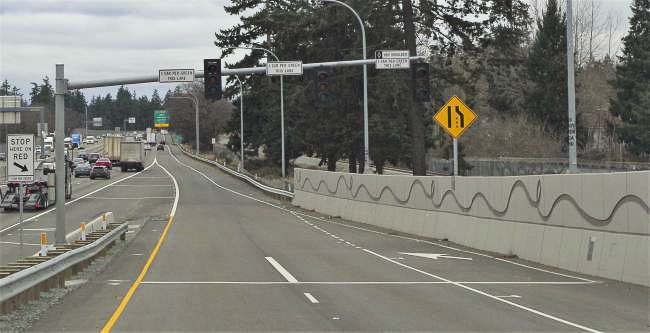
Ramp meters activating along southbound I-205 and northbound I-5 at Fourth Plain Boulevard to ease congestion
VANCOUVER – Interstate 205 and I-5 travelers in southwest Washington will now experience improved travel times and reduced congestion during their commute.
Washington State Department of Transportation’s contractor, Northeast Electric, LLC., installed new ramp meters at multiple I-205 and I-5 on-ramps in Clark County. The ramp meters will be activated individually beginning Tuesday, Aug. 13, and continuing throughout the remainder of the month.
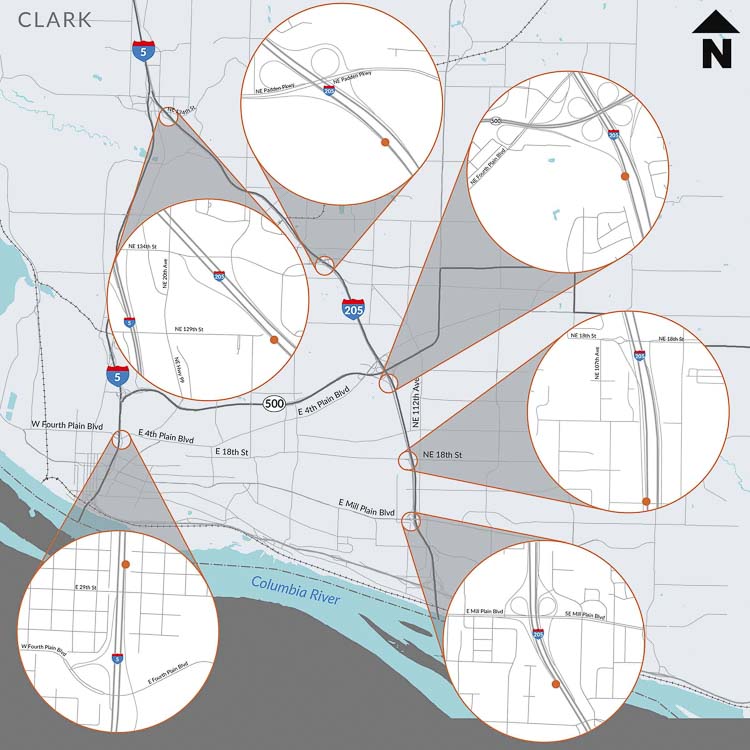
Northbound I-5 ramp meter location
- Fourth Plain Boulevard on-ramp
Southbound I-205 ramp meter locations
- Northeast 134th Street on-ramp
- Northeast Padden Parkway on-ramps
- Northeast Fourth Plain Boulevard and State Route 500 on-ramps
- Northeast 18th Street on-ramp
- East Mill Plain Boulevard on-ramps
“We’re excited to turn on these meters and watch traffic flow more efficiently,” said Project Engineer Mike Briggs. “The new meters will help shorten everyone’s commute time, especially for those traveling between Vancouver and Portland.”
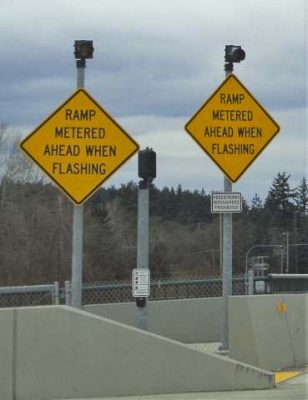
How ramp meters work
Ramp meters are traffic signals that operate according to real-time conditions on the highways and ramps. The traffic signals provide consistent gaps in on-ramp traffic, preventing multiple vehicles from entering the highway at the same time. More efficient merging allows drivers to continue traveling smoothly and keeps traffic flowing at highway speeds. Ramp meters also reduce the potential for collisions by 30%.
How to use ramp meters
Drive the vehicle up to the white stop line to trigger the ramp meter. If the light is red, stop at the white line. When the light turns green, accelerate and merge onto the highway. Most ramp meters allow only one vehicle to proceed with each green light, creating a 4- to 15-second delay between cars entering the highway.
Ramp meter data
According to the Southwest Regional Transportation Council’s 2022 Congestion Management Process Summary Report, the peak travel time on southbound I-5 from Main Street, milepost 3, to Jantzen Beach in Oregon was reduced by 11 minutes, following the activation of ramp meters.
On-ramp delays
While ramp metering benefits drivers already on the highway, it can produce delays for drivers merging onto the highway. Unlike other states, ramp meters in Washington are not set to run during a scheduled time of day. Rather, WSDOT ramp meters adapt and operate based on real-time traffic conditions on the freeway. Additionally, WSDOT traffic crews will fine-tune ramp meter operations and closely monitor traffic at each ramp following activation.
WSDOT’s goal is to balance the needs of drivers merging onto the highway with the needs of drivers already there.
Also read:
- Save Vancouver Streets will make its argument before Washington State Court of Appeals
 Save Vancouver Streets will argue before the WA Court of Appeals on Sept. 11 after collecting 6,500 signatures.
 - Opinion: Portland’s War on Cars Part 4 – A smarter automobile strategy to end gridlock
 O’Toole argues fuel wasted in Portland-area congestion has sextupled since 1982, generating 250,000 tons of extra greenhouse gases annually.
 - Opinion: Transit ridership trends are dismal but regional plans are oblivious
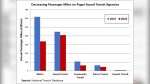 Puget Sound transit passenger-miles fell 31% from 2015 to 2024 despite a half-million-resident population increase.
 - Interstate Bridge Replacement Program seeks qualified firms for bridge replacement contract
 The CRBR project is backed by $5.7 billion from state funds, federal grants, and future tolling.
 - Opinion: Bankrupt – A $3.5 billion Rose Quarter Freeway widening project
 Joe Cortright argues ODOT’s Rose Quarter project has grown from a $450M approval to a $3.5B estimate, with a $2B funding gap.