



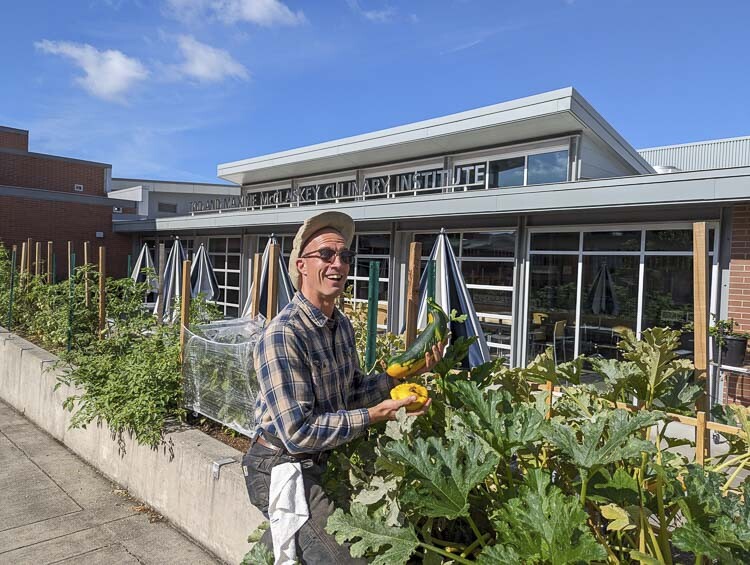
Both cuisine and baking programs use homegrown produce in their recipes
VANCOUVER — The kitchen garden that wraps around three sides of the Tod and Maxine McClaskey Culinary Institute at Clark College is reaping a bountiful, colorful harvest for students to use in their recipes.
Students and instructors from both the Cuisine Management program and the Professional Baking and Pastry Arts program have been harvesting herbs, vegetables and fruit throughout the summer. This is the second year the garden has produced an abundant harvest.
“The tomatoes are really coming in and the squashes are still producing,” said Chef James “Sonny” Demartini, a cuisine instructor who spearheaded the kitchen garden project with Fay Shorten, a stockroom attendant in the college’s food services department.
Clark College renovated its culinary space in 2017, thanks to a grant from the Tod and Maxine McClaskey Foundation. The blueprints included plans for culinary gardens around all three sides of the building, but there was no funding for a garden.
Demartini and Shorten did not let the lack of funding become a barrier to creating a kitchen garden for their students. They cleared otherwise unused space outside the building and created gardens including fruit trees, berries, herbs and vegetables.
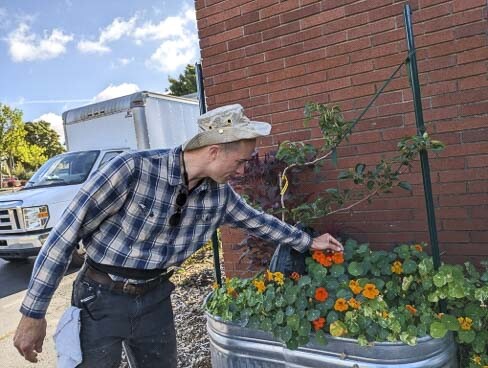
Demartini is a Midwesterner who grew up immersed in gardening. He rolled up his sleeves and got to work. Sweat equity from Demartini, Shorten and many others laid the groundwork. Demartini made a list of everything they would need to get started.
The first step was recruiting a team of volunteers to get to work amending the soil, including adding nutrient-rich composted produce from the college’s kitchens. The culinary programs save all organic food scraps—from carrot tops to eggshells. Demartini feeds the scraps into a blue Landworks industrial wood chipper he converted into a food waste mulcher. Rather than waiting for many weeks for the food to become compost, it chops food waste into rich, organic matter that immediately can be worked into the garden soil.
Demartini credits the college’s hard-working grounds crew that has provided much labor, including revamping an irrigation system. Demartini and Shorten found ways to get products at no cost. This includes getting deliveries of bark chips from pear trees removed from Washington State School for the Blind. Demartini also pointed to a stack of pear logs that students will use to cure and smoke meats.
Not everything was free. About $8,000 in grant money was used to purchase some items, including the chipper and galvanized stock tanks they have repurposed as raised beds. Although some plants and seeds were donated, they also purchased others.
- Concrete planters along the north entrance to Gaiser Hall — and just steps from the McClaskey Institute — are bursting with tomatoes, squash, peppers and an assortment of fragrant herbs, including sage, mint, rosemary, sorrel, lovage, parsley and chives.
- Red grapes hang from the vines.
- Hops grow high above the roof.
- Thriving fruit trees include five different types of espalier apple and pear trees plus plum, quince and fig trees
- A dozen varieties of sunflowers, which have edible petals and seeds. These were harvested earlier this month.
- Nasturtiums provide edible petals, a pretty garnish and an infusion in oils and vinegars.
- An assortment of edible wildflowers also attracts pollinators to the garden.
The Tod and Maxine McClaskey Culinary Institute at Clark College is the only public, accredited culinary program in the metro region that offers a two-year associate in applied technology degree. Clark’s program offers competitive programs, a seasoned team of instructors with real-world experience, a state-of-the-art culinary facility and collaborative industry partnerships. Classes begin September 25. Learn more about Cuisine Management at Clark College here.
About Clark College
Founded in 1933 and celebrating its 90th year, Clark College provides residents of Southwest Washington with affordable, high-quality academic and technical education. It is a public community college offering more than 100 degree and certificate programs, including bachelor’s and associate degrees; professional certificates; high school diplomas and GED preparation; and non-credit community and continuing education. Clark serves a wide range of students including high school students, displaced workers, veterans, parents, non-native English speakers, and mature learners. Approximately three-quarters of its students are in the first generation of their families to attend college.
Also read:
- VIDEO: WA diesel hits record $6.53, crushing truckers and school budgets
 With diesel nearing $6.53 per gallon in Washington, trucking businesses and school districts now confront sharply higher fuel expenses affecting budgets and workers.
 - WA’s status solidifies as one of the most expensive places in US
 A new study shows Washington outpaces most states on cost of living, with metrics revealing a sharp rise in daily expenses and major metro areas ranking among the nation’s most expensive.
 - Opinion: Someone explain the Democrat Party to me please
 Lars Larson criticizes Democrat politicians for shutdown threats, Homeland Security funding refusals, and positions on election laws, housing, and gun rights.
 - CCSO to conduct search related to 1971 disappearance of Jamie Grissim
 Clark County Sheriff’s Office is coordinating a targeted search in Dole Valley, aiming to recover the remains of Jamie Rochelle Grissim, missing since 1971.
 - Business Profile: Columbia River volleyball coach teaches The Elite Competitor
 Bre Smedley co-founded The Elite Competitor to help young athletes handle the mental demands of sports by offering support, resources, and ongoing training for players, parents, and coaches.
 - POLL: Do you agree with requiring board members to follow council direction?
 Disagreement among county councilors centers on whether C-TRAN board members should reflect the council’s collective wishes or act independently, highlighting ongoing concerns about public accountability.
 - High-value WA home listings increase by 65% after income tax passage
 After lawmakers approved an income tax targeting millionaires, listings for homes priced at $2 million or more jumped 65 percent compared to last year, with experts urging caution about interpreting the spike.
