



Bill passed in the face of Republican opposition that said it lacks guardrails around toll revenue and will hurt southwest Washingtonians
TJ Martinell
The Center Square Washington
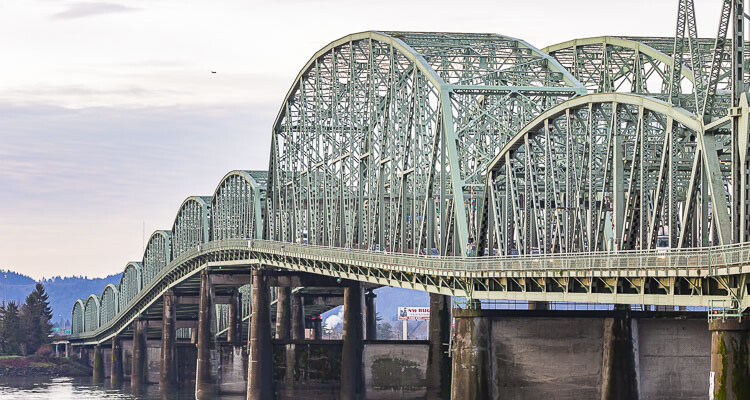
The Washington Legislature passed a bill allowing tolling on the Interstate 5 Bridge spanning the Columbia River between Vancouver and Portland in the face of Republican opposition that said it lacks guardrails around toll revenue and will hurt southwest Washingtonians.
“There is distrust by many people in southwest Washington about how these funds are going to be used,” Rep. Ed Orcutt, R- Kalama, told colleagues on April 18. “I agree we need that bridge. I’ve driven over that bridge, it does need to be replaced. No question about it. But we need to earn the trust of the people in southwest Washington.”
SB 5765 is intended to help the states of Washington and Oregon generate a portion of the revenue necessary to replace the more than century old I-5 Bridge.
Tolling would only be charged on the current bridge and the replacement bridge when it is eventually built. The Washington and Oregon Transportation Commissions would set the toll rates. It would also be illegal to extend Oregon’s tolling system on Interstate 205 into Washington state’s section of that road.
As passed, the bill stipulates that toll expenditures are subject to appropriation by the Legislature and can only be done for specific reasons, such as repaying debt or covering the operating costs of the toll facility.
One failed amendment would have further limited the expenditure of toll funds to covering the facility’s operating costs and repayment of debt, while another unsuccessful amendment would have limited toll collection to the replacement bridges.
Much of the opposition to the bill focused on how the tolling would impact Clark County residents who commute to Oregon and are subject to the state’s income tax. One failed amendment would have exempted Washington residents who pay the Oregon income tax from paying the I-5 toll. Prior to 2020, only seven of Oregon’s 36 counties paid more to the state in income taxes than Clark County.
“They shouldn’t be doubled taxed,” Rep. Greg Cheney, R-Battle Ground, told colleagues on April 18.
Another failed amendment concerned an existing agreement between Clark County Transit, or C-Tran, and Tri-County Metropolitan Transportation District of Oregon, or TriMet, which grants TriMet eminent domain authority in Washington state within C-Tran’s jurisdiction in order to expand its light rail system.
Orcutt said the contract has been perceived by local residents as “an assault on property rights. That’s not good for the people of southwest Washington. It’s a precedent that should have never been set.”
Also in favor of the amendment was Rep. Jim Walsh, R-Aberdeen, who said “Let’s keep the state border clean. It is a matter of local control, and ceding local control to an entity in another state is not good policy.”
Another failed amendment would have required the toll rate be lowered to a level necessary for the bridge’s maintenance and preservation once the bonds to pay for the bridge have been fully paid off.
SB 5765 has been sent to Gov. Jay Inslee for signing.
This report was first published by The Center Square Washington.
Also read:
- Opinion: IBR’s evasive, misleading and dishonest excuses for higher cost
 Joe Cortright argues the Interstate Bridge Replacement Program has withheld detailed cost estimates while offering contradictory explanations for rising costs tied to the I-5 Bridge project.
 - Rep. David Stuebe sponsors bill to strengthen enforcement of auto insurance laws and protect Washington drivers
 Rep. David Stuebe has introduced HB 2308, a bill aimed at strengthening enforcement of Washington’s auto insurance laws and increasing accountability for repeat uninsured drivers.
 - Letter: Interstate Bridge Replacement’s Park & Ride insanity
 Bob Ortblad criticizes the Interstate Bridge Replacement Program’s proposed Park & Ride garages, arguing the costs are excessive and unlikely to receive federal funding.
 - Letter: Interstate Bridge Replacement $13.6 billion estimate is too low!
 Bob Ortblad argues the Interstate Bridge Replacement Program’s $13.6 billion cost estimate understates the true expense, citing comparable projects, construction challenges, and engineering assumptions.
 - Opinion: ‘The drama and the waste of taxpayer money continues’
 Rep. John Ley outlines his objections to the approved fixed-span I-5 Bridge design, citing cost concerns, engineering standards, funding uncertainty, and opposition to light rail and tolls.
 wpDiscuz
