



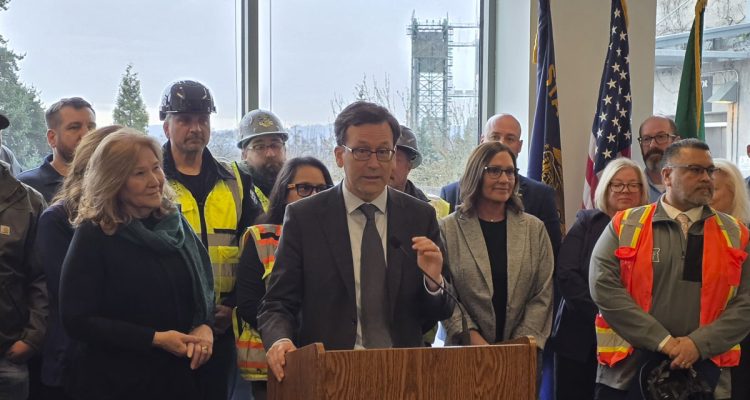
Washington Governor Bob Ferguson was in Vancouver to provide his vision for the Interstate Bridge Replacement Program, saying that a new bridge will be built and it will be built with light rail, and that phase one — replacing the bridge — of the project will cost $7.65 billion
Paul Valencia
Clark County Today
The governor of Washington joined the mayor of Vancouver and the team at the Interstate Bride Replacement Program (IBR) to announce the next steps for the potential new bridge across the Columbia River from downtown Vancouver and into Portland.
There did not appear to be any sense of sticker shock from the many IBR supporters in the room at the press conference on Tuesday in Vancouver. The latest cost estimate? Likely to be $14.4 billion for the entire project.
Governor Bob Ferguson, incidentally, never said that number during the press conference. Instead, he focused on the initial phase of the project — building the bridge — which is estimated to be $7.65 billion
Among his points of emphasis on Tuesday:
A new bridge will be built.
Construction should begin in 2028.
Light rail is happening in Vancouver even if most Clark County residents do not want it.
Of note, the governor did not say the estimated cost for the entire project, not during the press conference anyway.
Just minutes before the press conference, the IBR sent out a press release that detailed the latest cost estimate. The entire project, which includes the bridge and the improvements to the five-mile corridor, would be between $13.5 to $15.2 billion, with a “most likely” cost of $14.4 billion. That number was 12 paragraphs deep into the IBR release.
During the press conference, the governor only talked about the $7.64 billion cost estimate of phase one of the project: replacing the northbound and southbound spans of the bridge, connecting the new bridges to I-5, and extending light rail service to Vancouver.
“The first thing I want to say is we’re going to build this bridge. That’s going to happen. That’s going to happen,” the governor said. “There is just far too much at stake for any other option. Replacing this 109-year-old bridge with a modern structure is essential to Washington and Oregon. It’s critical for our economy, it’s critical for public safety, and it’s critical for the thousands of good paying jobs that come with this project.”
A project of this magnitude, Ferguson added, will have good days and bad days along the way. He noted recent “great news” with the U.S. Coast Guard’s approval of a fixed span for the replacement bridge.
As far as “not so good news,” the governor noted the rising costs.
Even with the price tag, Washington and Oregon are committed to a replacement bridge, he said.
“Construction will start in 2028,” Ferguson said. “I’m going to be personally doing everything I can to ensure that this happens.”
Vancouver Mayor Anne McEnerny-Ogle and TriMet CEO Sam Desue Jr. praised the light rail portion of the project.
The mayor said she is looking forward to the extension of Oregon’s TriMet coming into downtown Vancouver, while Desue noted Portland and Vancouver’s long history of connection.
“Together, we are building more than a bridge. We are building a transportation system that connects people, supports economic growth, and strengthens our future,” Desue said.
The governor returned to the podium to take questions. He noted that the mayor, Desue, and others have “persuasively” explained the impact light rail will have for the community.
He added that he is here to say to everybody that “We’re going to build this bridge and get light rail in there. That’s going to happen.”
Clark County Today asked the governor why light rail has to be part of the project when historically Clark County residents have been against light rail.
“I know how important light rail is,” the governor said. “That literal and figurative train has left the station. We’re going forward and we’re going forward with light rail. … Nobody gets everything they want with something of this scope. That’s an essential part of this. It’s in there, so we’re looking forward.
“I want to be clear: … We’re building this damn bridge. That’s happening.”
A replacement bridge has been in the works for decades, including the failed Columbia River Crossing project. Ferguson said it is time to move forward with the current project.
“Delaying a major project has never made costs go down,” the governor said.
He then quoted Republican State Senator Paul Harris of Southwest Washington: “The cheapest bridge you’re going to build is the one you start today.”
The IBR currently has $5.5 billion in available state and federal funding, and the program is pursuing an additional $1 billion through the Federal Transit Administration’s Capital Investment Grant program, according to the IBR release.
Oregon Governor Tina Kotek did not attend Tuesday’s event in Vancouver. She did release a statement through the IBR’s release.
“We need a new bridge, and it’s time to start building it,” Kotek said. “By focusing our available funding on a core set of projects, we can deliver what Oregonians have been waiting on for decades: a modern, earthquake-ready bridge, with no bridge lifts, less traffic congestion, extended light rail, and better options for people walking and biking.”
Ferguson and IBR officials also announced a tentative timeline for what’s next for the project. The program is hoping to get a Record of Decision by the middle of this year and expects to hire a contractor in 2027 to complete design work. The governor said construction should begin in 2028. From there, it is a 6- to 7-year time frame until the new bridge is operational for vehicles.
Also read:
- POLL: Do you support extending light rail beyond the waterfront to connect with C-TRAN at Library Square?
 Readers can weigh in on Anne McEnerny-Ogle’s proposal to extend light rail beyond the waterfront to Library Square for improved C-TRAN connections.
 - Opinion: Passing a cyclist – Law, myth and a little patience
 Most drivers can’t legally pass cyclists in-lane due to vehicle width versus road measurements.
 - Vancouver mayor counters IBR’s proposal for the only light rail stop to be at the waterfront
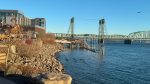 Vancouver’s mayor wants light rail extended beyond the waterfront to connect with C-TRAN buses at Library Square.
 - Letter: ‘This is the worst thing that ever happened to the region’
 A Hayden Island resident Sam Churchill is criticized in a letter calling the $14 billion Interstate Bridge Replacement project a “boondoggle” that destroys local businesses.
 - Opinion: Half the road, full stop – Understanding pedestrian right-of-way
 Doug Dahl explains how Washington’s law requires drivers to stop when a pedestrian is within one lane of their half of the road, not just when directly in front.
 wpDiscuz
