



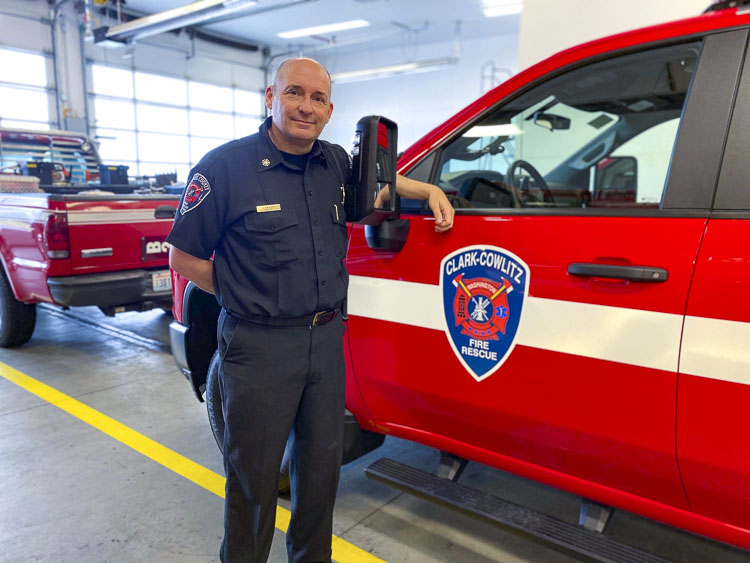
Revenue from the levy will be used to hire 25 new emergency response personnel, placing a paramedic on duty at each staffed CCFR station 24-hours a day, seven days a week
Clark-Cowlitz Fire Rescue (CCFR) is holding three community meetings to provide information on the upcoming Emergency Medical Services (EMS) levy. Revenue from the levy will be used to hire 25 new emergency response personnel, placing a paramedic on duty at each staffed CCFR station 24-hours a day, seven days a week. In addition, CCFR will staff an ambulance to transport critical residents to the hospital when the private ambulance provider is unable to meet response time requirements.
The EMS levy, which will cost the average homeowner $21 per month, will appear on the August 2 primary election ballot.
“The number of emergency calls went up nearly 18 percent from 2020 to 2021 and is up 57 percent since 2016” said Fire Chief John Nohr. “Because we are out on more emergencies, our units are traveling farther to cover all of our emergencies. This has caused our response times to rise by 11 percent in the last two years.”
Fire and EMS agencies rely on fast response times to save a person having a medical emergency or to stop a fire from spreading.
The CCFR response time problem is further aggravated by long response times of the private ambulance provider – American Medical Response (AMR). AMR is the ambulance company that is called to emergency medical incidents to transport patients to the Emergency Room. As part of our safety protocol, CCFR units must wait on scene for ambulances to arrive to ensure safe transitions of care for community members in need of emergency support.
“We are routinely waiting over 20 minutes, and often much longer, for an AMR ambulance to arrive to our emergency incidents,” said Chief Nohr. “This is too long for our residents to wait for transport to the ER when they are having a medical emergency.”
A portion of the EMS levy will be used to staff a CCFR ambulance so that residents in need of transport to the Emergency Room will get on their way sooner, and other CCFR units can get back in service and ready to respond to the next emergency.
“Having our responders back in service more quickly will make them available for other incidents and reduce overall response times,” said Nohr.
The community meetings will take place on Thu., July 7 at 6 p.m. at Fire Station 21 (911 N. 65th Avenue, Ridgefield), on Thu., July 14 at 6 p.m. at Fire Station 26 (21609 NE 72nd Avenue, Battle Ground) and on Thu., July 21 at 6 p.m. at Fire Station 21.
CCFR currently staffs Paramedic personnel on response units just over 50% of the time. All other responders have Emergency Medical Technician (EMT) credentials. Paramedics have advanced emergency medical education, training, and experience compared to EMTs, and they can perform more advanced life saving measures such as starting IV’s, giving life-saving medications, and using advanced airway management devices to support breathing.
If approved by voters, the CCFR Emergency Medical Services (EMS) levy will generate $.50 per $1000 of assessed property value and would cost the owner of a $500,000 home an additional $21 per month or $250 per year. The EMS levy will hire a minimum of 25 additional emergency response personnel and provide for three firefighters on duty on each response unit each day, with at least one of the firefighters also being a Paramedic. A portion of the funds would also go toward purchasing two new ambulances and other EMS response apparatus and equipment, hiring an EMS Training Officer, and providing on-going training to the CCFR EMTs and Paramedics.
Clark-Cowlitz Fire Rescue (CCFR) serves 45,000 people over 125 square miles – including the cities of La Center, Ridgefield, Woodland, the Cowlitz Indian Reservation, and the surrounding unincorporated Clark and Cowlitz county areas. Our combination department includes full-time and volunteer firefighters responding to an average of 5000 fire and emergency medical calls a year. CCFR operates under a balanced budget and has a history of passing independent financial audits by the state.
Also read:
- VIDEO: Rejected – WA SOS will not process referendum to repeal income tax law
 State officials stopped Let’s Go Washington’s referendum to overturn the new tax, citing constitutional limits. Legal and political battles, including a Supreme Court challenge, are expected next.
 - Washington’s studded tire deadline is March 31
 Drivers must remove studded tires by March 31 or face a $137 fine, with WSDOT urging early action due to busy service centers and no planned deadline extension.
 - Community in Action: Police cruisers ‘crammed’ with snacks to benefit local students
 Nearly 8,500 snacks filled police cruisers at Fred Meyer as the community rallied to stock high school pantries and build new relationships.
 - Southwest Washington lawmakers to hold a series of town hall meetings throughout the 17th Legislative District
 Sen. Paul Harris, Rep. Kevin Waters, and Rep. David Stuebe will answer questions and discuss the state’s expanded operating budget and newly passed income tax at five April town halls.
 - Can your wellness routine be harming your teeth?
 Dental enamel can’t regenerate once damaged, but steps like using a straw, rinsing with water, and choosing fluoride toothpaste can help protect your teeth from acidic beverages.
 - Vancouver Police investigate attempted murder
 A 29-year-old man suffered critical injuries in a stabbing incident on NE 12th Street, with the alleged assailant Jason Johnson now facing multiple felony charges after release from medical care.
 - Project 42: It is an income tax, not a millionaire’s tax
 Project 42 co-founder Dann Mead Smith urged Clark County residents to organize against the new income tax law, emphasizing it can be expanded to reach more than just millionaires.
