



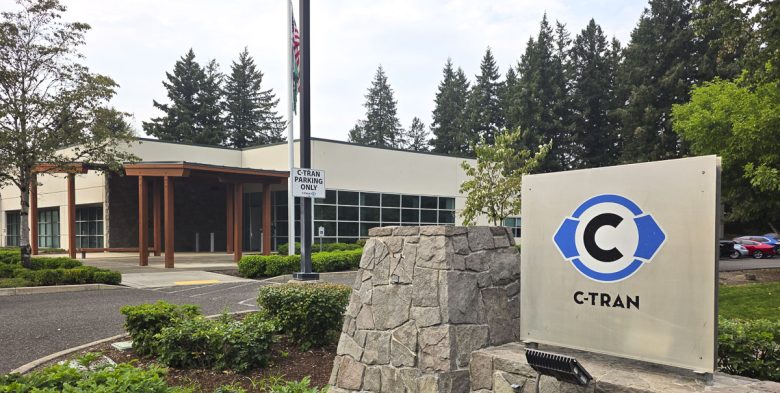
The C-TRAN Board of Directors on Tuesday voted to reject a motion that would revert to older language that would have protected taxpayers from paying for annual operations and maintenance costs for light rail expansion into downtown Vancouver
Paul Valencia
Clark County Today
The C-TRAN Board of Directors on Tuesday voted to allow C-TRAN, or rather its taxpayers, to potentially be on the hook to pay for annual operations and maintenance costs should Oregon’s light rail expand into downtown Vancouver on the proposed new Interstate 5 Bridge.
The three City of Vancouver representatives and the two Clark County councilors on the C-TRAN board voted to reject a motion to revert to older language in the Modified Locally Preferred Alternative for the Interstate Bridge Replacement Program. The older language said C-TRAN “will not be responsible for any costs” associated with light rail operations and maintenance. The new language, passed last November, says C-TRAN “may participate in funding” O&M.

The battle over the language has lasted most of 2025 after the board was poised to revert to the older language in a vote in March. At the last minute, a move was made to delay that vote. Later that week, Michelle Belkot — who was on record with her intention to vote to protect taxpayers — was removed from the C-TRAN board by the Clark County Council. The council then named Wil Fuentes to the C-TRAN board, presumably to vote to keep the new language.
Six months later, the vote happened, Fuentes was one of five who voted to keep the new language, and Belkot happened to be in attendance as a spectator at Tuesday’s meeting.
Belkot’s removal has led to two lawsuits that are still pending. The C-TRAN Board had delayed the language vote in hopes of those lawsuits being resolved.
In the meantime, the C-TRAN Board was informed that it was out of compliance with state law in regard to representation based on population. The C-TRAN Board Composition Review Committee has proposed a change that will lead to the smaller cities losing one seat, and the state might force the committee to take away two seats from the smaller cities. The state has also threatened to withhold roughly $10 million in grants if the board is not in compliance by October.
Facing that timeline and uncertainty, Tim Hein of Camas called for a vote to revert to the older language at Tuesday’s board meeting. He knew it had little chance of prevailing, but there was almost no chance under a new composition of the C-TRAN board that will only be handing more power to Vancouver and Clark County.
“Our objective was to highlight the issues, how we got here, what the concerns are, and to clearly have the individuals vote … on where they stood,” Hein said.
Hein of Camas, Troy McCoy of Battle Ground, Molly Coston of Washougal voted to revert to the older language. Sean Boyle, representing La Center, Ridgefield, and Yacolt, abstained.
Vancouver Mayor Anne McEnerny-Ogle, and Vancouver city council members Erik Paulsen and Bart Hansen, and Clark County councilors Sue Marshall and Fuentes voted against the motion to revert to the older language — effectively giving C-TRAN the right to negotiate, and then vote on how much Southwest Washington would pay for O&M costs.
To be clear, though: Had the C-TRAN board reverted to the old language, C-TRAN would not be paying for any O&M costs. Now, it is possible, and some might say, likely.
“We failed in our fiduciary responsibility to protect this organization. I stand by that,” Hein said.
He noted he does not understand how some board members can worry about losing $10 million in grants through the state’s threat on proportionality but then allow C-TRAN to potentially be on the hook for millions of unknown dollars, partnering with a failed organization such as TriMet.
Hein was one of the board members who voted to change the language last November. He said he did so in good faith. In December, he saw some preliminary numbers and was shocked at how much the O&M costs could be for the taxpayers. Some estimates have it between $6.8 million and $8 million, Clark County Today has learned.
“At that point in time, I realized I made a mistake,” Hein said. “We put C-TRAN, this very organization, at financial risk … in supporting light rail … with TriMet.”
He noted that TriMet announced earlier in the day that it is reorganizing, restructuring, and losing money, and hopes to be back in the black by 2030.
Paulsen disagreed with Hein, saying that the new language just gives C-TRAN the chance to be at the table while discussing options with a potential new partner.
“All this language does is allow us to have those conversations,” Paulsen said. “It does not commit us to anything.”
Paulsen said once the real numbers are finalized, then the C-TRAN board would discuss and vote on any future financial obligation.
By then, of course, it is possible that Vancouver could have four C-TRAN board members and Clark County could have three. If that happens, and the new board composition votes to give any money to TriMet, the small cities just might turn their backs on C-TRAN. Camas officials have already openly discussed the possibility of opting out of C-TRAN.
Interestingly, some of the votes Tuesday were determined by the city councils that the board members represent.
Bart Hansen, for example, went on the record earlier this calendar year saying he would not support C-TRAN partnering with TriMet for light rail. But he did vote to keep the new language, allowing for the potential for C-TRAN to pay for O&M.
“I voted the will of my council,” Hansen told Clark County Today.
Belkot was in the conference room where the meeting was held. She sat quietly as the motion she proposed back in March, that was poised to pass back then before the delay, was being rejected by a board that included the person who took her seat.
“It’s disappointing because this vote (today) would have never happened if they had honored my vote and not removed me as a C-TRAN board member,” Belkot said.
Her case will be determined at a later date. (Reform Clark County’s lawsuit against Clark County has a hearing scheduled for this week.) Belkot said she remains hopeful that the court will reinstate her to the C-TRAN board.
“I am fighting for my constituents and more than my constituents. Clark County residents have voted down light rail three times,” Belkot said. “I keep hearing, ‘How many times do we have to vote no? How many times do we have to say we don’t want light rail in Clark County?’”
The majority of the C-TRAN board, as currently seated, does not share that opinion.
Belkot was dismayed by Tuesday’s vote.
“I saw (some) board members … were tired of discussing it and would rather move on, and would rather put the price tag of O&M light rail expense on our Clark County taxpayers,” Belkot said.
Also read:
- Expect delays on SR 14 in Vancouver for guardrail repairs Wednesday
 State Route 14 travelers in Vancouver should plan for morning delays as WSDOT will close two eastbound lanes for guardrail repairs, affecting mileposts 6.0 to 7.0.
 - Overnight closure planned on westbound SR 14 Camas Slough Bridge Tuesday
 WSDOT crews will close westbound SR 14 at Exit 14 in Camas to collect bridge deck samples and plan future repairs; detours will be in effect.
 - Opinion: Stay in your lane – seriously, it’s the law
 Drivers must choose the nearest lane when turning in Washington, and left turns bring added risk. Even with signals, every driver must help prevent crashes by following law.
 - POLL: After hearing state leaders describe the I-5 Bridge as vulnerable in an earthquake, what is your reaction?
 State and local leaders describe the I-5 Bridge as structurally at risk but recommend drivers continue crossing it while complex replacement plans unfold.
 - WA and OR scale back I-5 Bridge ambitions as cost balloons
 A $14.4 billion price tag prompts Washington and Oregon leaders to delay portions of the I-5 bridge project and prioritize just the main spans.
 wpDiscuz
