



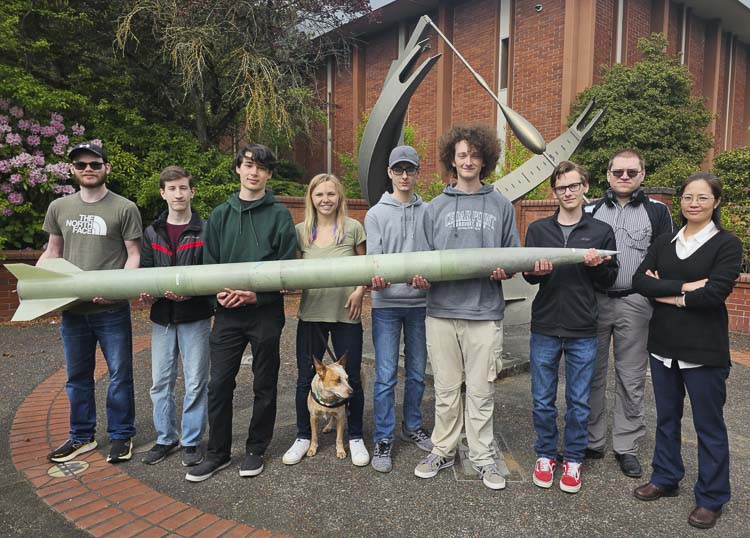
This year’s event in New Mexico is June 17-24
Paul Valencia
ClarkCountyToday.com
Every year, aerospace clubs from colleges and universities from across the country, and from around the world, travel to New Mexico for the Spaceport America Cup.
The event features the brightest young minds in rocketry, with launch after launch, showcasing the students’ skills and ingenuity.
For the most part, these are students from four-year universities.
Last year, though, there was one two-year college — a group of students from Clark College in Vancouver.
This year, the Clark Aerospace and Robotics program is preparing to return to New Mexico.
Spaceport America Cup started with around 200 clubs submitting their proposals. From those,158 were selected to proceed, all preparing to compete in Las Cruces, N.M. from June 17-24.
Clark College is one of two remaining two-year colleges in this year’s competition.
“We’re very much the underdogs,” said Alex Kari, president of the club.
The dozen or so club members appreciate representing Clark College and Southwest Washington, going up against Ivy League schools and more famous universities known for its technology studies.
“There is a lot of pride when everything works perfectly,” said Ethan Walters, the rocket lead for the club.
“We are successful rocket scientists,” Kari added. “That’s an awesome thing to say.”
Last month, the club launched what they describe as “version one” of their rocket, called Emperor Penguin.
“Everything performed nominally,” Kari said of the launch in Central Oregon.
The parachute was a bit undersized, and the rocket came down faster than club members wanted, but that has already been corrected for the next launch.
At Spaceport America Cup, there are several categories in different competitions. The Clark College team is looking to get a 9-pound payload to as close as 10,000 feet as possible.
Teams are judged on making those marks, as well as the design of the rocket and, of course, the recovery of the rocket. It is not a successful mission just to get to 10,000 feet. The rocket must safely return to earth, too. Once members recover the rocket, they must show it to the judges.
Walters, in his second year at Clark College, was at Spaceport last year.
“It’s a really fun competition. A lot of people are just happy to have made it to the competition,” Walters said. “We have a session where everyone talks to one another.”
The students share ideas on payloads, motors, the rockets, and more.
“Teams are happy to help each other out,” Walters said.
The launches are spectacular, one right after the other.
“I always get nervous,” Walters said. “We go through the checklist and stuff, but we still go: ‘Did we miss something? Is something wrong?’”
He joked that perhaps one of the electronics simply decides not to work that day, sending everything else into chaos.
“There is always that fear that something is going to go wrong,” Walters said.
The launch at Spaceport America Cup is, after all, the final test for a club each academic year.
For a club such as Clark’s, it is at a disadvantage for many reasons, said team member Edward Markaryan.
“Clark College is a genuine underdog in this affair, as we are running on less people, less money, less space … everything you can think of,” Markaryan wrote in an email.
Kari and Walters note that knowledge transfer is key for all aerospace clubs, but that is more difficult for clubs with turnover every two years rather than four.
“We try to document everything so we learn from past mistakes,” Kari said.
Whatever it is that the Clark Aerospace and Robotics program is doing, it is working.
The students, and their rocket, are heading back to New Mexico for the Spaceport America Cup.
To help support the club with its journey to Spaceport, you can donate to the Clark College Foundation at https://www.clarkcollegefoundation.org/. Be sure to click on “other” when asked where to designate your donation. Then type: Clark Aerospace and Robotics program.
Also read:
- Letter: ‘Public trust in elections isn’t maintained by repeating talking points’
 Camas resident demands answers after ballots discovered next to trash can, endorses Quiring O’Brien for auditor.
 - Lincoln Day Gala: Independent journalist Jonathan Choe wants more storytellers
 Investigative journalist Jonathan Choe challenged Clark County Republicans to become citizen reporters at Saturday’s fundraiser.
 - Vancouver Fire Department responds to emergency aircraft landing on SR-14
 A Cessna aircraft made an emergency landing on State Route 14 near milepost 2 after experiencing mechanical issues.
 - Vancouver Police investigate shooting
 Vancouver Police seek suspect after 20-year-old shot in SE Mill Plain parking lot early Saturday morning.
 - Dollars flowing into a pair of hotly contested WA congressional races
 Amanda McKinney leads 4th District GOP field with $523,892 raised, while Braun trails significantly behind incumbent.
 - Final Supplemental Environmental Impact Statement published for Interstate Bridge Replacement Program
 Federal agencies published the final environmental impact statement for the Interstate Bridge replacement project.
 - Belkot appeals judge’s decision to dismiss her case against Clark County
 Belkot’s attorney says the federal appeals court will hear the case in several months after judge dismissed all five claims.
