



The state’s economy is projected to generate $66.5 billion for the current biennium that ends on June 30, 2025. That’s down $477 million from the February forecast
Carleen Johnson
The Center Square Washington
A newly released revenue forecast for Washington state indicates less money coming in than lawmakers were told to expect earlier this year.
The state’s economy is projected to generate $66.5 billion for the current biennium that ends on June 30, 2025. That’s down $477 million from the February forecast.
Capital gains tax receipts coming in far below what was projected and declining tax receipts from cannabis sales were among the main reasons for the decline, according to Dave Reich, the state’s chief economist, who on Wednesday updated members of the Economic Revenue Forecast Council.
“Overall change for the 2023-25 biennium has revenues for the general fund down $286 million,” Reich said, informing lawmakers that changes made by the Legislature to the business and occupation tax structure led to a decline in revenue.
In 2022, lawmakers passed legislation – and Gov. Jay Inslee signed it into law – that exempted firms with up to $125,000 in gross receipts from the B&O tax, and expanded the Small Business Tax Credit to those enterprises earning nearly $250,000 annually.
Reich said the recently passed law that allows an excise tax exemption for medical marijuana is now factored into their lowered projections for cannabis revenue.
The Education Legacy Trust Fund is down $188 million.
“Most of that is due to lower capital gains taxes coming in,” Reich said.
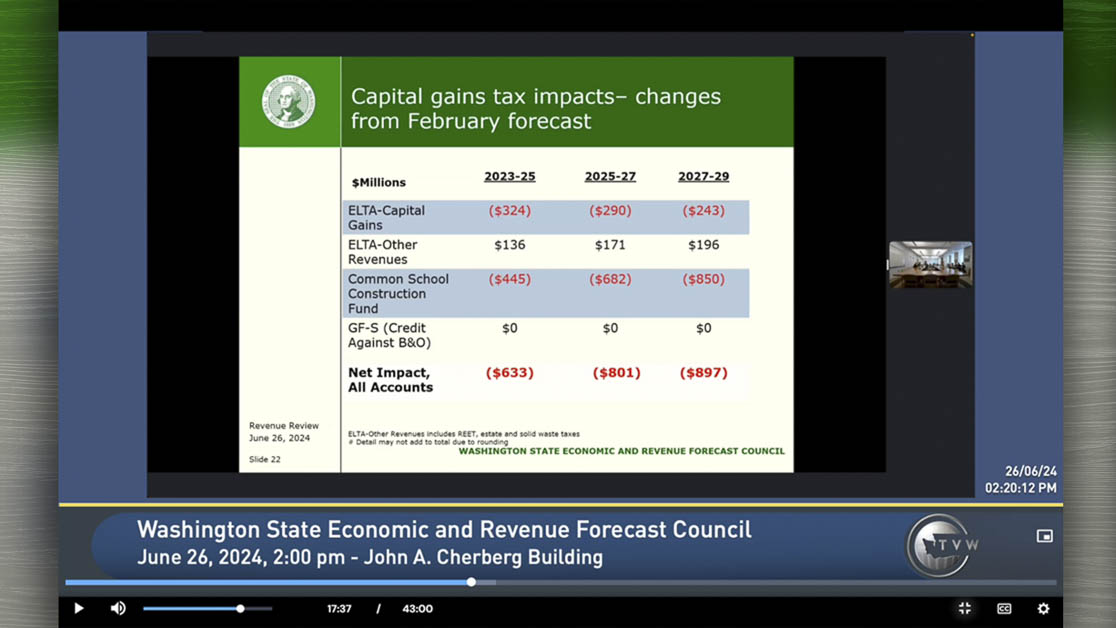
Capital gains revenue is down $324 million for the biennium, compared to what was anticipated in February.
Less retail spending translated to another $224 million dip in sales tax collections.
Reich said payments from estate taxes and real estate transactions came in a bit higher than February’s forecast.
Sen. Lynda Wilson, R-Vancouver, asked Reich, “Assuming capital gains makes it past November, why are you thinking capital gains taxes will be 50% less?”
Voters will decide the fate of the state’s capital gains tax this November. Initiative 2109 would repeal the 7% capital gains tax imposed on sales and exchanges of long-term capital assets by individuals with capital gains over $250,000.
Reich answered Wilson by explaining that the state Department of Revenue had to pay out some refunds to those who overpaid, while also noting the lower revenues coming in are likely a result of “taxpayers learning how to operate in the new environment.”
The Legislature passed legislation creating the capital gains tax in 2021. It took effect on Jan. 1, 2022.
Before passage of the capital gains tax bill, opponents argued capital gains taxes are a volatile source of revenue, prone to up and down swings from year to year.
According to a May release from Washington State House Democrats, “Washington taxpayers filed 3,850 returns for capital gains, and collections from the tax reached $433 million in tax year 2023.”
According to the capital gains tax law, the first $500 million in revenues from the capital gains excise tax is deposited into the Education Legacy Trust Account annually, and any remainder is deposited into the Common School Construction Account for capital investment.
This year, refunds – due to taxpayers who overestimated what they would pay in cap gains taxes – and payments from the first year decreased the total by $62 million, meaning $371 million has been deposited into the Education Legacy account.
No additional funds are expected for the Common School Construction Account this year, with revenues falling significantly short of those expected in the February 2024 forecast.
Sen. Wilson also asked about potential revenue impacts of a possible repeal of the Climate Commitment Act via Initiative 2117 on the November ballot.
Wilson said despite CCA revenues not being part of the general fund balance, there are certainly impacts on Washingtonians from higher gas taxes and other inflationary factors impacted by the CCA.
“I think we should start adding that revenue source into the ERFC reports,” Wilson said. “I think we need another layer of accuracy and transparency to the budget.”
After a lengthy pause, Reich said supplying that information would require a change from lawmakers about how revenue collections are reported.
This report was first published by The Center Square Washington.
Also read:
- Union baseball, softball teams honor military, veterans, and first responders
 Baseball and softball teams combined efforts to recognize military heroes and first responders with ceremonial pitches.
 - Union baseball, softball teams honor military, veterans, and first responders
 Baseball and softball teams combined efforts to recognize military heroes and first responders with ceremonial pitches.
 - Speed cameras designed to bring added safety to work zones
 WSP issued 65,000 infractions in first year, with 59,000 being penalty-free first offenses as program expands statewide.
 - Cathy Doriot retiring as the Ridgefield Chief of Police
 Chief Cathy Doriot expanded Ridgefield PD with detective, sergeants, officers and drone program during her tenure.
 - Opinion: Tax day is painful enough without Washington adding its own
 Washington’s new 9.9% income tax mirrors federal pattern: start narrow, expand to hit everyone within years.
 - Marie Gluesenkamp Perez seeks federal assistance in combating sea lion predation of salmon & steelhead fishing stock
 Congresswoman pushes for expanded lethal removal authority as sea lions devour Columbia River fish stocks.
 - POLL: What do you believe is the biggest reason school districts are facing budget shortfalls?
 Districts across Washington warn of budget gaps as debate grows over rising costs versus inadequate state funding.
