



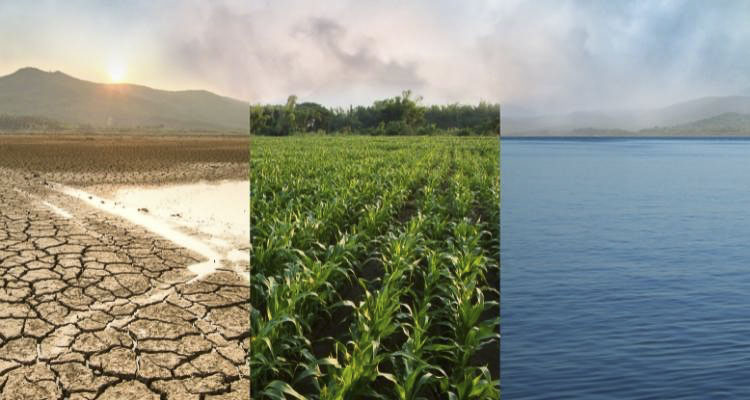
‘Scientists should openly address uncertainties and exaggerations in their predictions’
Art Moore
WND News Center
Led by a Nobel Prize laureate, more than 1,100 scientists and scholars have signed a document declaring climate science is based more on personal beliefs and political agendas than sound, rigorous science.
The World Climate Declaration states climate science “should be less political, while climate policies should be more scientific.”
“Scientists should openly address uncertainties and exaggerations in their predictions of global warming, while politicians should dispassionately count the real costs as well as the imagined benefits of their policy measures,” the declaration reads.
The declaration was organized by Climate Intelligence, an independent policy foundation founded in 2019 by Dutch emeritus professor of geophysics Guus Berkhout and Dutch science journalist Marcel Crok.
The U.K. website the Daily Sceptic reported one of the lead authors of the declaration, atmospheric physicist Richard Lindzen, has called the current climate narrative “absurd.” Yet relentless propaganda from grant-dependent academics and agenda-driven journalists has generated a widely accepted narrative that the science is “settled.”
“We should free ourselves from the naïve belief in immature climate models,” the WCD states. “”In future, climate research must give significantly more emphasis to empirical science.”
Last week, President Biden signed the Inflation Reduction Act, which spends $368 billion for “green” energy with the aim of reducing CO2 emissions by 40% by 2030. When Joe Biden was vice president under Barack Obama, the administration subsidized “green” energy with federal grants and tax breaks. Joe Biden himself announced in 2009 a $535 million loan guarantee for the solar panel company Solyndra to go along with $700 million in venture capital funding. Biden said the plant built with that money would power more than half a million homes. But two years later, the company filed for bankruptcy and shut down its operations.
The World Climate Declaration points out that since emerging from the Little Ice Age in the mid-19th century, the world has warmed significantly less than predicted by the U.N.’s International Panel on Climate Change’s models
“The gap between the real world and the modeled world tells us that we are far from understanding climate change,” the WCD states.
The declaration argues Earth’s climate has varied, with cold and warm periods, for as long as the planet has existed, and it is “no surprise that we are experiencing a period of warming.”
The climate models “are not remotely plausible as global policy tools,” ignoring, for one, the benefits of carbon dioxide, which is “not a pollutant.”
“It is essential to all life on Earth,” the declaration says. “Photosynthesis is a blessing. More CO2 is beneficial for nature, greening the Earth; additional CO2 in the air has promoted growth in global plant biomass. It is also good for agriculture, increasing the yield of crops worldwide.”
There is no statistical evidence, the signatories say, “that global warming is intensifying hurricanes, floods, droughts and such-like natural disasters, or making them more frequent.”
“There is no climate emergency. We strongly oppose the harmful and unrealistic net-zero CO2 policy proposed for 2050.”
Last year, Steven Koonin, an under-secretary of science in the Obama administration, published a book titled “Unsettled” that said “the science is insufficient to make useful projections about how the climate will change over the coming decades, much less what our actions will be.”
The idea that climate change is settled demeans and chills the scientific enterprise, he contended, “retarding its progress in these important matters.”
In 2020, the long-time green activist Michael Shellenberger wrote a book called “Apocalypse Never” that lamented the conversation about climate change has “spiraled out of control.”
Also read:
- VIDEO: WA and OR lawmakers irked as update on I-5 Bridge costs still missing
 Washington and Oregon lawmakers expressed frustration after planners failed to provide updated cost estimates for the I-5 Bridge replacement during a recent legislative oversight meeting.
 - Opinion: Atmospheric River events mean even less clearance for vessels crossing under the proposed Interstate Bridge Plan
 Neighbors for a Better Crossing argues that high river levels from atmospheric river events further reduce vessel clearance under the proposed Interstate Bridge design, creating long-term navigation risks on the Columbia River.
 - Vancouver USA Arts & Music Festival opens applications for 2026 performers, artists, and more
 Organizers of the Vancouver USA Arts & Music Festival have opened applications for 2026 performers, artists, and vendors ahead of the three-day event returning to downtown Vancouver in August.
 - Opinion: Why I won’t mourn the end of enhanced ACA subsidies
 Elizabeth New (Hovde) argues that allowing enhanced ACA subsidies to expire forces a necessary conversation about rising health care costs rather than continued cost shifting to taxpayers.
 - Columbia River salmon and steelhead endorsement goes into effect Jan. 1
 Beginning Jan. 1, anglers 15 and older must purchase a Columbia River salmon and steelhead endorsement to fish for those species in the Columbia River and many Washington tributaries.
 - City of Washougal launches Strategic Plan Dashboard and shares year-end update
 The city of Washougal has launched a new Strategic Plan Dashboard and released a year-end update outlining progress, economic indicators, and key accomplishments tied to its 2023–2028 Strategic Plan.
 - Letter: Worried about a replacement bridge?
 Sharon Nasset raises concerns about congestion, bridge capacity, and unanswered questions surrounding inspections and decisions tied to the I-5 bridge replacement effort.
 wpDiscuz
