



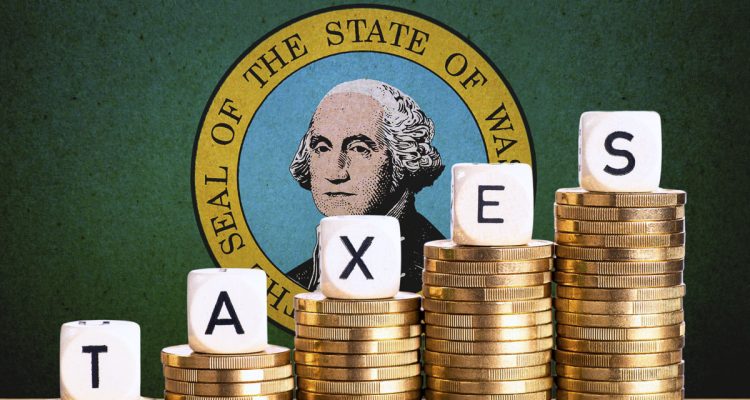
Mark Harmsworth believes Washingtonians deserve a government who fights for their economic stability on all fronts, not one that points fingers at federal policies while piling on state-level burdens
Mark Harmsworth
Washington Policy Center
In a recent press conference, Washington Governor Bob Ferguson (D) expressed grave concerns about the potential economic fallout from President Trump’s proposed tariffs, citing their threat to affordability and economic stability for Washington families and businesses. Ferguson’s rhetoric about the potential tariffs, projected to cost Washington residents $2.2 billion over four years and potentially 31,930 jobs by 2029 rings hollow when viewed against Washington’s own fiscal policies. This year, Ferguson signed into law a budget that included a staggering $9 billion in tax increases on Washington residents, the largest in state history.

Ferguson’s statement on July 14, 2025, called Trump’s tariffs “escalating and illegal,” arguing they disrupt Washington’s trade-dependent economy, which saw $120 billion in exports and imports last year. Ferguson is not entirely wrong, Washington’s ports, agriculture, and aerospace sectors face real risks from tariffs, with a reported 16.3% drop in international imports and a 36% decline in agricultural exports to China already this year. The Washington Office of Financial Management’s nonpartisan report underscores these concerns, predicting higher costs for families and businesses. Yet, Ferguson’s indignation seems selective when he’s simultaneously imposed a tax burden that dwarfs the tariff’s projected impact.
The $9 billion tax increase, part of a $78 billion state budget to address a self-created $16 billion shortfall, includes new business-to-business sales taxes and a gas tax hike, directly impacting working families and small businesses. These taxes hit Washingtonians at a time when grocery and gas prices are already among the nation’s highest.
The increased taxes passed by the legislature disproportionately harm low-income households. The business-to-business sales tax effective October 1, 2025, will raise costs for goods and services, hitting the same vulnerable families he claims to protect. For example, businesses like Boon Boona Coffee face uncertainty from tariffs, but they’re also grappling with Ferguson’s tax increases, which force tough decisions on expansion and hiring. Northwest Harvest’s CEO noted rising food insecurity due to tariffs, but state taxes exacerbate this by inflating costs for essentials.
The $9 billion tax hike is over four times the projected $2.2 billion tariff impact but is framed as the greater threat. If affordability is the goal, the Governor and legislators should reconsider the tax-heavy approach and seek efficiencies in state spending.
Washingtonians deserve a government who fights for their economic stability on all fronts, not one that points fingers at federal policies while piling on state-level burdens.
Mark Harmsworth is the director of the Small Business Center at the Washington Policy Center.

Also read:
- Opinion: In search of joy at Vancouver Mall during Christmas time
 Paul Valencia reflects on his annual Christmas-time visit to Vancouver Mall, finding nostalgia, people-watching, and moments of joy amid last-minute holiday shopping.
 - Opinion: Atmospheric River events mean even less clearance for vessels crossing under the proposed Interstate Bridge Plan
 Neighbors for a Better Crossing argues that high river levels from atmospheric river events further reduce vessel clearance under the proposed Interstate Bridge design, creating long-term navigation risks on the Columbia River.
 - Opinion: Why I won’t mourn the end of enhanced ACA subsidies
 Elizabeth New (Hovde) argues that allowing enhanced ACA subsidies to expire forces a necessary conversation about rising health care costs rather than continued cost shifting to taxpayers.
 - Letter: Worried about a replacement bridge?
 Sharon Nasset raises concerns about congestion, bridge capacity, and unanswered questions surrounding inspections and decisions tied to the I-5 bridge replacement effort.
 - Opinion: IBR promotes ‘giving away’ historic interstate bridges while withholding cost estimate for replacement
 Neighbors for a Better Crossing argues the IBR program is promoting demolition of the historic Interstate Bridges without releasing updated cost estimates or current seismic data to justify replacement.
