



🎧 Clark County Council picks growth path for 2045 plan
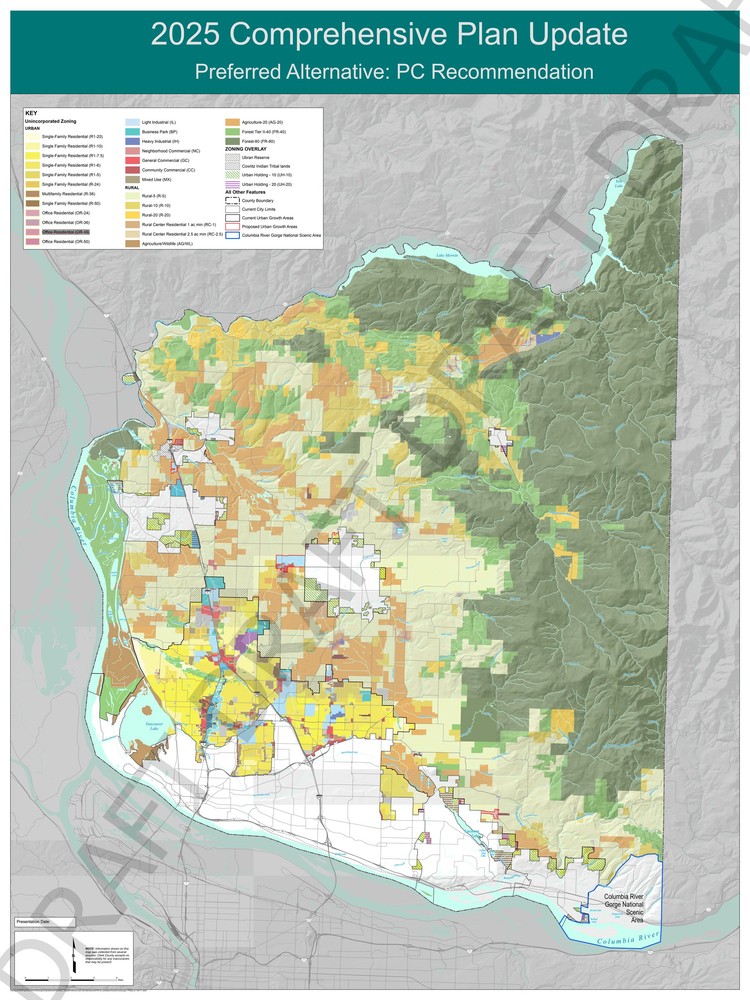
The councilors voted 3-2 Tuesday to approve the preferred alternative recommendation made by the Clark County Planning Commission
Ken Vance, editor
Clark County Today
Members of the Clark County Council selected a preferred land-use alternative for the county’s 2045 Comprehensive Plan update this week. After a lengthy meeting Monday (April 27) for deliberations on the available alternatives, the councilors voted during a meeting continued Tuesday (April 28) to approve the preferred alternative recommendation made by the Clark County Planning Commission.
The draft environmental impact statement (DEIS) on the 2025 Comprehensive Plan update alternatives was released on Oct. 1, 2025. The comment period ended Nov. 30, 2025. Joint hearings were held on Jan. 8 and 15 with the County Council and the Planning Commission for the purpose of taking testimony on the three alternatives that were analyzed in the DEIS. The Planning Commission deliberated on Jan. 29, 2026 and made a recommendation on a preferred alternative to the Council.
Key planning assumptions for the Comprehensive Plan Update included a 2045 total population projection of 718,154, which includes a projection of 190,754 new residents, an assumed annual population growth rate of 1.4 percent and the anticipation of 103,695 new housing units.
The preferred alternatives were as follows:
- Alternative 1 – The ‘No Action’ alternative. This option would keep the existing 2015-2035 Comprehensive Growth Management Plan in place with the inclusion of required density changes in the cities of Camas, Vancouver and Washougal to reflect the implementation of HB 1110. The members of the Planning Commission voted 7-0 to deny this alternative.
- Alternative 2 and Alternative 3. Both alternatives included a number of city-initiated actions and county-initiated actions. A list of those alternatives is available in county Exhibit B 2026-0108 Preferred alternative selection table.
At Tuesday’s meeting, Councilor Matt Little proposed adopting most of the Clark County Planning Commission recommendations in one motion rather than voting item-by-item. His motion included:
- Adopting the Planning Commission recommendation in Exhibit B.
- Changing the Battle Ground Meadow Glade recommendation from “retain” to “remove.”
- Removing the Planning Commission’s TDR (Transfer of Development Rights) stipulation.
- Holding Camas item 3B for a separate later motion.
An amendment by Chair Sue Marshall to remove all agricultural land de-designations failed.
The main motion then passed 3-2, with Councilors Glen Yung, Michelle Belkot and Little voting yes, while Wil Fuentes and Marshall voted no.
The meeting revealed two very competing views:
Growth/Capacity Argument
Supporters of the motion argued:
- Housing shortages remain severe.
- Modeling assumptions changed significantly and may change again.
- Keeping more options available now allows flexibility later.
- Today’s vote was not the final adoption, only the preferred alternative for further study.
Farmland/Conservation Argument
Opponents argued:
- Existing urban growth areas already have enough housing and job capacity.
- Expanding boundaries would unnecessarily convert farmland.
- Outward growth increases infrastructure costs, sprawl, traffic and emissions.
- The county risks legal challenges under the Growth Management Act.
The council’s 3-2 vote marked a major step toward a growth-oriented preferred alternative that preserves future expansion options rather than adopting a no-expansion path. However, sharp disagreement remained over farmland protection, housing need, legal risk, and how much flexibility Clark County should preserve heading toward the final plan.
“I voted NO on Preferred Alternative 2,’’ Councilor Fuentes wrote on Facebook after Tuesday’s meeting. “The data is clear: cities like Ridgefield and La Center already have enough land within their existing boundaries to meet growth over the next 20 years. “So why expand?
“This decision moves us toward more sprawl, higher infrastructure costs, and the loss of agricultural land costs that will ultimately fall on our community,’’ Fuentes wrote. “We had a better path. We chose not to take it. I will continue to push for responsible growth, fiscal accountability, and land use policies that actually serve our community, not short-term interests.’’
Ridgefield Mayor Matt Cole was pleased with the council’s decision, which he believes will be beneficial to small cities in Clark County.
“Today the Clark County Council took a significant step forward for Ridgefield,’’ Cole wrote on Facebook. “They voted to largely support the DEIS Alternative 2, which means our Urban Growth Area expansions, the 1,261 jobs, the 840 affordable housing units, and the targeted and responsible growth our community planned for in those areas stay on the table.
“This didn’t happen by accident,’’ Cole wrote. “It happened because our community did the work, our Council held the line, and we made the case clearly and together.
“More to come as this process moves forward,’’ Cole added. “But today, Ridgefield’s vision is intact. I am grateful to our staff, partners, and my fellow council members for the extensive work we did to preserve the long-term vision for our community.’’
Also read:
- Passionate crowd speaks up at Clark County Council in regard to fireworks
 Forty people spoke during public comment, with 34 supporting current aerial fireworks rules in unincorporated Clark County.
 - County Council approves preferred alternative for the county’s 2045 Comprehensive Plan update
 The 3-2 council vote preserves future expansion options despite sharp disagreement over farmland protection.
 - Judge blocks Washington’s new sheriff standards law
 Thurston County Superior Court judge finds Legislature may have exceeded constitutional authority in setting new sheriff requirements.
 - Judge blocks Washington’s new sheriff standards law
 Thurston County Superior Court judge finds Legislature may have exceeded constitutional authority in setting new sheriff requirements.
 - Battle Ground High School presents ‘Little Shop of Horrors’
 Battle Ground High School drama club presents the musical May 1, 2, 6, 7 and 8 with Saturday matinee.
