



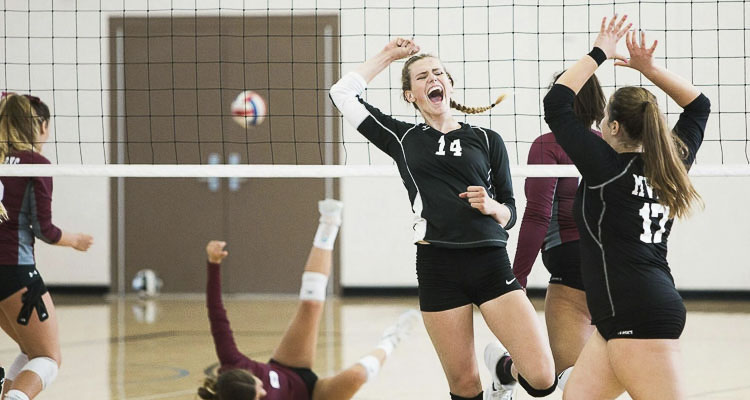
The WIAA proposed the creation of a girls’ division and an ‘open division,’ where all students could participate, regardless if their gender identity matches the sex they were born as
Ari Hoffman
The Post Millennial.com
On Tuesday (Dec. 10), the governing body for high school sports in Washington state announced that it had proposed two bylaw amendments that would limit participants in girls’ sports to students who were born as females and prevent students who were born male and now identify as female from competing in girls’ sports. The announcement follows multiple headline-grabbing victories by boys in Washington competing in girls’ events.
One of the amendments proposed by The Washington Interscholastic Activities Association (WIAA) would create a girls’ division and an “open division.” In the new division, all students could participate, regardless if their gender identity matches the sex they were born as. The other amendment proposes the creation of a boys division, girls division, and an “open division.”
According to the new proposal, “The WIAA encourages participation for all students, regardless of their gender identity or expression. Further, most local, state, and federal rules and regulations require schools to provide transgender and other gender-diverse student-athletes with equal opportunities to participate in athletics. However, in order to maintain fair and equitable competition, participation in girls’ sports and girls’ divisions of sports is restricted to students who were assigned female at birth. The purpose of this policy is to offer clarity with respect to the participation of trans and gender-diverse student-athletes. Additionally, this policy encourages a culture in which student-athletes can compete in a safe and supportive environment, free of discrimination.”
The proposal goes on to make the case that girls’ sports should be restricted to students who were born female to ensure a “level playing field,” but discusses the possibility of creating an appeals process as a “pathway for gender-diverse student-athletes to participate in competition best-aligned to their physiological development.”
The proposal lists arguments for and against the amendment, including potential legal challenges as cons. The Kennewick, Mead, Moses Lake, and Colville school districts have already announced their support for the proposals.
In May, a trans-identified male athlete won the Washington state girls’ 400-meter race by over a full second, leading the East Valley (Spokane) girls’ track team to a state championship. The following month, the losing team’s track and field coach spoke out against state rules that allow biological males to compete in female-designated sports, telling the Independent Women’s Forum that his team would have won the state championship if it were not for the inclusion of one of these trans-identifying male athletes.
“We had no idea that this was coming. As a coach, I found out about it just through talking to other coaches from around the state. Then, in the [girls’] 400-meter open race, the individual from our school that qualified only found out about an hour before.”
The coach added, “The male [runner] is going to be stronger and more powerful, so you use that to your advantage to get yourself around the track. As a woman, the level of strength and power is different, so you end up having to do it with more grace and finesse,” noting “We’ve had many coaches, through text, emails, or just verbally, state their displeasure with the situation.”
He continued, “My biggest disappointment in this situation is how our state association [the WIAA] didn’t prepare us for what was coming.” In October, a trans-identified male runner, who competed as a male in the 2021 season and finished the season overall in 72nd place, led his team in the women’s division to victory in a Washington cross-country championship. The WIAA is scheduled to discuss and potentially adopt the amendments on January 27 during the organization’s virtual Winter Coalition.
This report was first published by The Post Millennial.
Also read:
- Gov. Ferguson signs controversial law tightening standards for WA sheriffs
 Sheriffs must now meet strict standards or risk removal, with local officials appointing replacements instead of voter recall, amid ongoing debate over constitutionality.
 - Opinion: Stalin would be proud – Clark County Socialists gathered for ‘No Kings’
 Reform Clark County’s Rob Anderson criticizes local and national groups for organizing protests that featured Auditor Greg Kimsey as a keynote, raising concerns about public trust and political partisanship.
 - Higher payroll taxes may hit workers as eligibility rules broaden
 Elizabeth New argues the state’s paid family leave system drains paychecks from lower-income workers and gives more to frequent and high-income users, urging repeal or major reform.
 - Clark County Sheriff’s Office completes extradition in homicide case
 Dariel Nunez-Montero was transferred from Kentucky to the Clark County Jail and is being held as the investigation into the death of Courtney Clinton moves forward.
 - Letter: Vancouver Mayor Anne McEnerny-Ogle makes several serious and incorrect engineering statements
 Bob Ortblad critiques engineering claims by Vancouver Mayor Anne McEnerny-Ogle, highlighting cost and safety advantages of an immersed tunnel for the I-5 crossing.
 - Opinion: The beginning of the end of anchor babies
 Lars Larson argues the Constitution excludes children born to non-legal residents, as the Supreme Court debates birthright citizenship and public opinion data shows limited support.
 - County extends application deadline for Commission on Aging openings
 Clark County is seeking diverse applicants to fill four roles on its Commission on Aging, with a focus on mobility and housing in 2026. New deadline set for applications.
 wpDiscuz
