



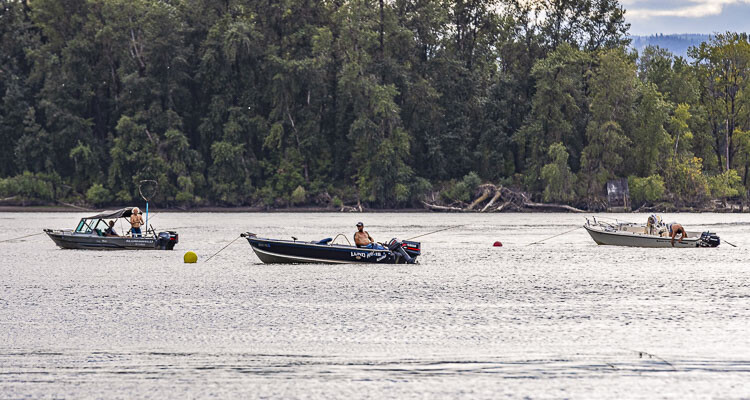
As a result, retention of adult summer Chinook will close from the Astoria-Megler Bridge upstream to Priest Rapids Dam
With summer Chinook salmon returning to the Columbia River in lower-than-expected numbers so far in 2023, fishery managers from Washington and Oregon announced this week that recreational fishing for adult summer Chinook will close on much of the Columbia River mainstem beginning Saturday (July 1).
Fishery managers with the Washington Department of Fish and Wildlife (WDFW) and Oregon Department of Fish and Wildlife (ODFW) said Wednesday that the current return of upper Columbia summer Chinook is tracking about 30 percent below the preseason forecast of 85,400 fish.
As a result, retention of adult summer Chinook will close from the Astoria-Megler Bridge upstream to Priest Rapids Dam.
Fishing for sockeye and jack Chinook (defined as Chinook between 12 to 24 inches in length) remains open from the Highway 395 Bridge in Pasco upstream to Priest Rapids Dam. Fishing also remains open for sockeye, hatchery jack Chinook, and hatchery steelhead from the Astoria-Megler Bridge upstream to the Highway 395 Bridge.
“We’ll continue monitoring the return, but all current indications suggest this closure is necessary for us to meet our allocation and conservation objectives for summer Chinook on the Columbia River,” said Quinten Daugherty, Columbia River fishery biologist with WDFW.
The mainstem Columbia River above Priest Rapids Dam will still open July 1 for adult summer Chinook retention.
The U.S. v. Oregon Technical Advisory Committee, which forecasts and monitors salmon and steelhead returns to the Columbia River, is expected to formally update the forecast for summer Chinook on Thursday.
As always, anglers should be sure to check the Washington Sport Fishing Rules pamphlet to see permanent regulations for the section of river where they hope to fish, as well as WDFW’s emergency rules webpage for updates to this fishery and other fisheries statewide.
The Washington Department of Fish and Wildlife works to preserve, protect, and perpetuate fish, wildlife and ecosystems while providing sustainable fish, wildlife, and recreational and commercial opportunities.
Also read:
- WA Gov. Ferguson to meet with NBA commissioner as hopes rise for Sonics’ return
 The meeting this week comes before a vote that could clear the way for the league’s expansion to Seattle Jake Goldstein-StreetWashington State Standard Washington Gov. Bob Ferguson on Thursday previewed an upcoming meeting with NBA Commissioner Adam Silver ahead of a planned vote on league expansion that could bring men’s professional basketball back to Seattle. …
 - Plenty of NBA connections expected in town Sunday for Vancouver Bears game
 Former NBA stars Gary Payton and Robert Pack will coach opposite each other when the SuperHawks visit the undefeated Vancouver Bears in a marquee USBL matchup.
 - State’s umpire-in-chief goes on recruiting trip in his final season as a baseball umpire
 Tim Stevens is spending his last season traveling to every Washington umpire association, working to address the shortage of officials and encourage young people to join the ranks.
 - Clark County Baseball presents Baseballism Kickoff this week with action all over the region
 Thirty-six teams from across the Northwest, including two state champs, are competing in free high school baseball tournaments at local turf fields in Vancouver, Camas, and Ridgefield.
 - The Study of Sports Podcast March 13, 2026: We discuss the state basketball tournaments, the incredible run from Columbia River boys, the state placing for Evergreen girls, and more
 Reporter Paul Valencia and sports administrators Tony Liberatore and Cale Piland discuss a series of subjects around the WIAA’s state basketball tournaments, plus we get into some Mariners baseball talk and NFL free agency/trade cancellations
