



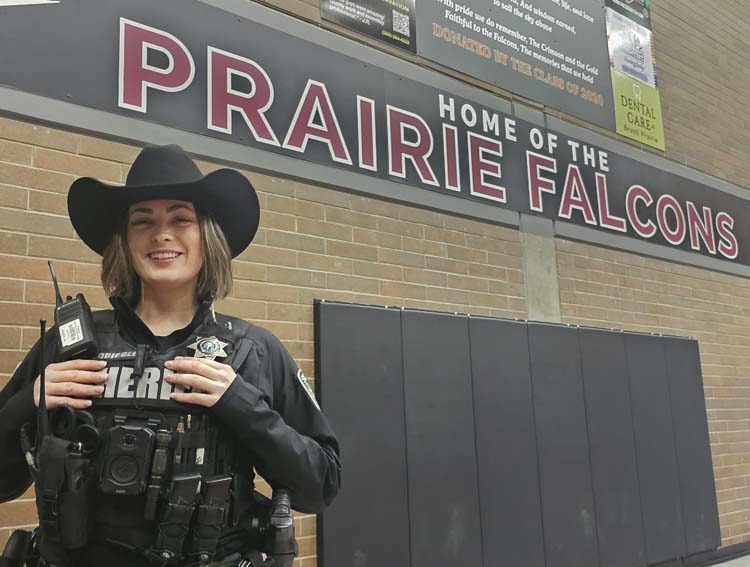
Chelsea Quiggle of the Clark County Sheriff’s Office used to be a teacher, and now she continues to serve students but now as a law enforcement officer
Paul Valencia
ClarkCountyToday.com
It was a moving moment on a special day at Prairie High School.
In front of the student body at an assembly to honor Martin Luther King Jr. back in January, Chelsea Quiggle, a deputy with the Clark County Sheriff’s Office, and senior Faith Prospere read a poem that Prospere wrote, with Quiggle’s help.
Together, they shared their thoughts, their points of view.
“Although we’re different, we’re united,” was the message.
It was just one of many memorable days for Quiggle, who is in her first academic year as the School Resource Officer at Prairie High School.
For years, many high schools in Clark County had SROs assigned to their campuses. For a number of reasons, SROs went away at Evergreen, Vancouver, and Battle Ground schools.
This school year, Battle Ground Schools was able to work an agreement with the sheriff’s office for the return of an SRO. Quiggle is based at Prairie High School, but works for 10 schools in the district. Battle Ground High School, it should be noted, has assistance from the Battle Ground police department.
“When I became Sheriff, one of my key objectives was to re-engage CCSO in the School Resource Officer program for local school districts interested in partnering with us,” said Clark County Sheriff John Horch back in August, adding that he looks forward to the prospect of expanding the program.
For Quiggle, this assignment seems like it was designed specifically for her. Before she was with the sheriff’s office, she was a teacher in Cowlitz County.
“I’ve always been just really good at engaging and building a rapport with kids, something that came naturally to me,” Quiggle said.
She might be in law enforcement now, but in many ways she is back to being an educator.
“This was a natural fit, being able to blend the two,” Quiggle said.
“The relationship piece is the biggest. I’m not here to arrest kids. I’m here to educate kids,” she said. “And I’m here to build relationships.”
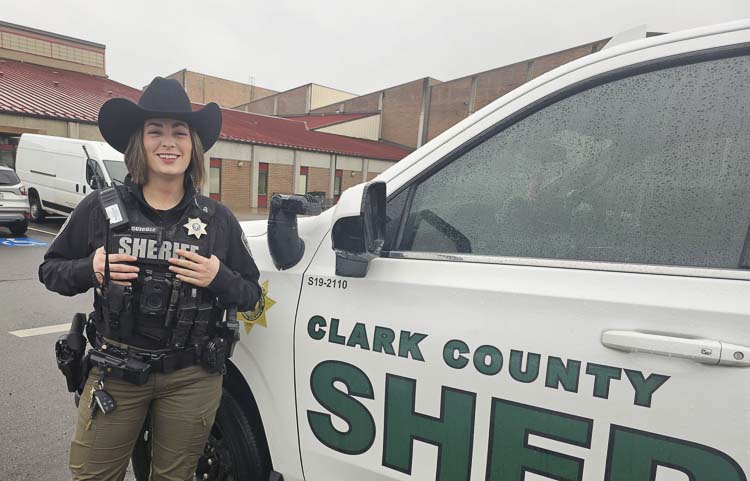
In the short term, students and staff have law enforcement on their campus every day. In the long term, Quiggle believes, the community will benefit from young people understanding the role of law enforcement.
“There has been a lot of damage in the media with our reputation as law enforcement over the last four years. These kids don’t have a lot of experience or exposure to law enforcement,” Quiggle said.
Quiggle walks the halls at Prairie, engages with so many students every day. She also has an office, a place for students to reach out to her.
“To be able to be in the schools and build relationships and help them understand what our role is in the community and who we are as people, it kind of puts a face to the profession,” Quiggle said. “They get to see me as a real person and not just somebody they should be scared of.”
Now six months into the SRO job, Quiggle said her office is a place for students to visit, to say hello, to have a snack.
She recalls a couple of students who went through rough patches.
“After some intervention and conversations and plans being made, I’ve seen a difference,” Quiggle said. “The biggest success is kids feel safe coming in here, sitting down, and chatting.”
As a teacher, Quiggle did not deal with a lot of the discipline issues in a school. Now, she is working with the dean of students, and she is in a lot of the conversations with students.
Yes, there have been some intense situations, too. Quiggle said she uses her judgment to determine the next steps on a case-by-case basis. The first step, usually, is education.
“I’m dealing with big statements kids are making. They don’t understand how much value words have,” Quiggle said.
A student might “pop off,” Quiggle said, with a threat.
“They say those things out of anger or frustration without knowing the ramifications,” Quiggle said.
Law enforcement has to take all such statements seriously. But that does not mean all situations escalate.
“We’re in a learning environment. Some situations, they go too far and we have to, unfortunately, get the legal side involved,” Quiggle said. “But for the most part, it’s the education piece, which has been good.”
Her presence at Prairie has been welcomed by the administration.
“Chelsea is doing an amazing job of connecting with our kids and the community and represents not only the CCSO, but law enforcement in general, very well,” said assistant principal Charbonneau Gourde. “Chelsea is an absolute credit to her profession.”
Quiggle, who has been with CCSO for more than five years, said she hopes to be assigned to Prairie High School for many years. She loves the mission, and she believes in it.
“The positive impact we can make now is really going to pay dividends later on,” Quiggle said.
Teenagers taking the time to get to know a law enforcement officer will help when those teenagers grow into adults.
“Later on, there is going to be more trust,” Quiggle said.
Also read:
- White House govt. Funding request for 2027 cuts $73 billion
 President Trump’s budget seeks to boost defense funding while cutting $73 billion from agencies like the EPA, NASA, and Agriculture, prompting sharp criticism from Democratic leaders.
 - Heywood asks WA Supreme Court to allow referendum effort on income tax
 Brian Heywood is petitioning the state Supreme Court after the Secretary of State rejected a referendum to repeal Washington’s new 9.9% tax on income over $1 million.
 - Opinion: Half the road, full stop – Understanding pedestrian right-of-way
 Doug Dahl explains how Washington’s law requires drivers to stop when a pedestrian is within one lane of their half of the road, not just when directly in front.
 - Clark County seeks volunteer for Law and Justice Council
 Applicants with experience in mental health services are encouraged to help guide Clark County’s coordination of local criminal justice and corrections planning.
 - VIDEO: Families at center of WA transgender sports debate face-to-face with OSPI
 Two Washington high school students and their parents met with Superintendent Chris Reykdal to discuss concerns about sports policies after one student faced an investigation for harassment.
 - As Washington lawmakers punt on school cellphone ban, some want more action
 At Robert Eagle Staff Middle School, all-day phone removal led to fewer conflicts and more student engagement, but some parents and lawmakers argue a ban should not be imposed statewide.
 - Opinion: The state’s RFK-proofing bill comes with a cost
 Mandates like HB 2242 can lead to higher premiums as insurance companies absorb costs for new preventive services, affecting affordability statewide.
 wpDiscuz
