


The Ballmer Group’s gift could add up to 10,000 early childhood education slots over the next decade; It comes on the condition that the state not make further cuts to the program
Jake Goldstein-Street
Washington State Standard.com
The Ballmer Group on Wednesday committed hundreds of millions of dollars for free preschool in Washington, a massive philanthropic contribution amid state budget cuts and federal rollbacks.
The donation of up to $170 million per year for the next decade could fund 10,000 additional slots in the state’s Early Childhood Education and Assistance Program, or ECEAP, for low-income families. The program currently has just over 14,000 slots statewide at over 460 locations.
The Ballmer Group was founded by former Microsoft CEO Steve Ballmer and his wife Connie.
Gov. Bob Ferguson called the funding “truly transformative.”
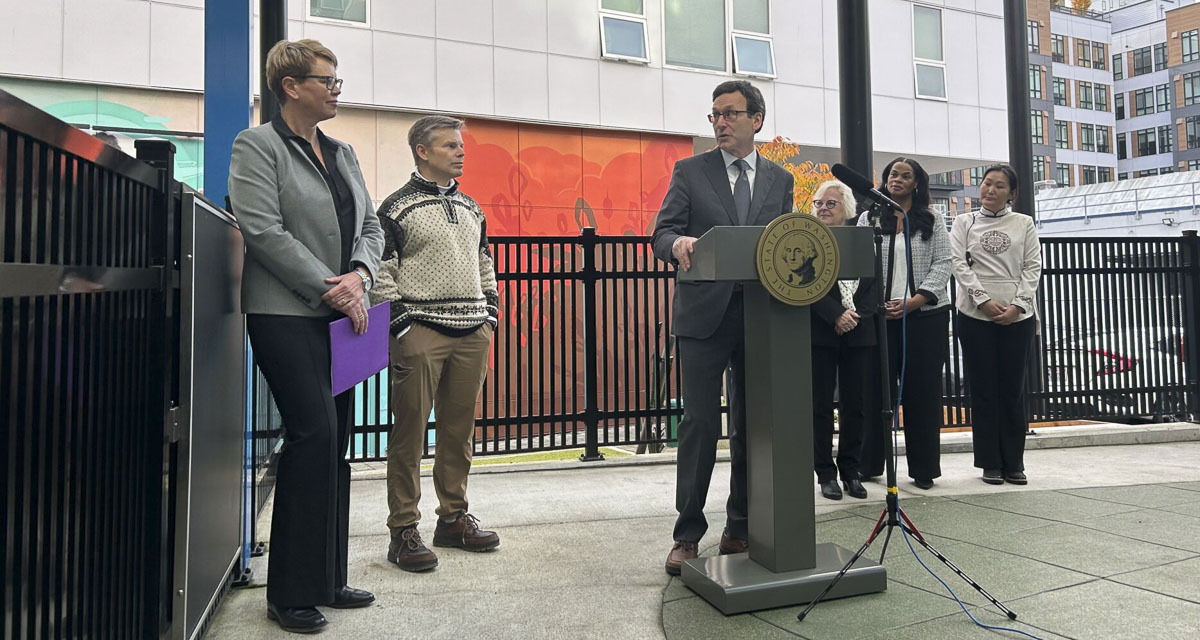
“It’d be hard to quantify how significant that investment will be for our state,” Ferguson said at a press conference Wednesday, announcing the news at the Denise Louie Education Center in Seattle.
As a condition of getting the gift, the state pledged no further budget cuts to the ECEAP program for the next 10 years.
Established in 1985, the Early Childhood Education and Assistance Program, open to kids ages 3 and 4, is similar to the federally-supported Head Start. Washington’s program offers free early learning child care or preschool, as well as support services.
Children who participate in ECEAP are more likely to be “kindergarten ready” and less likely to need special education services, according to a 2022 Washington State Institute for Public Policy report. But as school goes on, it doesn’t necessarily correlate with better test scores or high school graduation rates.
“We at Ballmer Group have been inspired by Washington state’s commitment to ensure that every eligible kiddo has access to high-quality early learning, and Ballmer Group’s role is simple: To help that vision move faster,” said Andi Smith, the organization’s executive director for Washington.
The exact amount the Ballmer Group will give each year will be determined by demand for additional slots and whether providers are available. It’ll likely be a years-long ramp-up to fully realize the investment.
“But we are going to be moving heaven and earth to make that happen,” Ferguson said.
The governor wants to enroll an additional 2,000 children in the program next school year.
If the state raises ECEAP funding sometime in the next decade, the Ballmers would match that, leading to added philanthropic funding. Ferguson didn’t commit to taking that step, given the state’s ongoing budget challenges, but said, “I think we have to seize this opportunity and maximize it.”
State and federal headwinds
Facing a multibillion-dollar budget shortfall this year, state lawmakers targeted ECEAP to help fill the gap.
They postponed expansions of the preschool program that would extend it to all qualifying low-income families and child care subsidies. They slashed about 12% of slots, totaling about 2,000, many of which were unfilled due to staffing issues. They eliminated state funding for an ECEAP program for toddlers younger than 3, affecting nearly 200 families. And they decreased funding for the state’s Complex Needs grant fund that supports providers serving children with disabilities, developmental delays and behavioral issues.
The cuts to ECEAP focused on part-day slots that might not appeal to working families, while shifting toward more full school-day slots.
In total, the budget cutbacks amounted to around $60 million.
To save money this year, state lawmakers also capped enrollment in the separate Transition to Kindergarten program.
Meanwhile, the state program’s federal counterpart has faced months of Trump administration efforts to dismantle Head Start, which serves roughly 15,000 kids in Washington. And the government shutdown threatened federal funding for programs that serve more than 3,100 Head Start students in Washington, and led to cutbacks across the country.
The Ballmers give millions every year to various causes in Washington, many of which focus on education.
In 2023, the Ballmers gave $38 million to the University of Washington for scholarships to study early childhood education. At the time, the university said the money would provide more than 1,500 scholarships over the ensuing eight years.
State lawmakers will need to pass a bill in the upcoming legislative session to formally receive the Ballmers’ latest gift.
To be eligible for ECEAP, families have to earn less than 36% of the state median income. For a family of four, that’s around $50,000 a year. It’s also available to children who are homeless or who’ve previously participated in certain birth-to-age-3 programs, and those on individualized education programs, which are for students with disabilities.
This report was first published by The Center Square Washington.
Also read:
- Opinion: Were Republican voters just sleeping during the August primary election?
 CCRP Chairman Matt Bumala says 60% of primary no-shows in the 17th and 18th districts were Republicans.
 - High school football: New coach prepares for long-term success at Prairie High School
 James Young-Lewis, a Clark County native who graduated from Evergreen in 2009, became Prairie’s head coach in May after working as an assistant coach across various programs since 2015, joining Prairie’s staff in 2024.
 - Cost to battle 20 wildfires in WA has topped $200M
 Twenty wildfires have cost Washington $207M in one month, more than two-thirds of what DNR spent all last fiscal year.
 - Opinion: WA Cares’ launch showcased care WA Cares did not provide
 Gov. Ferguson showcased a caregiving arrangement at the WA Cares launch that the program had not paid for a single day of.
 - Former State Rep. Liz Pike provides update on husband Neil Cahoon
 Neil Cahoon, a Camas resident, has undergone multiple surgeries including five on Aug. 15 after the Aug. 10 crash near La Center’s Daybreak Airport.
 - Opinion: Portland’s War on Cars Part 4 – A smarter automobile strategy to end gridlock
 O’Toole argues fuel wasted in Portland-area congestion has sextupled since 1982, generating 250,000 tons of extra greenhouse gases annually.
 - $1,000 first prize for Camas Plein Air Art Event honoring Marquita Call on Sept. 26
 Plein air artists compete Sept. 26 in Camas for $1,000 first prize honoring gallery founder Marquita Call.