



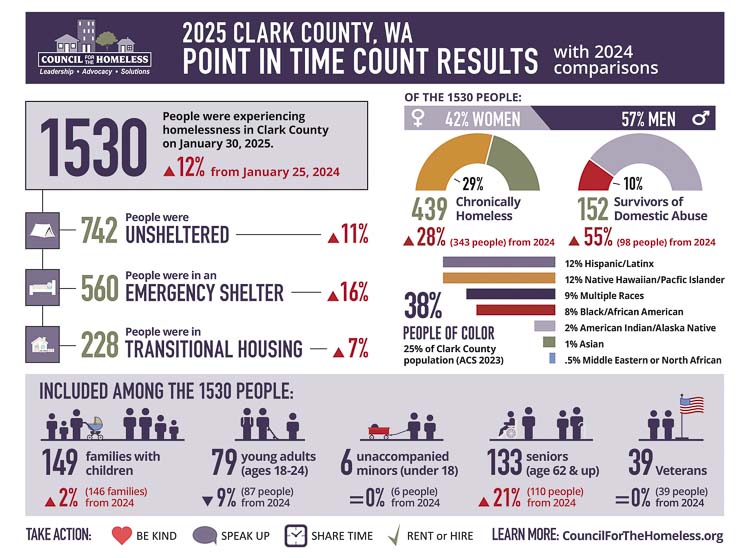
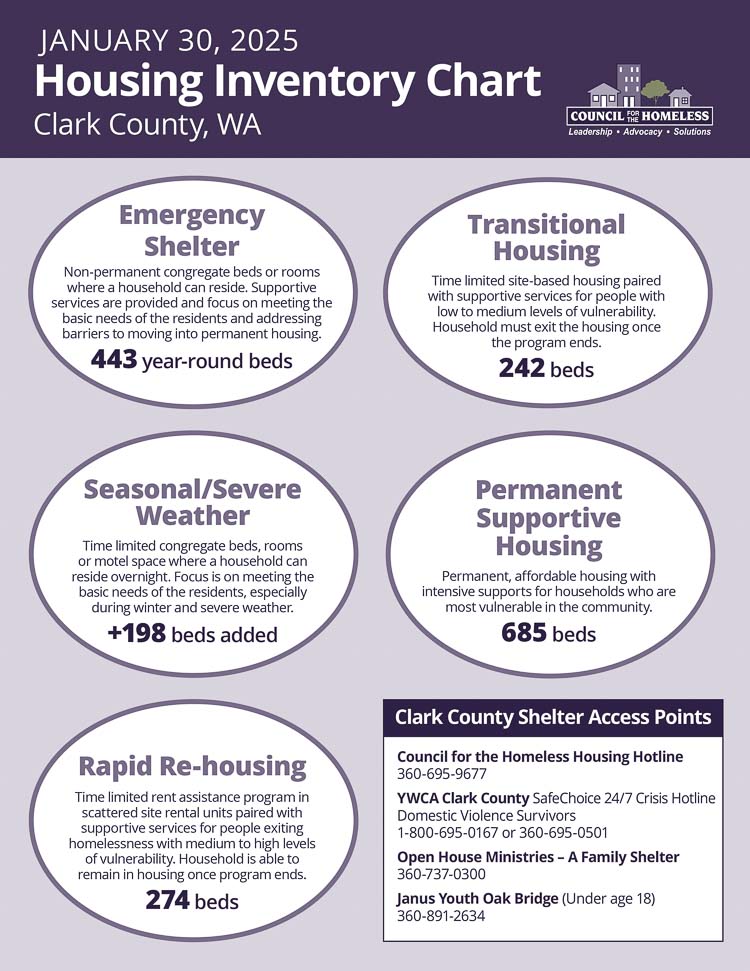
While the PIT Count provides a valuable snapshot of homelessness on a single day, CFTH emphasized that the numbers do not capture the full scope of homelessness in the region
The Council for the Homeless (CFTH) released the results of the 2025 Point-in-Time (PIT) Count, a one-day census conducted on Jan. 30 that documents the number of individuals and families experiencing homelessness in Clark County. The data, collected as required by the U.S. Department of Housing and Urban Development (HUD) and the Washington State Department of Commerce, is available in full at https://www.councilforthehomeless.org/point-in-time-count/.
While the PIT Count provides a valuable snapshot of homelessness on a single day, CFTH emphasized that the numbers do not capture the full scope of homelessness in the region.
“The PIT Count is a one-day view of 2025,” said CFTH Chief Operating Officer Sunny Wonder. “Council for the Homeless collects and analyzes data all year long to create a more comprehensive understanding of homelessness in Clark County.”
2025 PIT Count Highlights:
- The number of people counted in Emergency Shelter increased 16 percent due in part to the increase in capacity of winter and severe weather overflow shelter.
- The number of seniors counted who were age 62 or older increased 21 percent. This increase was primarily among sheltered seniors.
- The number of unsheltered people counted increased 11 percent from the 2024 count. This increase was almost all among single individuals or households without children.
- The number of people who identify as Black, Indigenous or Person of Color made up 38 percent of the people counted. This is an overrepresentation as BIPOC individuals make up 25 percent of the population in Clark County, according to the U.S. Census Bureau’s American Community Survey, 2024.
“Ending homelessness on the individual and community level requires continued investment and collaborative strategies,” CFTH Chief Executive Officer Sesany Fennie-Jones said. “Council for the Homeless is proud of its cross-sector partnerships established over the years.”
Challenges remain to solving homelessness on an individual, family and community level, including:
- A lack of housing for people at all income levels, especially people with incomes at 30 percent or lower of the Area Median Income. A lack of affordable housing makes it difficult for individuals and families to move out of emergency shelter and transition into stable housing.
- Rising rental costs. The Fair Market Rent for a one-bedroom apartment in Clark County is $1,750 per month. To afford this while spending no more than 30 percent of income on rent, a person would need to earn $33.65 per hour. (Source: National Low Income Housing Coalition)
CFTH remains committed to working with community members, public and private partners, and elected officials to address the root causes of homelessness and expand access to housing solutions across Clark County.
About Council for the Homeless: Council for the Homeless (CFTH) is a nonprofit organization dedicated to preventing and ending homelessness in Clark County, WA, by providing community leadership, compelling advocacy, and practical solutions to solve homelessness on an individual and community level. Founded in 1989, CFTH serves as the lead agency and coordinated entry for delivery of homeless services through the Continuum of Care for Homeless Services in Clark County, WA.
Also read:
- White House govt. Funding request for 2027 cuts $73 billion
 President Trump’s budget seeks to boost defense funding while cutting $73 billion from agencies like the EPA, NASA, and Agriculture, prompting sharp criticism from Democratic leaders.
 - Heywood asks WA Supreme Court to allow referendum effort on income tax
 Brian Heywood is petitioning the state Supreme Court after the Secretary of State rejected a referendum to repeal Washington’s new 9.9% tax on income over $1 million.
 - Opinion: Half the road, full stop – Understanding pedestrian right-of-way
 Doug Dahl explains how Washington’s law requires drivers to stop when a pedestrian is within one lane of their half of the road, not just when directly in front.
 - Clark County seeks volunteer for Law and Justice Council
 Applicants with experience in mental health services are encouraged to help guide Clark County’s coordination of local criminal justice and corrections planning.
 - VIDEO: Families at center of WA transgender sports debate face-to-face with OSPI
 Two Washington high school students and their parents met with Superintendent Chris Reykdal to discuss concerns about sports policies after one student faced an investigation for harassment.
 - As Washington lawmakers punt on school cellphone ban, some want more action
 At Robert Eagle Staff Middle School, all-day phone removal led to fewer conflicts and more student engagement, but some parents and lawmakers argue a ban should not be imposed statewide.
 - Opinion: The state’s RFK-proofing bill comes with a cost
 Mandates like HB 2242 can lead to higher premiums as insurance companies absorb costs for new preventive services, affecting affordability statewide.
