



🎧 A Pastor’s Grief: Bill Ritchie on Loss, Faith, and Hope
Bill Ritchie, founding pastor of Crossroads Community Church, recently self-published a book about his journey to respond to his wife’s trip to paradise
Ken Vance, editor
Clark County Today
Just more than two years ago, Bill Ritchie’s wife Betty went to paradise. Needless to say, his life changed dramatically.
“One day I was picking up something at Walmart,’’ said the 82-year-old Ritchie, the founding pastor of Crossroads Community Church in Vancouver. “I was walking back to my car and I thought to myself, ‘Betty is in paradise, and I’m here at Walmart.’ What am I going to do now?’’
He didn’t know it at the time, but that experience provided him the title of his recently released book, “MY WIFE IS IN PARADISE, AND I’M HERE AT WALMART. What do I do now?: Learning to live between grief and hope.’’

Prior to that awakening in the Walmart parking lot, Ritchie had spent four and a half years as his wife’s primary caregiver. He says she was one of the first residents in the area to be stricken with COVID. After a harrowing experience with the medical profession during Betty’s extended stay at an area hospital, Bill brought his wife home. He knew that even though her health had been permanently impacted, he would make sure she got the best care possible under the roof of the couple’s Battle Ground home rather than any medical facility.
Bill was right. Under his care, Betty lived much longer, and with a greater quality of life, than medical professionals had suggested she would. But, inevitably, her journey moved on to a path that we will all travel at some point.
Even though Bill had been a pastor for decades, and had counseled literally (hundreds if not) thousands of people through exactly what he was now experiencing, he quickly realized he was overwhelmed by his new reality.
“Here I was a pastor for over 40 years,’’ Ritchie said. “I taught every single word of the Bible from beginning to end – verse by verse, chapter by chapter – and when I finished Revelation, I’d go back to Genesis and start all over again. But, in retrospect, I did not get deeply into the subject of heaven. Of course I talked about it, how great it was, that it wasn’t the booby prize if things didn’t work out the way we wanted, I never dealt with it in depth. Neither did most pastors I knew. That caused me to do a deeper dive on heaven itself, our relationships there, and what it’s like that I simply had never done.”
Ritchie wants others to know from the beginning. His book is not a blueprint for how to deal with the loss of a spouse, loved one or any type of grief. He says there is no blueprint.
“The book was not suggesting for anyone to do anything from a top-down perspective, like I’m an expert and I will tell you like it is,’’ he said. “Rather, I wanted it to just be what I am doing as a fellow traveler through an experience that every human being will have. How can we help each other get strong during this process and move forward, carrying love with us. That’s how I wrote the book.’’
Their love story
Bill and Betty began dating exclusively after the ninth grade, so they knew each other for a very, very long time.
“We were together as a couple for 65 years, married for 58 and a half of that, otherwise we were dating or engaged,’’ he said.
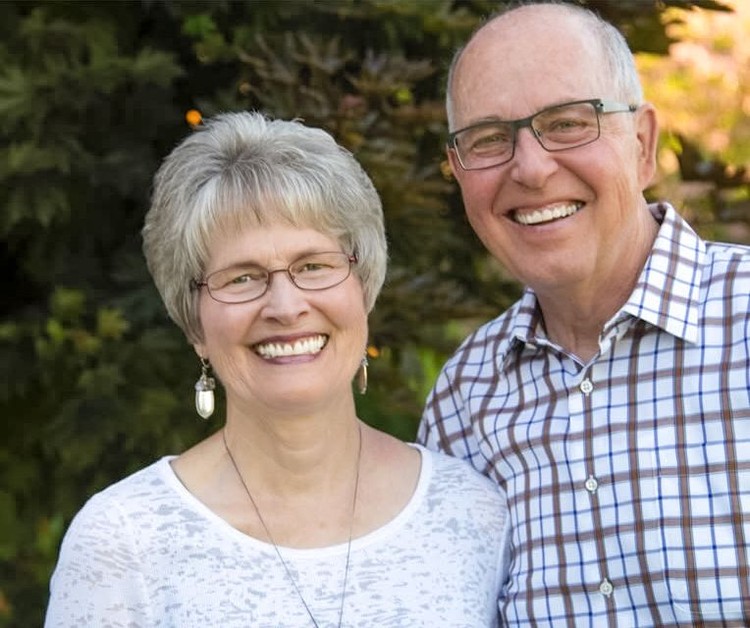
Later in life, Betty had a battle with breast cancer. Bill said the radiation treatments caused a lung condition. When she contracted COVID, that led to complications. At the height of the pandemic, she spent five and a half weeks in Intensive Care at an area hospital. Bill said that if it wasn’t for the intervention of their son-in-law, who is a physician, Betty most likely would never have made it back home.
“It was brutal,’’ Bill said. “If not for my son-in-law, she wouldn’t have made it out of the hospital. The hospitalist suggested I put her on ‘comfort care’ so she could enjoy the ‘last two months of her life.’ I suggested he look into a different profession!’’
“I just couldn’t believe it,’’ he said. “But, we got her through it and got her home. She was irrevocably changed. It affected her in more ways than I could imagine. Even though that change was real, she was that lady we all loved, and we were thrilled to keep doing life together. Interestingly enough, those four and a half years were some of the sweetest times we had ever experienced, even with all the limitations.’’
Bill cared for Betty 24 hours a day, seven days a week, 365 days a year for those four and a half years.“You do what you do,’’ said Bill, downplaying his role in his wife’s care. “When she moved to paradise, that’s when everything changed.’’
Falling off a cliff
Ritchie has been retired from his full-time role as a pastor for many years. Even though he spent many decades guiding others, none of his professional or personal experiences prepared him for Betty’s death.
“I had walked with people through grief thousands of times,’’ he said. “I thought I had a level of understanding, but truth be told I didn’t have a clue. It’s like falling off a cliff. Unless you’ve been there, you haven’t been there. It’s just that simple. I was reeling in this world on every level.’’
Ritchie describes himself as an avid reader. Prior to his wife’s passing, he had three books published. And, as a pastor of more than 40 years, he was obviously a scriptural theologian. So, he poured himself into a search for new answers to his questions and new information about how to deal with his grief.
The first question he wanted to answer: Was he still going to be married to Betty in heaven?
“Most pastors say in heaven, there is no marriage,’’ he said. “I probably said that myself numerous times. This is always based on Jesus’ words in Matthew 22:29: ‘For in the resurrection they neither marry nor are given in marriage, but are like angels of God in Heaven.’ But as I now studied it afresh, I ran across the work of Biblical Scholar Ben Witherington, who notes that Jesus wasn’t talking about the institution of marriage, but marriage ceremonies. Had he wanted to say there was no marriage, he would have said that, but he didn’t. Witherington said that of course we will still be married! And I said, scoreboard! You have no idea how powerful that finding was for me!’’
Ritchie then went deeper into all things that related to this transition and heaven, or paradise, itself.
“For example, I didn’t and don’t use the word die in relation to Betty. I don’t say she died,’’ he said. “Yes, her body did, but she didn’t. Jesus says, ‘he who lives and believes in me will never die.’ ‘Never’ is a powerful word. For the believer, while their body ‘dies,’ ‘they’ just change locations. Like what Jesus said to the thief on the cross: ‘Today you will be with me in paradise.’ And as Paul says, to be absent from the body is to be present with the Lord.’’
When Bill started thinking about paradise, wondering what Betty might be up to, it led him into subjects like terminal lucidity and near-death experiences.
“This is something I had never looked into and I dare say I never would have,’’ he said. “I went head-long into all of these things.’’
Ritchie’s research on the subject led him to a book written by Christopher Kerr entitled, “Death Is But A Dream.’’
“He writes about experiences people often have when they are dying,’’ Ritchie said. “They often have a moment of rather stunning lucidity. His conclusion is that as people are dying, they become the most spiritually perceptive that they have ever been in their entire lives. They will often have the experience of being here and there at the same time. That helped me make sense of some experiences Betty had in the last month of her physical life.’’
Just trying to be helpful
Ritchie kept his book to just 156 pages.
“It’s a very fast read,’’ he said. “I intentionally made it that way. When you’re going through grief, you don’t want to sit down with a 300-page book. You’re just not ready for that. You just want someone to give you something you can handle that can help you out.’’
Within two months of Betty’s move to paradise, Bill started a small group of widowers, first with just two long-time friends. The group has grown to 10 members, and they gather each week at Bill’s home. It has proven to be a huge help to all of those who participate.
“There are certain themes anyone dealing with grief has to wrestle with,’’ Ritchie said. “One of the biggest is loneliness. In my case, for example, I’m an external processor, yet now I had nobody to process with. It hit me how alone that made me feel.”
Whether he is meeting with the members of his widower’s group, or sharing his experiences in his book, Ritchie makes one thing very clear.
“In no way do I ever say that I have the answers,’’ he said. “These are just things I’ve found helpful. Maybe you will find them to be helpful as well.’’
In addition to the book, Ritchie has also published a companion journal. Each chapter has six questions to provoke the reader into personal exploration, with space to interact with each question.
“It causes you to think about this stuff, process this stuff,’’ he said. “At the end of the 12 chapters, I have another section with three pages apiece for each chapter, so you can keep reflecting on each issue. Grief is not a linear process, as much as we would like it to be. But the more you interact with your own experiences and thoughts, the more you come to realize ‘I really am moving forward, and I really am stronger than I was before.’’’
Ritchie hopes his book will help those dealing with not just the loss of a spouse or child but any major crisis that they’re dealing with in grief.
“Dealing with any kind of grief that cuts you off from life as you know it is a challenge,’’ he said. “That was my hope to help people through their process.
“I found writing this book to be gut wrenching,’’ he said. “I knew I would have to go down some memory areas that I really didn’t want to, but it was important for me and it was really therapeutic.
“The bottom line is that now I am here and she is there, so until we are together again, I want to do everything I can to honor the Lord and her in the days I have going forward. That is a purpose worth getting up for.’’
Also read:
- Cost to battle 20 wildfires in WA has topped $200M
 Twenty wildfires have cost Washington $207M in one month, more than two-thirds of what DNR spent all last fiscal year.
 - Former State Rep. Liz Pike provides update on husband Neil Cahoon
 Neil Cahoon, a Camas resident, has undergone multiple surgeries including five on Aug. 15 after the Aug. 10 crash near La Center’s Daybreak Airport.
 - Auditor, auditor candidate address scrutiny over job title
 Greg Kimsey says roughly 40 county employees hold the deputy county auditor designation Kelly used in his campaign.
 - Ridgefield Waterfront plans meet resistance: Community voices weigh in
 Residents opposing Ridgefield’s waterfront development cite scale, wildlife impact, and inadequate boat launch parking as key concerns.
 - Gunfire at Hockinson Park leaves one dead; BGHS graduate, UW baseball signee charged with manslaughter
 Trent Richardson, 18, died from a gunshot wound at Hockinson Meadows Community Park; James Gill III charged with second-degree manslaughter.