



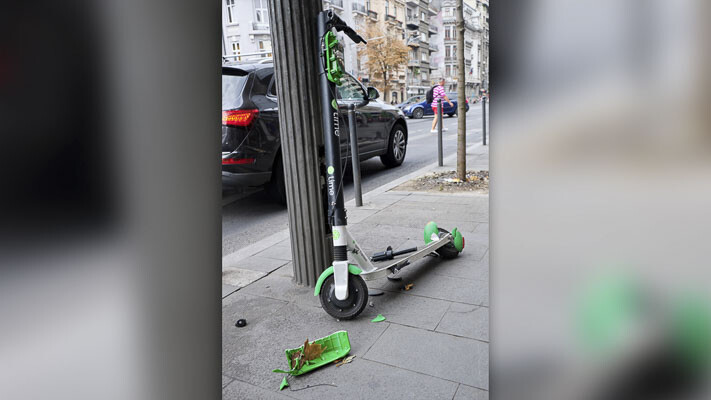
Mark Harmsworth of the Washington Policy Center believes the scooter companies continuing to provide scooter services should pay their fair share for road improvements to run their services safely
Mark Harmsworth
Washington Policy Center
Urban planners and bureaucrats continue to expand government funded electric bike and scooter programs in downtown cores, despite the obvious safety concerns with having scooters in close proximity to faster, heavier vehicles, including cars and buses.

Seattle even repealed bicycle helmet laws, citing helmets were discriminatory and ignoring the obvious negative safety implications of riding without one.
The Associated Press is reporting the National Transportation Safety Board (NTSB) has published a study that shows 119 deaths occurred from electric bike and scooter use between 2017 and 2021.
As the Washington Policy Center has highlighted previously, cities that have allowed scooters to be deployed in their downtown areas have had mixed results on their effectiveness and safety. Not only are scooter users at a higher risk of injury, but pedestrians are also at risk from scooter riders who ride on the sidewalk.
Additionally, as inner-city residents have discovered, abandoned scooters on the sidewalk are causing a safety issue for pedestrians, pushing some into the street to avoid the discarded scooters. Preventing scooter abandonment is nearly impossible in many downtown cores and many accidents are going unreported.
There is a real litigation risk to municipalities and it is only a matter of time before a fatal accident occurs in the public right of way that results in a lawsuit filed against both the scooter company and the municipality.
In addition to safety concerns, this adds to the cost of running the service as the scooters must be retrieved and repaired, shortening the lifespan of the scooter.
Many local governments that are pushing the benefits of having electric scooters in their downtown areas don’t really have a clear picture the overall fiscal impact.
Cities that have tried the experiment and failed are embroiled in controversy and are experiencing “scooter rage” with their residents. The company Jump already pulled out of San Diego when the scooter program failed there. And that doesn’t include the scooters that end up in ditches on the side of the road.
As with many feel-good environmental policies, the benefits of scooters are frequently inflated while safety and costs are diminished or altogether ignored.
Many downtown cores, including Bellevue and Seattle were not designed for scooter use and retrofitting the streets to improve safety for scooters is not practical or cost effective without removing the existing infrastructure for both pedestrians, cars and to some degree bicycles. Infrastructure that is currently paid for through the assessment of property, sales and gas taxes and vehicle fees.
If the scooter rental companies were to pay for the public road access and improvements that they currently enjoy for free, the cost to run and rent scooter programs would not be profitable. The scooter companies are making a profit from the fees and taxes paid for by other road users for the road improvements the scooters use.
The scooter companies continuing to provide scooter services should pay their fair share for road improvements to run their services safely.
Mark Harmsworth is the director of the Small Business Center at the Washington Policy Center.
Also read:
- Opinion: IBR’s evasive, misleading and dishonest excuses for higher cost
 Joe Cortright argues the Interstate Bridge Replacement Program has withheld detailed cost estimates while offering contradictory explanations for rising costs tied to the I-5 Bridge project.
 - Rep. David Stuebe sponsors bill to strengthen enforcement of auto insurance laws and protect Washington drivers
 Rep. David Stuebe has introduced HB 2308, a bill aimed at strengthening enforcement of Washington’s auto insurance laws and increasing accountability for repeat uninsured drivers.
 - Letter: Interstate Bridge Replacement’s Park & Ride insanity
 Bob Ortblad criticizes the Interstate Bridge Replacement Program’s proposed Park & Ride garages, arguing the costs are excessive and unlikely to receive federal funding.
 - Letter: Interstate Bridge Replacement $13.6 billion estimate is too low!
 Bob Ortblad argues the Interstate Bridge Replacement Program’s $13.6 billion cost estimate understates the true expense, citing comparable projects, construction challenges, and engineering assumptions.
 - Opinion: ‘The drama and the waste of taxpayer money continues’
 Rep. John Ley outlines his objections to the approved fixed-span I-5 Bridge design, citing cost concerns, engineering standards, funding uncertainty, and opposition to light rail and tolls.
 wpDiscuz
