


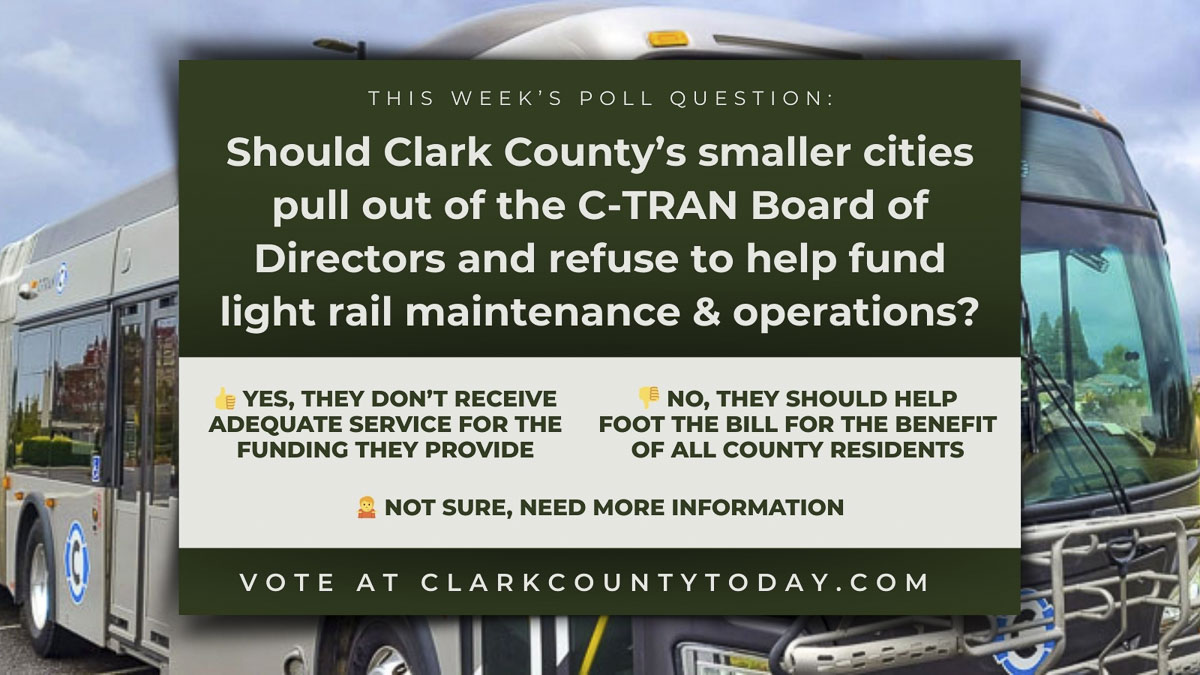
Debate grows over small cities’ role in C-TRAN and funding for light rail
With possible changes coming to the makeup of the C-TRAN Board of Directors, some Camas leaders are questioning whether smaller cities are getting their fair share of service compared to the taxes they pay. Camas currently contributes around $5 million annually while receiving an estimated $2 million in service. Concerns have intensified with the prospect of C-TRAN helping cover operating and maintenance costs for TriMet’s light rail expansion into Vancouver. That has sparked new discussion about whether smaller cities should remain in the partnership — and now we want to hear from you in this week’s poll.
More info:
C-TRAN remains committed to all jurisdictions regardless of the makeup of the C-TRAN board

C-TRAN says it will remain committed to serving all jurisdictions in Clark County, even as small cities face losing seats on the transit authority’s board of directors.
Read more
Opinion: TriMet & C-TRAN – Who pays versus who gets service

Rep. John Ley argues TriMet’s financial mismanagement and C-TRAN’s funding model unfairly burden Clark County taxpayers, especially small cities and rural residents, whil...
Read more
Also read:
- Opinion: Portland’s War on Cars Part 4 – A smarter automobile strategy to end gridlock
 O’Toole argues fuel wasted in Portland-area congestion has sextupled since 1982, generating 250,000 tons of extra greenhouse gases annually.
 - Opinion: Transit ridership trends are dismal but regional plans are oblivious
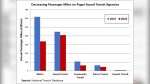 Puget Sound transit passenger-miles fell 31% from 2015 to 2024 despite a half-million-resident population increase.
 - Interstate Bridge Replacement Program seeks qualified firms for bridge replacement contract
 The CRBR project is backed by $5.7 billion from state funds, federal grants, and future tolling.
 - Opinion: Bankrupt – A $3.5 billion Rose Quarter Freeway widening project
 Joe Cortright argues ODOT’s Rose Quarter project has grown from a $450M approval to a $3.5B estimate, with a $2B funding gap.
 - Opinion: Portland’s War on Cars 3 – Ending the war on automobiles
 O’Toole argues Portland should add toll lanes, fix safety hazards, and redesign TriMet routes to end its anti-auto policies.
 wpDiscuz