



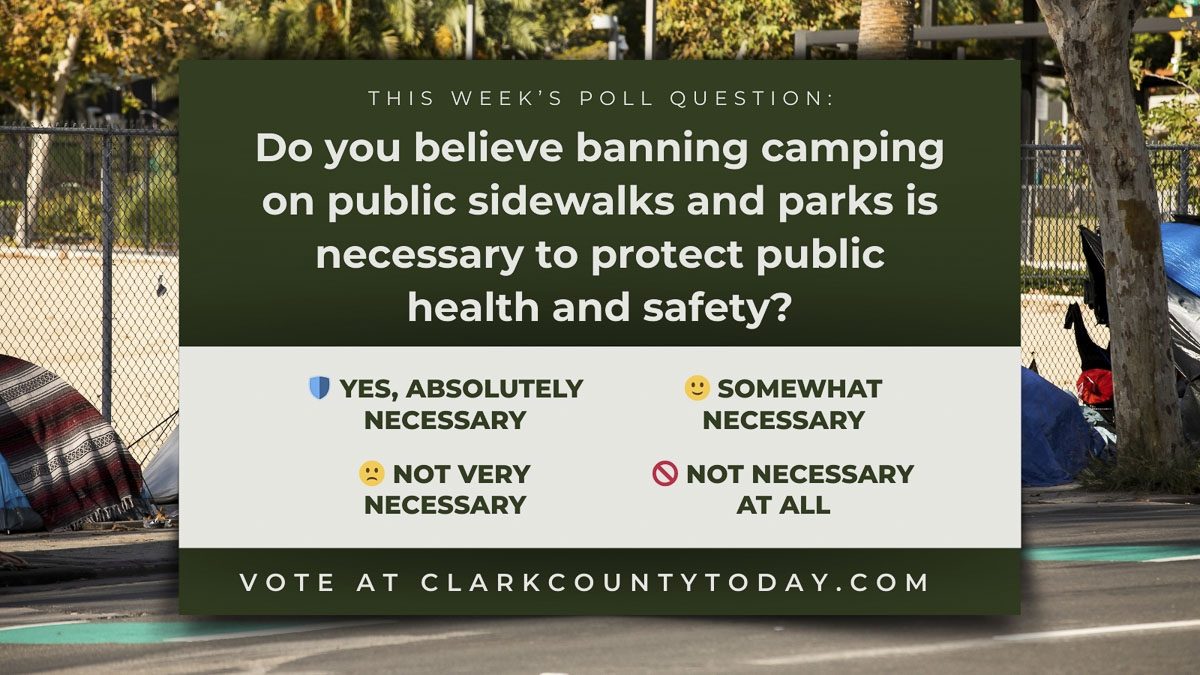
Is banning public camping necessary for health and safety?
As part of Ordinance No. 25-015, Camas officials emphasized that public spaces such as sidewalks, parks, and streets are designed for recreation, walking, biking, and other shared uses. The ordinance states that unauthorized encampments without sanitation create health and safety risks for both campers and the wider community. Supporters argue the new law will help keep public areas clean and accessible, while critics worry about its impact on unhoused individuals. With health and safety at the center of the debate, we’re asking readers what they think about the new ban.
More info:
Camas bans camping on public property

The Camas City Council unanimously approved an ordinance banning camping on public property, following a Supreme Court ruling that allows such laws. Police stress the foc...
Read more

Also read:
- Opinion: Stalin would be proud – Clark County Socialists gathered for ‘No Kings’
 Reform Clark County’s Rob Anderson criticizes local and national groups for organizing protests that featured Auditor Greg Kimsey as a keynote, raising concerns about public trust and political partisanship.
 - Letter: Vancouver Mayor Anne McEnerny-Ogle makes several serious and incorrect engineering statements
 Bob Ortblad critiques engineering claims by Vancouver Mayor Anne McEnerny-Ogle, highlighting cost and safety advantages of an immersed tunnel for the I-5 crossing.
 - Opinion: The beginning of the end of anchor babies
 Lars Larson argues the Constitution excludes children born to non-legal residents, as the Supreme Court debates birthright citizenship and public opinion data shows limited support.
 - Opinion: Defend bail now or face more chaos on our streets
 A proposed Washington court rule would cap bail for most misdemeanors and allow defendants to bypass bondsmen, raising concerns about accountability and public safety.
 - Opinion: Some worker rights get a poster, others get fine print
 Elizabeth New questions why Washington state highlights some workplace protections while Janus First Amendment rights for public employees remain hidden in official materials.
 wpDiscuz
