



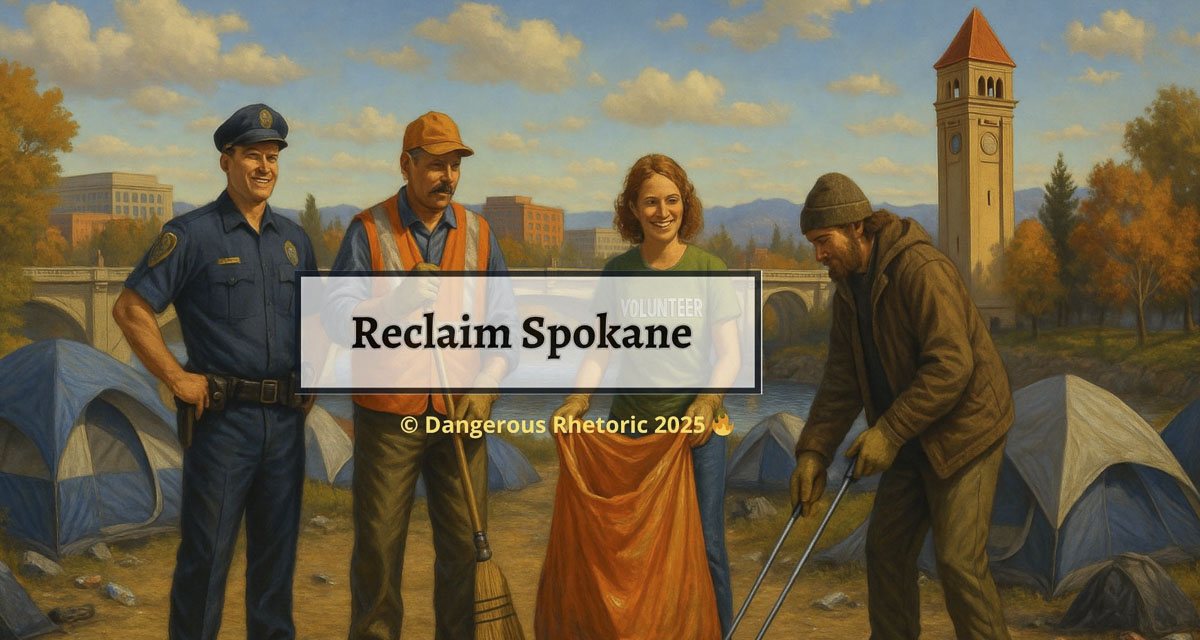
Local will, federal help, and the road out of chaos
Nancy Churchill
Dangerous Rhetoric
Spokane’s homeless crisis isn’t just a city problem — it’s a warning to every mid-sized community that’s gone soft on enforcement and big on ideology. Yes, housing costs have gone up, but blaming rent is a smokescreen. The real issue is policy failure — soft camping rules, hands-off policing, and public services so generous they pull people in from all over.

The Spokane Business Association ran its own numbers. They found over half of the city’s homeless population moved here after becoming homeless. In other words, they didn’t lose their homes in Spokane — they arrived already on the streets. The city’s 2025 “Point-in-Time” count claims only 14% came from out of town, but even city council members aren’t buying it.
Councilman Jonathan Bingle called it out: “Our 2023 PIT count said two-thirds weren’t from Washington.”
Let’s be honest — housing is just a piece of this puzzle. Since 2018, home prices in Spokane shot up nearly 70%, but wages stayed flat. Still, that doesn’t explain the tent cities, the addiction, or the mental health breakdowns.
Phil Altmeyer, who’s been with Union Gospel Mission for over 40 years, laid it out plainly: “Street homelessness, you can trace that back to the beginning of legalization of marijuana and the increase of meth.” Addiction and untreated mental illness — not rent — are what’s driving this crisis.
If most folks on the streets didn’t even start here, and long-time providers are warning us about the drug surge, then we’ve got to stop pretending this is about affordability. It’s about choices — both personal and political — and Spokane has been making the wrong ones for too long.
What happened with Prop 1 and why it still matters
In November 2023, Spokane voters passed Proposition 1 by a landslide—nearly 75%. It was simple: no camping within 1,000 feet of schools, parks, or daycare centers. That’s not extreme. That’s just basic protection for families and kids.
But in April 2025, the Washington State Supreme Court threw it out. The court ruled Prop 1 violated procedural rules and overstepped city authority. That’s legal-speak for ignoring what voters clearly demanded.
As Brad Barnett from the Spokane Business Association put it: “Letting people suffer and die on our sidewalks isn’t compassion — it’s abdication.”
The new ordinance: A step forward?
After the courts struck down Prop 1, the Spokane City Council came up with a new camping and obstruction ordinance, passed on July 1, 2025.
This one applies citywide. It says outreach has to be offered first, but if someone refuses help, police can issue citations or make arrests. It’s more balanced on paper—but laws only work if they’re enforced.
Kaitlin Malmquist, a commercial real estate coordinator, said it straight: “Expecting voluntary compliance is not only unrealistic … it’s abandonment.”
The new ordinance might be legally tighter than Prop 1, but if it’s not backed by action, it’s just more empty words.
Trump’s Executive Order: Federal backing for real change
On July 24, 2025, President Trump signed an Executive Order called “Ending Crime and Disorder on America’s Streets.” It gives cities like Spokane the green light — and the resources — to take back control.
The order tells the U.S. Attorney General to remove old restrictions that tied cities’ hands and shifts federal dollars to communities willing to crack down on camping, loitering, open drug use, and squatting.
It also encourages long-term treatment and civil commitment for those too sick or addicted to care for themselves. For the first time in years, Spokane isn’t on its own. But it has to act now and align with an enforcement-first approach if it wants to earn federal dollars.
How Spokane can turn this around
The voters spoke clearly with Prop 1, and they haven’t changed their minds. The new ordinance is a small win, but without serious enforcement, it means nothing. Spokane needs to show its people that it respects their vote — and their neighborhoods.
It’s also important to stop giving away housing and services with no expectations. The “housing first” model has failed. It rewards dysfunction. What works is “recovery first”—where help comes with conditions: sobriety, nonviolence, and treatment. That’s real compassion.
Thanks to Trump’s Executive Order on Homelessness, Spokane now has a shot at building what it’s been missing — sobering centers, mental health beds, and transitional housing that actually moves people off the streets and into recovery.
And we need to be smart about location. Instead of spreading shelters across town and overwhelming neighborhoods, Spokane should build a few regional resource centers on the city’s edges. They should include law enforcement, shelter, mental health, and treatment—all in one place, accessible by transit but away from schools and homes.
That’s how you balance compassion with order.
The bottom line
Spokane is at a crossroads. After years of policy failure and rising disorder, the city now has the voter support, the legal tools, and federal backing needed to turn the tide.
The path forward is clear: enforce the law, expand real treatment, build smart infrastructure, and stop making excuses.
This is Spokane’s moment to lead — to show that order and compassion can work together.
If city leaders rise to the occasion, Spokane can reclaim its streets—and secure its future.
Nancy Churchill is a writer and educator in rural eastern Washington State, and the chair of the Ferry County Republican Party. She may be reached at DangerousRhetoric@pm.me. The opinions expressed in Dangerous Rhetoric are her own. Dangerous Rhetoric is available on Substack, X, and Rumble

Also read:
- Opinion: Sheriffs fight back
 Four county sheriffs are suing to block a new law giving a governor-appointed board power to decertify and remove sheriffs, bypassing voter oversight in Washington.
 - Opinion: The growing gap between public voice and political power
 Todd Myers describes how large-scale protest and sign-ins often fail to sway state leaders, and argues authentic influence is most likely found through local action.
 - Opinion: Who is winning the race for affordable power?
 Hydroelectric power keeps Washington competitive, but new laws and carbon pricing are driving up electricity costs for residents each year.
 - Opinion: Half the road, full stop – Understanding pedestrian right-of-way
 Doug Dahl explains how Washington’s law requires drivers to stop when a pedestrian is within one lane of their half of the road, not just when directly in front.
 - Opinion: The state’s RFK-proofing bill comes with a cost
 Mandates like HB 2242 can lead to higher premiums as insurance companies absorb costs for new preventive services, affecting affordability statewide.
 wpDiscuz
