



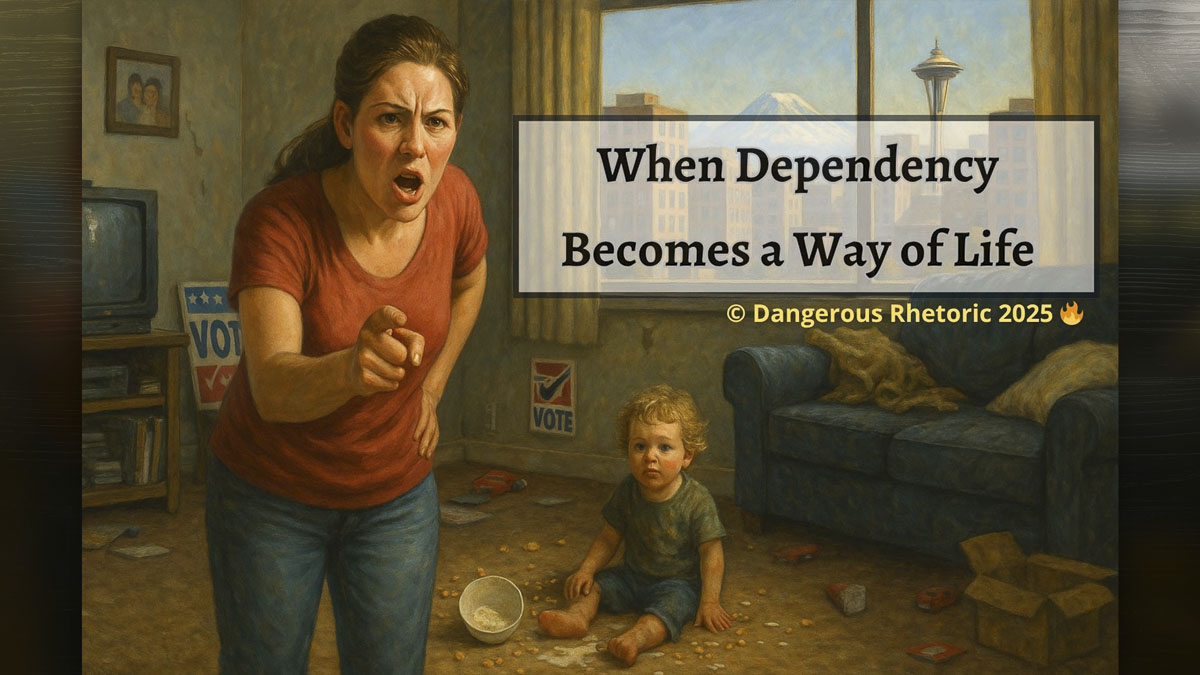
Nancy Churchill concludes her four-part series on incentives in American public life
Nancy Churchill
Dangerous Rhetoric
This essay concludes our series on incentives in American public life. In Part One, we explored how fear shapes perception. In Part Two, how legitimacy is framed to protect power. In Part Three, how financial systems are preserved even against voters’ wishes.

Now we turn to the most personal level: how public assistance can shape identity, behavior, and the expectations people hold for their lives.
Safety nets serve a clear purpose: To help individuals and families through hard times. Most Americans agree with that. No one wants to see a child go hungry or a household collapse due to illness or job loss. But over time, some safety nets have turned into permanent income systems. They’ve shifted from temporary relief to predictable, long-term support.
At that point, they’re no longer nets. They’re lifestyles.
This shift doesn’t happen because people are immoral or lazy. It happens because systems start rewarding dependency while removing the drive for work, responsibility, or upward mobility. Behavior follows incentives — often without people realizing it.
And once dependency becomes routine, it starts shaping identity.
The voters owe me
Online, we see clips of young mothers explaining how benefit programs like SNAP provide enough support that they don’t need to work. Some express open resentment toward working families, saying taxpayers “don’t understand.” These aren’t just one-offs. They reflect a generational mindset — kids raised in homes where government support isn’t seen as a short-term help, but as the normal way of life.
One widely shared video shows a woman describing how she had seven children with seven different men and receives $3,000 a month in food aid. She wasn’t complaining. She called it strategy, an efficient way to secure income without employment. What stood out wasn’t just the numbers. It was the lack of any sense of loss or ambition. The system had taught her that dependency was stable, safe, and even smart.
Household choices, community consequences
Dependency doesn’t just affect households. It affects communities. In urban areas where welfare has been entrenched for decades, we often see rising crime, addiction, homelessness, and decay.
In some of these neighborhoods, when National Guard troops or federal agents are called in, many residents express relief and even gratitude. They ask why their own leaders allowed things to deteriorate for so long.
The reason is tough but clear: certain political figures and their allies benefit when suffering never ends. A neighborhood in crisis needs programs, management, and money. That turns into political support, grant renewals, budgets, and votes. We see this dynamic at play in the Seattle and Spokane homeless industrial complex.
Dependency or resilience?
When dependency becomes the default, dignity fades. People lose their sense of worth and capability. Self-governance weakens. Someone who believes they can’t provide for themselves becomes easier to manipulate. Those who depend upon others for food become political pawns: A new kind of slavery.
That’s not compassion. That’s control.
When whole neighborhoods internalize that mindset, their votes become predictable. When a country loses faith in its own self-reliance, it becomes easier to rule from above.
That’s the true cost of long-term dependency. It’s not just the financial cost, but the loss of agency. Dependency replaces resilience.
And resilience is the foundation of a free people.
Rebuilding a free society
The answer isn’t cruelty or abandonment. It’s rebuilding the conditions where independence becomes possible again. That means strong families, steady work, safe streets, quality education, and communities where responsibility is expected and honored.
We can’t just cut dependency. We have to restore dignity.
We get more of what we reward
Throughout this series, one theme has come up again and again: we get more of what we reward.
Fear is rewarded in our media and politics, and so fear spreads more easily than calm deliberation. Claims of illegitimacy are rewarded when elections do not go a preferred way, and so trust in the civic process steadily erodes. Corporations and interest groups are rewarded for influencing federal programs, and so the programs grow more complex and more insulated from public oversight. And when financial dependency becomes easier to maintain than personal responsibility, dignity and aspiration weaken.
These outcomes are not random. They are not the result of cultural decay in the abstract, nor the inevitable decline of a nation. They are the result of incentives that have been allowed to operate without examination.
If we want different outcomes — more trust, more stability, stronger families, healthier communities — then we must be willing to reward different behaviors.
That doesn’t begin with Washington D.C or even in Olympia. It begins where we live.
It looks like parents investing time in their kids. Adults modeling personal responsibility. Churches and nonprofits supporting people with accountability and purpose, not endless dependency. It looks like work that connects people to value and pride. It looks like stronger bonds with neighbors, schools, and faith.
No law can produce that. No party can legislate it. These habits have to be chosen and built by real people in real places.
A free society depends on a self-governing people. That doesn’t just mean voting. It means living with intention, strength, and responsibility.
If we keep rewarding fear and dependency, we should expect more of both. If we want a better future, we need to start encouraging what builds real confidence and resilience.
This isn’t about nostalgia. It’s about national survival.
The work ahead won’t be fast or easy. But it is possible. Our institutions didn’t shape our culture. Our culture shaped the institutions.
So the turning point isn’t somewhere else — it’s here, with us.
The future will reflect what we choose to encourage today.
Nancy Churchill is a writer and educator in rural eastern Washington State, and the chair of the Ferry County Republican Party. She may be reached at DangerousRhetoric@pm.me. The opinions expressed in Dangerous Rhetoric are her own. Dangerous Rhetoric is available on Substack, X, and Rumble

Also read:
- Letter: Vancouver Mayor Anne McEnerny-Ogle makes several serious and incorrect engineering statements
 Bob Ortblad critiques engineering claims by Vancouver Mayor Anne McEnerny-Ogle, highlighting cost and safety advantages of an immersed tunnel for the I-5 crossing.
 - Opinion: The beginning of the end of anchor babies
 Lars Larson argues the Constitution excludes children born to non-legal residents, as the Supreme Court debates birthright citizenship and public opinion data shows limited support.
 - Opinion: Defend bail now or face more chaos on our streets
 A proposed Washington court rule would cap bail for most misdemeanors and allow defendants to bypass bondsmen, raising concerns about accountability and public safety.
 - Opinion: Some worker rights get a poster, others get fine print
 Elizabeth New questions why Washington state highlights some workplace protections while Janus First Amendment rights for public employees remain hidden in official materials.
 - Opinion: Someone explain the Democrat Party to me please
 Lars Larson criticizes Democrat politicians for shutdown threats, Homeland Security funding refusals, and positions on election laws, housing, and gun rights.
