


Jason Mercier of the Washington Policy Center points out that many of the violations were with accounting and use of federal COVID relief funds
Jason Mercier
Washington Policy Center
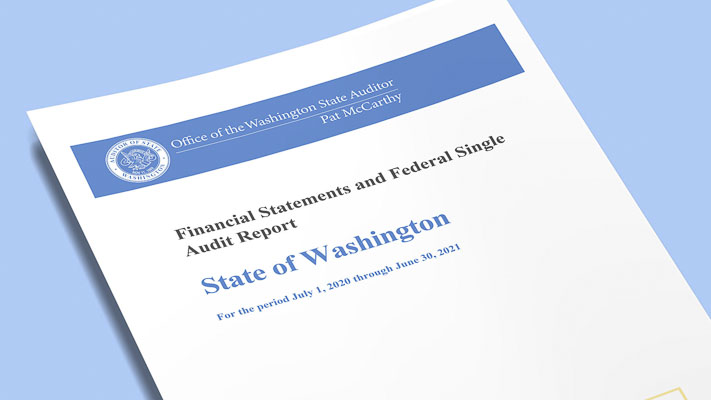
The state auditor today released Washington’s “Financial Statements and Federal Single Audit Report” covering agency compliance with federal rules in 2021. The state auditor identified 62 violations, several dealing with accounting and use of federal COVID relief funds. According to the report:
“We issued an adverse opinion on the state’s compliance with requirements applicable to the 21.019 Coronavirus Relief Fund, 21.027 Coronavirus State and Local Fiscal Recovery Funds, and 93.558 Temporary Assistance for Needy Families programs.”
Here is a sampling of the 62 audit findings:
- “The State lacked adequate internal controls over financial reporting for ensuring accurate recording and monitoring of financial activity in its financial statements.”
- “The Department of Social and Health Services did not have adequate internal controls to ensure payments were allowable and properly supported, and did not comply with federal requirements to conduct fiscal monitoring of subrecipients for the Coronavirus Relief Fund.”
- “The Department of Commerce did not have adequate internal controls over and did not comply with federal requirements to conduct fiscal monitoring of subrecipients and ensure payments were allowable and properly supported for the Coronavirus Relief Fund.”
- “The Office of Financial Management did not have adequate internal controls over and did not comply with reporting requirements for the Coronavirus Relief Fund.”
- “The Department of Commerce did not have adequate internal controls over and did not comply with federal requirements to ensure subrecipients of the Coronavirus Relief Fund received risk assessments.”
- “Washington State University did not establish adequate internal controls over and did not comply with federal requirements to conduct risk assessments of student information security for the Student Financial Assistance programs.”
- “The Office of Superintendent of Public Instruction did not have adequate internal controls over and did not comply with requirements to ensure payments to subrecipients were adequately supported for the Special Education programs.”
- “The Office of Superintendent of Public Instruction did not have adequate internal controls over and did not comply with requirements to perform risk assessments for subrecipients of the Education Stabilization Fund programs.”
- “The Department of Children, Youth, and Families did not have adequate internal controls over and did not comply with financial reporting requirements for the Child Care and Development Fund Cluster.”
- “The Health Care Authority did not have adequate internal controls over and did not comply with federal provider eligibility requirements for the Medicaid and Children’s Health Insurance programs.”
The complete 1,083 page audit and the state’s response to the 62 findings are available here.
Jason Mercier is the director of the Center for Government Reform at the Washington Policy Center.

Also read:
- Opinion: Were Republican voters just sleeping during the August primary election?
 CCRP Chairman Matt Bumala says 60% of primary no-shows in the 17th and 18th districts were Republicans.
 - Opinion: WA Cares’ launch showcased care WA Cares did not provide
 Gov. Ferguson showcased a caregiving arrangement at the WA Cares launch that the program had not paid for a single day of.
 - Opinion: Portland’s War on Cars Part 4 – A smarter automobile strategy to end gridlock
 O’Toole argues fuel wasted in Portland-area congestion has sextupled since 1982, generating 250,000 tons of extra greenhouse gases annually.
 - Opinion: The Tooth Fairy’s secrets to making brushing & flossing magical
 Delta Dental of Washington’s Tooth Fairy Experience offers free resources to help children build lifelong brushing and flossing habits.
 - Opinion: Transit ridership trends are dismal but regional plans are oblivious
 Puget Sound transit passenger-miles fell 31% from 2015 to 2024 despite a half-million-resident population increase.