



Todd Myers of the Washington Policy Center explains how the governor is not being straight with reporters or the public about the impact of his law
Todd Myers
Washington Policy Center
Washington’s new tax on CO2 emissions began on January 1 and gas prices are already rising.

The precise amount of the tax won’t be known until the first state auction of CO2 allowances occurs at the end of February. Despite that, fuel distributors began incurring liabilities for the gas, diesel, propane and other fuels they sell at the beginning of the year. They are increasing prices to cover that liability.
To estimate the impact of those taxes on prices at the pump, environmental economist Yoram Bauman suggested using price data from the U.S. Energy Information Administration and comparing Washington state gas prices to the West Coast aggregate price since the two have tracked fairly closely over the last year.
As the most recent data indicate, Washington’s price per gallon jumped more than ten cents in the last two weeks compared to the West Coast.
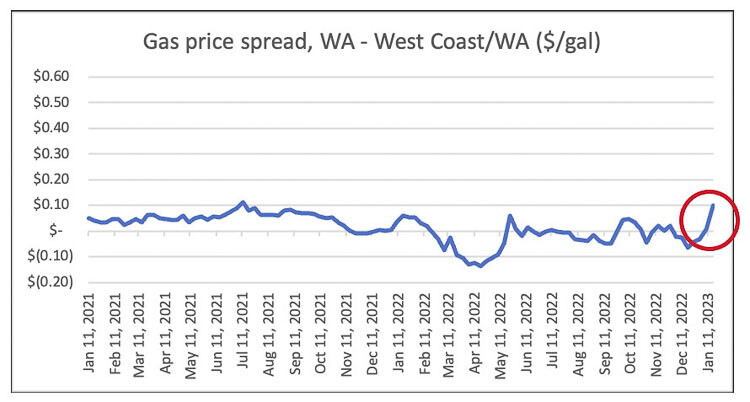
Although the specific cost of allowances isn’t yet known, the law sets a minimum price of $22/metric ton of CO2, which translates to 17 cents per gallon. The price could go as high as $81/MT which would be 65 cents per gallon.
In a press conference, the governor was asked specifically about these price increases. The governor responded emotionally, saying, “to blame gasoline prices on something that has hardly even gone into effect is just baloney.” He went on to say, “to blame price increases in Arkansas and New York and Connecticut on Washington climate laws in nuts.” He also claimed that the Ukraine war was to blame for increases.
Our comparison, however, isolates the impact of gas prices compared to the rest of the West Coast. It has nothing to do with price changes in New York, Arkansas, or Connecticut.
What the data show is that prices in Washington state jumped suddenly over the last two weeks much more than the other states on the West Coast. Perhaps the governor thinks the Ukraine war only affects gas prices in Washington state and not the rest of the West Coast.
Clearly the governor is not being straight with reporters or the public about the impact of his law.
It is a strange hill to die on since energy economists, the State of California, and even advocates of the tax on CO2 emissions all say the purpose of such taxes is to raise the price of gasoline. Only the governor and staff at the Department of Ecology are clinging to the fiction that it won’t raise gas prices.
New data from the U.S. Energy Information Administration come out each week and we will continue to update the data as they become available.
Todd Myers is the director of the Center for the Environment at the Washington Policy Center.

Also read:
- Opinion: Half the road, full stop – Understanding pedestrian right-of-way
 Doug Dahl explains how Washington’s law requires drivers to stop when a pedestrian is within one lane of their half of the road, not just when directly in front.
 - Opinion: The state’s RFK-proofing bill comes with a cost
 Mandates like HB 2242 can lead to higher premiums as insurance companies absorb costs for new preventive services, affecting affordability statewide.
 - Opinion: What is the cost of a bridge?
 John Ley argues the I-5 Bridge replacement’s soaring cost stems from costly extras like light rail, noting other states deliver larger, toll-free bridges for much less.
 - POLL: Do you agree with giving a state commission the power to remove an elected sheriff?
 A new poll asks if a state commission—not voters—should have the power to remove an elected sheriff, following concerns raised by Clark County Sheriff John Horch.
 - Opinion: Defending Democracy by denying it?
 Washington voters are blocked from weighing in on new income taxes as state lawmakers and officials bypass public input, drawing criticism from Northwest voices.
 wpDiscuz
