




Mark Harmsworth of the Washington Policy Center believes Washington has the opportunity to supercharge the economy by reducing regulations on small businesses and enacting reforms that will encourage job growth and investment in the state
Mark Harmsworth
Washington Policy Center
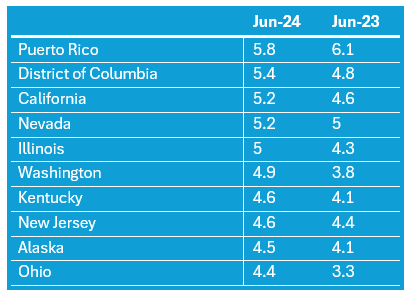
The Washington Employment Security Department (ESD) is reporting that for June (the latest numbers available) the unemployment rate in Washington is 4.9%. That sounds great, until you compare Washington’s performance with the other 49 states where it ranks 7th worst in the nation.

South Dakota, which during the pandemic did not implement any significant economic restrictions, has the lowest rate at 2%
It gets worse when you consider that compared to a year ago, Washington had an unemployment rate of 3.8% and as a percentage, has a higher rate of jobs loss over the last 24 months than every other state except Rhode Island.
While Washington has robust tech, internet retail and aerospace sectors, significant layoffs from some of the region’s largest employers have had an impact on the job market. Continued high interest rates, implemented to counter inflationary pressures, are slowing business growth as borrowing for expansion is expensive.
Highest unemployment rates for US States June 2024
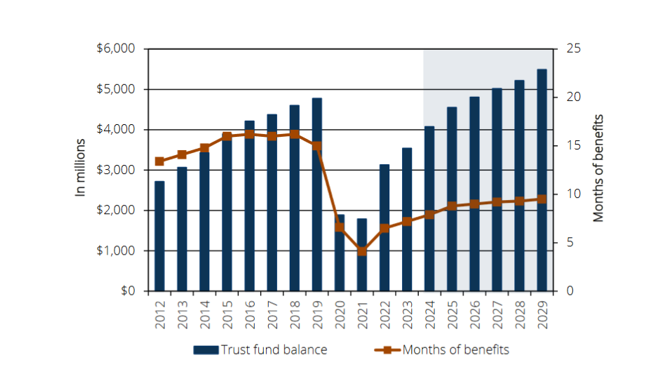
The Unemployment Trust Fund balance, which took a significant hit during the pandemic, due to government mandated shutdowns, has recovered but not to its pre-pandemic levels. ESD has increased unemployment tax rates on employers, driving up the cost of products and services, to replenish the loss of the fund balance. Over the next few years, ESD is predicting a drop in employer unemployment contributions, but reverses this trend in 2028. Unemployment benefit payouts are expected to reach $1.753MM by 2029, up from 1.576MM in 2024 with unemployment rates not changing significantly for the next 3 years.
Washington Unemployment Trust Fund Balance June 2024
Washington is particularly difficult to build and run a business due to its punitive tax structure which includes the Business and Occupation tax (B&O) on gross receipts and the recently implemented capital gains income tax on the sale of a business. Both taxes are baked into in the cost of a producing product or providing a service. This B&O tax represents 19.1% of the taxes a business pays to Washington and is calculated on gross revenue, allowing no deductions for costs. Even a business that loses money has to pay B&O tax on any revenue generated.
While most employees invest in a 401K pension for retirement, many small business owners rely on the sale of a business, built over many years, to fund the retirement years. Most business owners have mobility and will move out of state before paying an effective income tax on their retirement income.
Washington has the opportunity to supercharge the economy by reducing regulations on small businesses and enacting reforms that will encourage job growth and investment in the state.
For Washington Policy Centers recommendations, read the whitepaper that describes the simple changes that would have an immediate impact on the business climate and job growth in Washington.
Mark Harmsworth is the director of the Small Business Center at the Washington Policy Center.

Also read:
- POLL: Do you support extending light rail beyond the waterfront to connect with C-TRAN at Library Square?
 Readers can weigh in on Anne McEnerny-Ogle’s proposal to extend light rail beyond the waterfront to Library Square for improved C-TRAN connections.
 - Opinion: Passing a cyclist – Law, myth and a little patience
 Most drivers can’t legally pass cyclists in-lane due to vehicle width versus road measurements.
 - Opinion: The path to real tax reform requires a spending limit
 Washington Policy Center director argues constitutional spending caps would force real budget tradeoffs instead of endless tax increases.
 - Opinion: ‘Both states know they have seriously flawed voter registration’
 Lars Larson argues Oregon and Washington are suing DOJ to avoid cleaning up fraudulent voter rolls before elections.
 - Letter: Compassion without accountability is failing Clark County
 Sarah Mittelman calls for clear standards and measurable results in homelessness spending.
